Pine Grove Rural Community
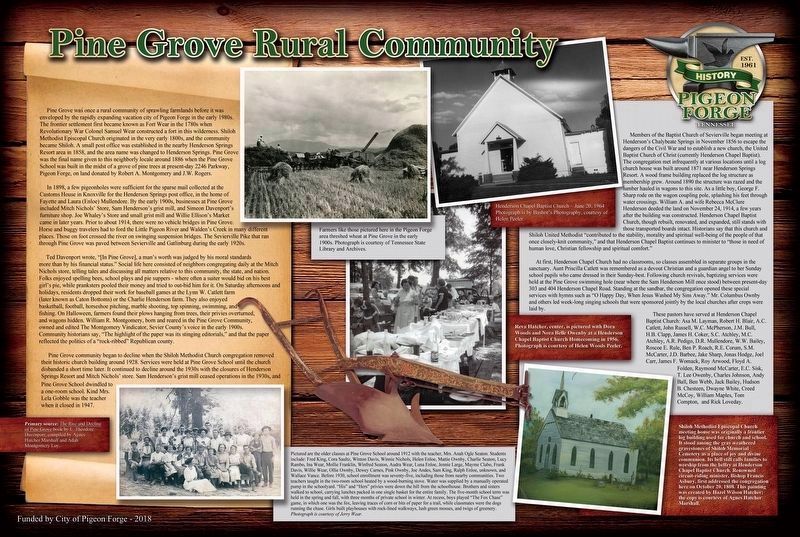
In 1898, a few pigeonholes were sufficient for the sparse mail collected at the Customs House in Knoxville for the Henderson Springs post office, in the home of Fayette and Laura (Enloe) Mullendore. By the early 1900s, businesses at Pine Grove included Mitch Nichols’ Store, Sam Henderson’s grist mill, and Simeon Davenport’s furniture
this page online
Ted Davenport wrote, “[In Pine Grove], a man’s worth was judged by his moral standards more than by his financial status.” Social life here consisted of neighbors congregating daily at the Mitch Nichols store, telling tales and discussing all matters relative to this community, the state, and nation. Folks enjoyed spelling bees, school plays and pie suppers - where often a suitor would bid on his best girl’s pie, while pranksters pooled their money and tried to out-bid him for it. On Saturday afternoons and holidays, residents dropped their work for baseball games at the Lynn W. Catlett farm (later known as Caton Bottoms) or the Charlie Henderson farm. They also enjoyed basketball,
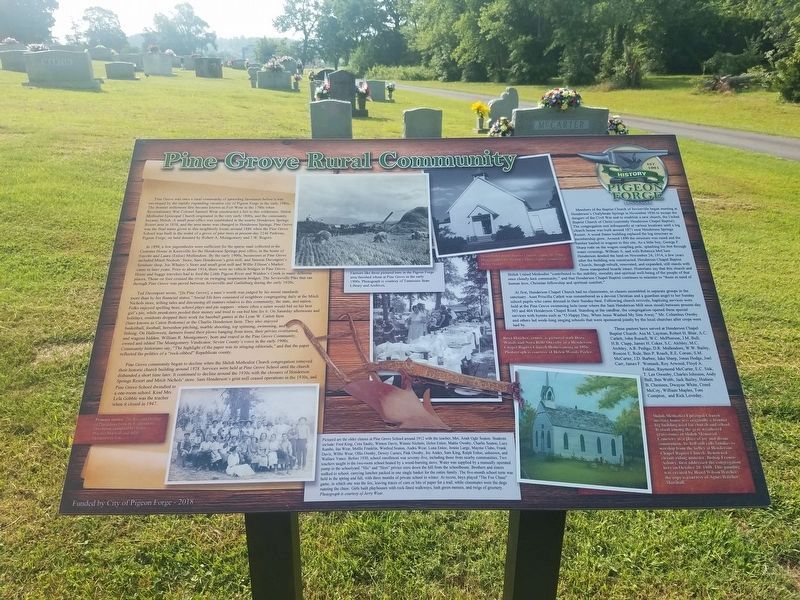
Pine Grove community began to decline when the Shiloh Methodist Church congregation removed their historic church building around 1928. Services were held at Pine Grove School until the church disbanded a short time later. It continued to decline around the 1930s with the closures of Henderson Springs Resort and Mitch Nichols’ store. Sam Henderson’s grist mill ceased operations in the 1930s, and Pine Grove School dwindled to a one-room school. Kind Mrs. Lela Gobble was the teacher when it closed in 1947.
Shiloh Methodist Episcopal Church meeting house was originally a frontier log building used for church
Members of the Baptist Church of Sevierville began meeting at Henderson’s Chalybeate Springs in November 1856 to escape the dangers of the Civil War and to establish a new church, the United Baptist Church of Christ (currently Henderson Chapel Baptist). The congregation met infrequently at various locations until a log church house was built around 1871 near Henderson Springs Resort. A wood frame building replaced the log structure as membership grew. Around 1890 the structure was razed and the lumber hauled in wagons to this site. As a little boy, George F. Sharp rode on the wagon coupling pole, splashing his feet through water crossings. William A. and wife Rebecca McClure Henderson deeded the land on November 24, 1914, a few years after the building was constructed. Henderson Chapel Baptist Church,
though rebuilt, renovated, and expanded, still stands with those transported boards intact. Historians say that this church and Shiloh United Methodist “contributed to the stability, morality and spiritual well-being of the people of that once closely-knit community,” and that Henderson Chapel Baptist continues to minister to “those in need of human love, Christian fellowship and spiritual comfort.”At first, Henderson Chapel Church had no classrooms, so classes assembled in separate groups in the sanctuary. Aunt Priscilla Catlett was remembered as a devout Christian and a guardian angel to her Sunday school pupils who came dressed in their Sunday-best. Following church revivals, baptizing services were held at the Pine Grove swimming hole (near where the Sam Henderson Mill once stood) between present-day 303 and 404 Henderson Chapel Road. Standing at the sandbar, the congregation opened these special services with hymns such as “O Happy Day, When Jesus Washed My Sins Away.” Mr. Columbus Ownby and others led week-long singing schools that were sponsored jointly by the local churches after crops were laid by.
These pastors have served at Henderson Chapel Baptist Church: Asa M. Layman, Robert H. Blair, A.C. Catlett, John Russell, W.C. McPherson, J.M. Bull, H.B. Clapp, James H. Coker, S.C. Atchley, M.C. Atchley, A.R. Pedigo, D.R. Mullendore, W.W. Bailey, Roscoe E. Rule, Ben P. Roach, R.E. Corum, S.M. McCarter, J.D. Barbee, Jake Sharp, Jonas Hodge, Joel Carr, James F. Womack, Roy Arwood, Floyd A. Folden, Raymond McCarter, E.C. Sisk, T. Lee Owenby, Charles Johnson, Andy Ball, Ben Webb, Jack Bailey, Hudson B. Chesteen, Dwayne White, Creed McCoy, William Maples, Tom Compton, and Rick Loveday.
Pictured are the older classes at Pine Grove School around 1912 with the teacher, Mrs. Anah Ogle Seaton. Students include: Fred King, Cora Saultz, Winton Davis, Winnie Nichols, Helen Enloe, Mattie Ownby, Charlie Seaton, Lucy Rambo, Ina Wear, Mollie Franklin, Winfred Seaton, Audra Wear, Luna Enloe, Jennie Large, Mayme Clabo, Frank Davis, Willie Wear, Ollie Ownby, Dewey Carnes, Pink Ownby, Joe Andes, Sam King, Ralph Enloe, unknown, and Wallace Vance. Before 1930, school enrollment was seventy-five, including those from nearby communities. Two teachers taught in the two-room school heated by a wood-burning stove. Water was supplied by a manually operated pump in the schoolyard. “His” and “Hers” privies were down the hill from the schoolhouse. Brothers and sisters walked to school, carrying lunches packed in one single basket for the entire family. The five-month school term was held in the spring and fall, with three months of private school in winter. At recess, boys played “The Fox Chase” game, in which one was the fox, leaving traces of corn or bits of paper for a trail, while classmates were the dogs running the chase. Girls built playhouses with rock-lined walkways, lush green mosses, and twigs of greenery.
Erected 2018 by City of Pigeon Forge.
Topics. This historical marker is listed in these topic lists: Industry & Commerce • Settlements & Settlers.
Location. 35° 49.001′ N, 83° 35.12′ W. Marker is in Pigeon Forge, Tennessee, in Sevier County. It is on Henderson Rd.. Located in Henderson Chapel Baptist Church parking area. Touch for map. Marker is at or near this postal address: 407 Henderson Rd, Pigeon Forge TN 37863, United States of America. Touch for directions.
Regionally, this marker is in East Tennessee and in the Great Smoky Mountains. It is also in the American South, specifically in the Upper South, in Appalachia, and specifically in Southern Appalachia. Globally, it is in North America, the Western Hemisphere, the Western World, and the Anglosphere. Historically, it finds itself in what was once the original Cherokee Nation, the territory of the Mississippian Culture, one of the Confederate States of America, the State of Franklin, and the Antebellum South.
Other nearby markers. At least 8 other markers are within 3 miles of this marker, measured as the crow flies: Shiloh Church (approx. 0.4 miles away); a different marker also named Shiloh Church (approx. 0.4 miles away); Titanic’s Center Anchor (approx. half a mile away); Colonel Samuel Wear Memorial (approx. 0.7 miles away); Fort Wear (approx. 0.7 miles away); Wear's Fort (approx. 0.8 miles away); Henderson Springs Resort (approx. one mile away); Early Pigeon Forge (approx. 2.6 miles away). Touch for a list and map of all markers in Pigeon Forge.
Another marker is no longer nearby. Titanic Eternal Flame (was approx. half a mile away but has been permanently removed).
Credits. This page was last revised on October 17, 2018. It was originally submitted on September 18, 2018, by Marcia Nelson of Pigeon Forge, Tennessee. This page has been viewed 923 times since then and 114 times this year. Last updated on September 24, 2018, by Marcia Nelson of Pigeon Forge, Tennessee. Photos: 1. submitted on September 18, 2018, by Marcia Nelson of Pigeon Forge, Tennessee. 2, 3. submitted on October 5, 2018, by Marcia Nelson of Pigeon Forge, Tennessee. • Andrew Ruppenstein was the editor who published this page.
