Downtown in Sioux Falls in Minnehaha County, South Dakota — The American Midwest (Upper Plains)
Lt. Jonas Lien
Photographed by Cosmos Mariner, August 21, 2016
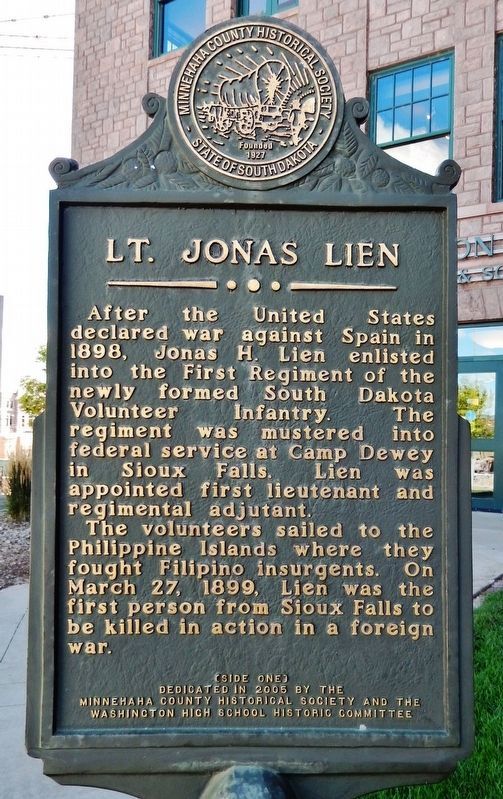
1. Lt. Jonas Lien Marker (side one)
(side one)
After the United States declared war against Spain in 1898, Jonas H. Lien enlisted into the First Regiment of the newly formed South Dakota Volunteer Infantry. The regiment was mustered into federal service at Camp Dewey in Sioux Falls. Lien was appointed first lieutenant and regimental adjutant.
The volunteers sailed to the Philippine Islands where they fought Filipino insurgents. On March 27, 1899, Lien was the first person from Sioux Falls to be killed in action in a foreign war.
(side two)
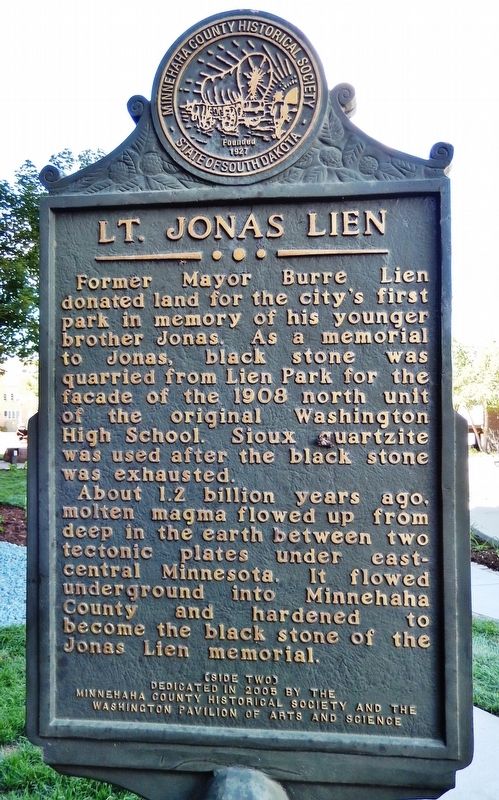
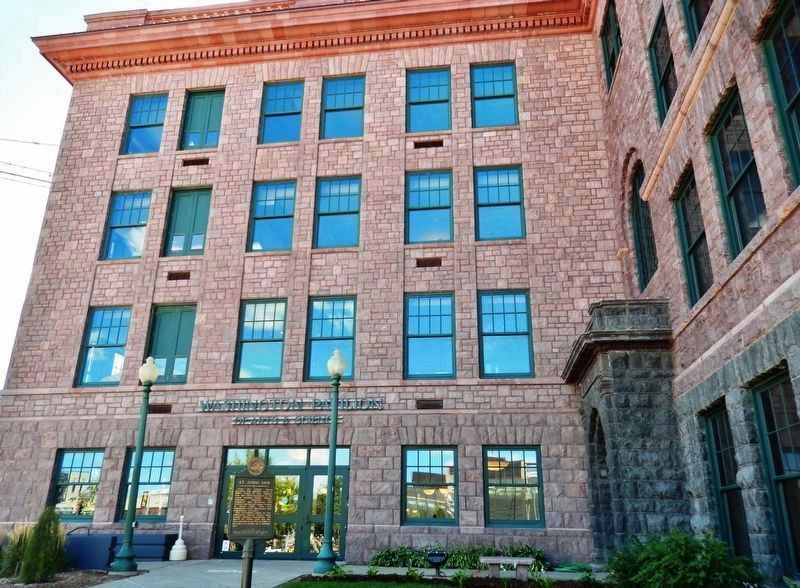
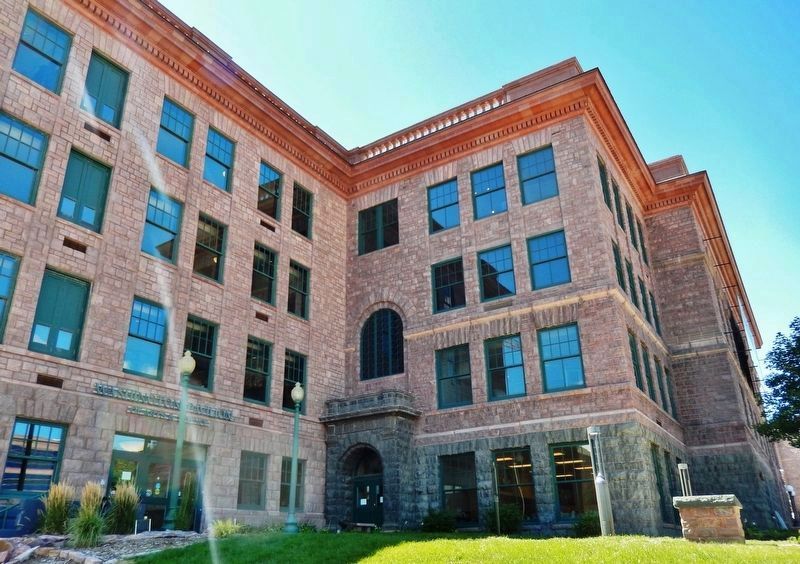
Former Mayor Burre Lien donated land for the city’s first park in memory of his younger brother Jonas. As a memorial to Jonas, black stone was quarried from Lien Park for the façade of the 1908 north unit of the original Washington High School. Sioux quartzite was used after the black stone was exhausted.
About 1.2 billion years ago, molten magma flowed up from deep in the earth between two tectonic plates under east-central Minnesota. It flowed underground into Minnehaha County and hardened to become the black stone of the Jonas Lien memorial.
Minnehaha County Historical Society and the
Washington High School Historic Committee
Erected 2005 by The Minnehaha County Historical Society and the Washington High School Historic Committee.
Topics. This memorial is listed in these topic lists: Patriots & Patriotism • War, Spanish-American. A significant historical year for this entry is 1898.
Location. 43° 32.66′ N, 96° 43.723′ W. Memorial is in Sioux Falls, South Dakota, in Minnehaha County. It is in Downtown. It is on South Main Avenue south of West 11th Street (State Highway 42), on the right when traveling south. Marker is located beside the sidewalk, near the northeast corner entrance to the Washington Pavilion of Arts and Science (formerly Washington High School)
this page online

Regionally, this memorial is in East River. It is also in the American Midwest, in the Lewis & Clark Corridor, in the Corn Belt, on the prairies, and on the Northern Plains. Globally, it is in North America, the Western Hemisphere, the Western World, and the Anglosphere. Historically, it finds itself in what was once Rupert’s Land and also the Louisiana Purchase.
Other nearby markers. At least 8 other markers are within walking distance of this marker: Nils A. Boe (a few steps from this marker); Sculptor H. Daniel Webster (within shouting distance of this marker); Washington High School (about 300 feet away, measured in a direct line); Eliza Tupper Wilkes (about 300 feet away); The First School House (about 400 feet away); Official Olympic Flagpole (about 400 feet away); Radio Station WFAT (about 400 feet away); First Lutheran Church (about 500 feet away). Touch for a list and map of all markers in Sioux Falls.
Also see . . .
1. 1LT Jonas H. Lien.
Photographed by Cosmos Mariner, August 21, 2016
2. Lt. Jonas Lien Marker (side two)
2. Washington Pavilion of Arts and Science. The Pavilion was a result of a renovation of Washington High School which was eventually moved to the northeast side of the city. The building is of Neoclassical styling and is architecturally interesting. The building's facade is created from large blocks of Sioux Quartzite, a pinkish quartzite native to the area and seen at the falls of the Big Sioux River. A small portion of the north wing is constructed of black rock which was believed to be black quartzite but is in fact corson diabase, which is hardened liquid magma.
Photographed by Cosmos Mariner, August 21, 2016
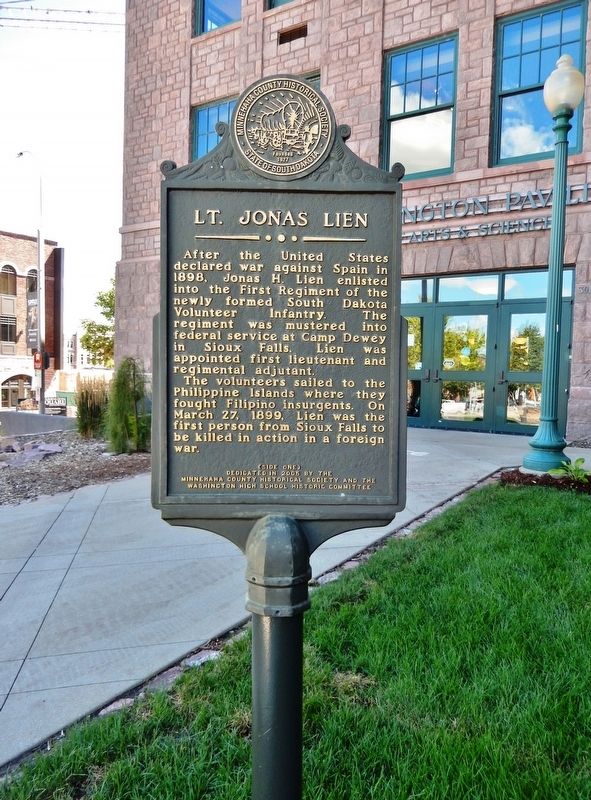
3. Lt. Jonas Lien Marker (tall view; Washington Pavilion / Washington High School in background)
Photographed by Cosmos Mariner, August 21, 2016
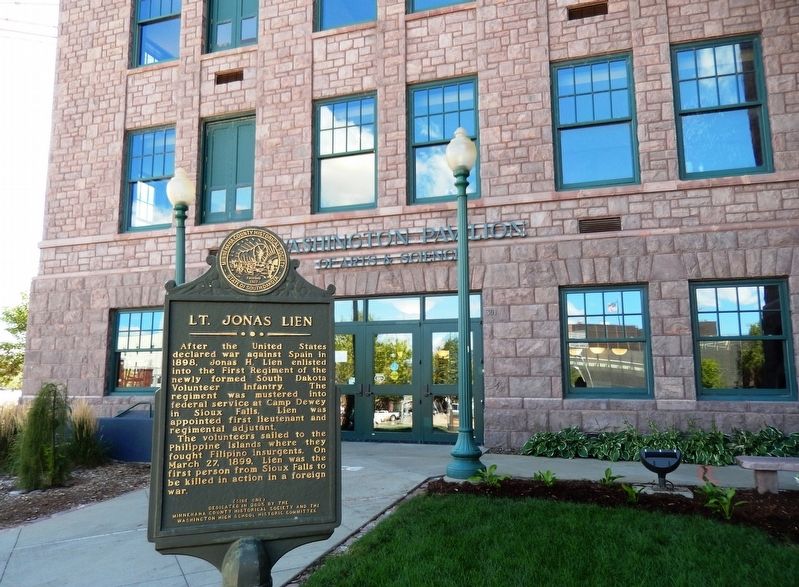
4. Lt. Jonas Lien Marker (wide view; Washington Pavilion / Washington High School in background)
Photographed by Cosmos Mariner, August 21, 2016
5. Washington Pavilion (black molten magma stone from Jonas Lien memorial visible on right)
Photographed by Cosmos Mariner, August 21, 2016
6. Washington Pavilion (black molten magma stone from Jonas Lien memorial visible on 1st story)
Credits. This page was last revised on February 16, 2023. It was originally submitted on October 3, 2018, by Cosmos Mariner of Cape Canaveral, Florida. This page has been viewed 1,003 times since then and 27 times this year. Photos: 1, 2, 3, 4, 5, 6. submitted on October 5, 2018, by Cosmos Mariner of Cape Canaveral, Florida. • Bill Pfingsten was the editor who published this page.
