Fort Pierre in Stanley County, South Dakota — The American Midwest (Upper Plains)
The Verendrye Site
Photographed by Cosmos Mariner, August 19, 2016
1. The Verendrye Site Marker
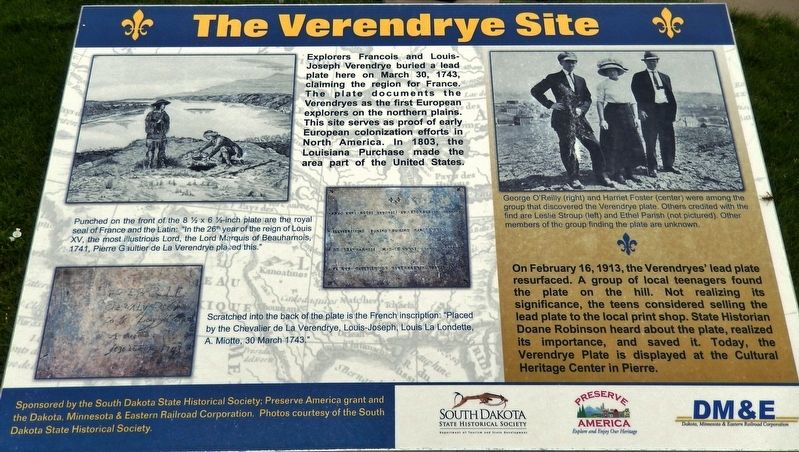
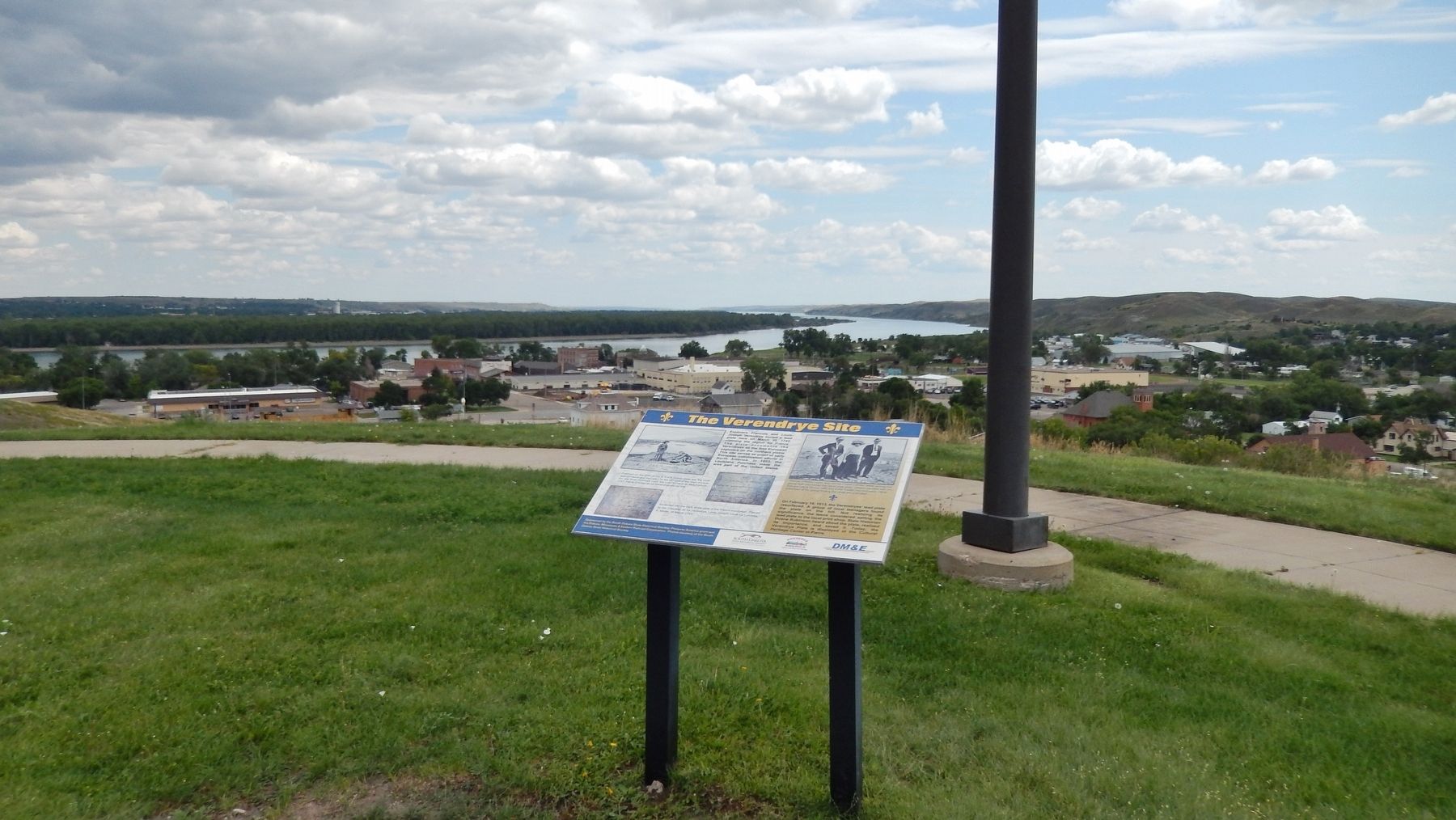
Explorers Francois and Louis-Joseph Verendrye buried a lead plate here on March 30, 1743, claiming the region for France. The plate documents the Verendryes as the first European explorers on the northern plains. This site serves as proof of early European colonization efforts in North America. In 1803, the Louisiana Purchase made the area part of the United States.
On February 16, 1913, the Verendryes' lead plate resurfaced. A group of local teenagers found the plate on the hill. Not realizing its significance, the teens considered selling the lead plate to the local print shop. State Historian Doane Robinson heard about the plate, realized its importance, and saved it. Today, the Verendrye Plate is displayed at the Cultural Heritage Center in Pierre.
Photos courtesy of the South Dakota Historical Society.
Erected by The South Dakota State Historical Society; a Preserve America grant and the Dakota, Minnesota and Eastern Railroad Corporation.
Topics. This historical
this page online
Location. 44° 21.316′ N, 100° 22.699′ W. Marker is in Fort Pierre, South Dakota, in Stanley County. It is on Verendrye Drive (2nd Street) 0.4 miles north of West 2nd Avenue. Marker is located at the Verendrye National Historic Site, on the hilltop overlooking Fort Pierre and the Missouri River. Touch for map. Marker is in this post office area: Fort Pierre SD 57532, United States of America. Touch for directions.

Regionally, this marker is in the Crow Creek Sioux Tribe and in East River. It is also in the American Lewis & Clark Corridor, on the prairies, and on the Northern Plains. Globally, it is in North America, the Western Hemisphere, the Western World, and the Anglosphere. Historically, it finds itself in what was once Rupert’s Land and also the Louisiana Purchase.
Other nearby markers. At least 8 other markers are within walking distance of this marker: Translation of the Verendrye Plate (here, next to this marker); Verendrye Explorers (a few steps from this marker); Verendrye Tablet Site (within
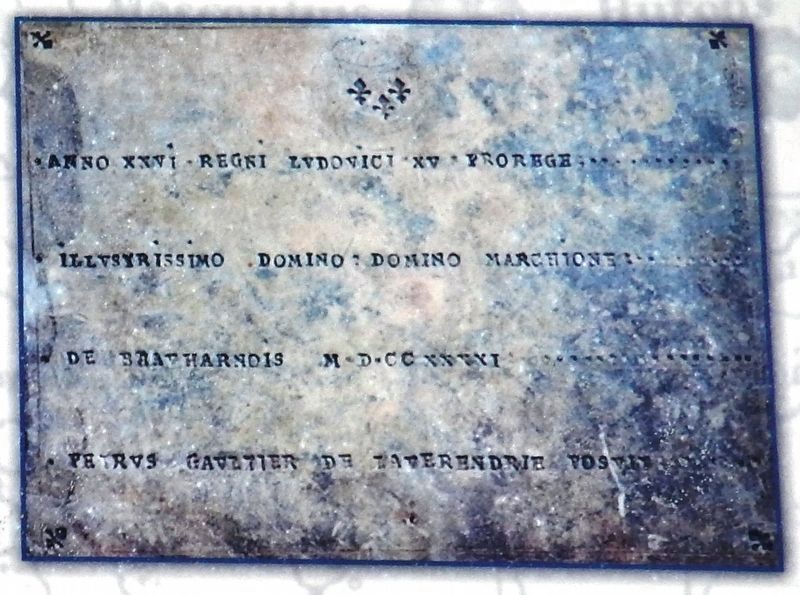
2. Marker detail: Verendrye Plate (front side)
Punched on the front of the 8 1/2 x 6 1/2-inch plate are the royal seal of France and the Latin: “In the 26th year of the reign of Louis XV, the most illustrious Lord, the Lord Marquis of Beauharnois, 1741, Pierre Gaultier de La Verendrye placed this.”
More about this marker. Marker is a large composite plaque, mounted horizontally, on waist-high posts.
Regarding The Verendrye Site. National Historic Landmark (1991)
Related markers. Click here for a list of markers that are related to this marker. The Verendrye National Historic Site
Also see . . .
1. Verendrye Plate. The American Survetor website entry:
On a warm winter day, 109 years after Lewis & Clark’s visit to this vantage point, young children played on the same hill. Stones brought in by the glaciers were scarce on the west side of the river, so when found they were carried away by the early pioneers for useful purposes. Hattie Foster, Ethel Parish, and George O’Reilly were among those on the hill that
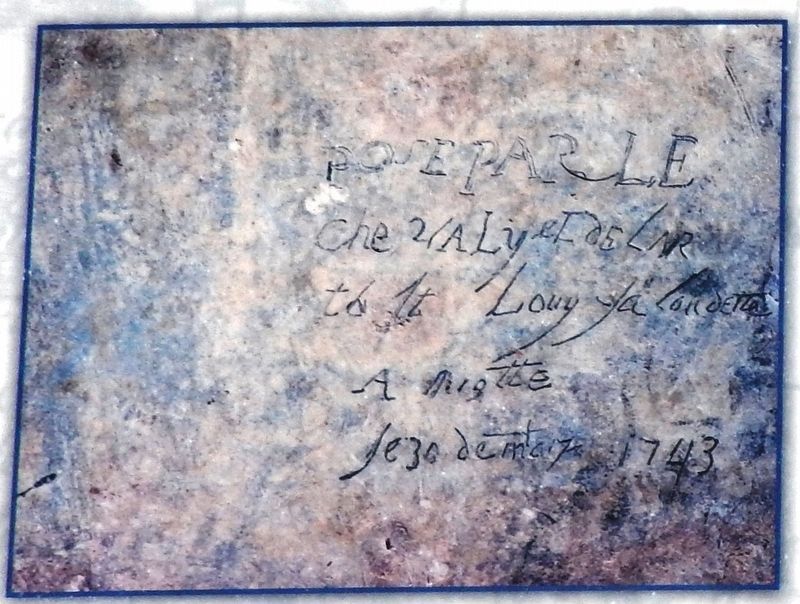
3. Marker detail: Verendrye Plate (back side)
Scratched into the back of the plate is the French inscription: “Placed by the Chevalier de La Verendrye, Louis-Joseph, Louis La Londette, A. Miotte, 30 March 1743.”
2. Discovering The Verendrye Plate. South Dakota Magazine website entry:
Ethel Parish and two friends found the plate while playing on a sunny February day on a hill over Fort Pierre. Their discovery caused historians to rethink their accounts of white man’s arrival in this region. The plate captured the imaginations of South Dakotans then, and it has remained one of the state’s most treasured museum pieces ever since. Ethel never saw friends George and Hattie after she left Fort Pierre as a 14-year-old. When the South Dakota State Legislature appropriated $700 to purchase the Verendrye plate from the finders, no one knew where she’d gone. The money was awarded to the others — George received $500, Hattie just $200. Ethel also lost credit for the find. Although townspeople knew there was a third teenager on the hill, the name was not always remembered accurately and other
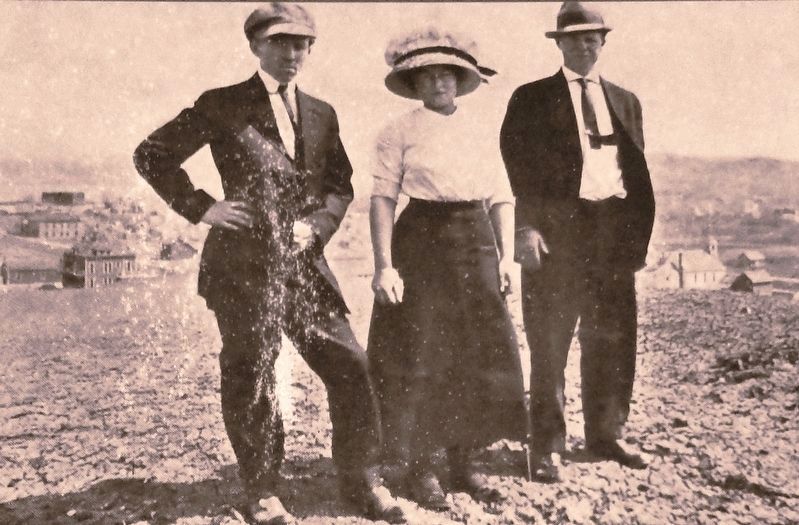
4. Marker detail: George O'Reilly, Harriet Foster and Leslie Stroup
George O'Reilly (right) and Harriet Foster (center) were among the group that discovered the Verendrye plate. Others credited with the find are Leslie Stroup (left) and Ethel Parish (not pictured). Other members of the group finding the plate are unknown.
Photographed by Cosmos Mariner, August 19, 2016
5. The Verendrye Site Marker (wide view; Fort Pierre and Missouri River in background)
Credits. This page was last revised on April 28, 2024. It was originally submitted on October 11, 2018, by Cosmos Mariner of Cape Canaveral, Florida. This page has been viewed 1,213 times since then and 170 times this year. Photos: 1, 2, 3, 4, 5. submitted on October 13, 2018, by Cosmos Mariner of Cape Canaveral, Florida. • Andrew Ruppenstein was the editor who published this page.
