St. Charles in St. Charles County, Missouri — The American Midwest (Upper Plains)
The Trail to Fort Osage
Eastern Trailhead
—
Established August 25, 1808
—
Photographed by Devry Becker Jones (CC0), October 7, 2018
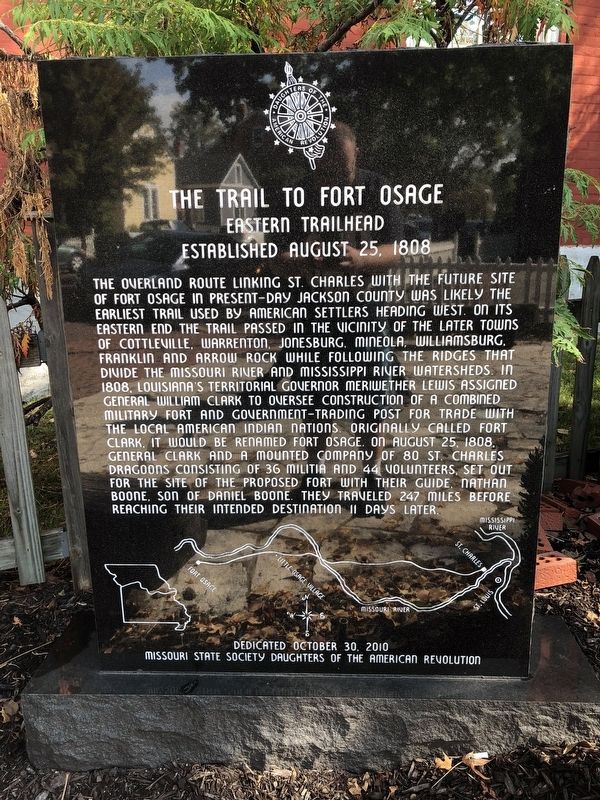
1. The Trail to Fort Osage Marker
Inscription.
The overland route linking St. Charles with the future sight of Fort Osage in present-day Jackson County was likely the earliest trail used by American settlers heading west. On its eastern end the trail passed in the vicinity of the later towns of Cottleville, Warrenton, Jonesburg, Mineola, Williamsburg, Franklin and Arrow Rock while following the ridges that divide the Missouri River and Mississippi River watersheds. In 1808, Louisiana's territorial Governor Meriwether Lewis assigned General William Clark to oversee construction of a combined military fort and government-trading post for trade with the local American Indian nations. Originally called Fort Clark, it would be renamed Fort Osage. On August 25, 1808. General Clark and a mounted company of 80 St. Charles dragoons consisting of 36 militia and 44 volunteers, set out for the site of the proposed fort with their guide, Nathan Boone son of Daniel Boone. They traveled 247 mile before reaching their intended destination 11 days later.
Erected 2010 by Missouri State Society Daughters of the American Revolution.
Location. 38° 46.54′ N, 90° 29.044′ W. Marker is in St. Charles, Missouri, in St. Charles County. It is at the intersection of South Main Street and Water Street, on the right when traveling north on South Main Street. Touch for map. Marker is at or near this postal address: 724 South Main Street, Saint Charles MO 63301, United States of America. Touch for directions.
Regionally, this marker is in the Missouri River Corridor and in Greater St. Louis. It is also in the American Midwest, in the Lewis & Clark Corridor, in the Corn Belt, and in the Great River Road Region. Globally, it is in North America, the Western Hemisphere, the Western World, and the Anglosphere. Historically, it finds itself in what was once the territory of the Mississippian Culture, the Louisiana Purchase, and the Antebellum South.
Other nearby markers. At least 8 other markers are within walking distance
Photographed by Devry Becker Jones (CC0), October 7, 2018
Credits. This page was last revised on December 17, 2020. It was originally submitted on October 13, 2018, by Devry Becker Jones of Washington, District of Columbia. This page has been viewed 929 times since then and 53 times this year. Photos:1, 2. submitted on October 13, 2018, by Devry Becker Jones of Washington, District of Columbia. • Andrew Ruppenstein was the editor who published this page.