Culpeper in Culpeper County, Virginia — The American South (Mid-Atlantic)
“Gallant” Pelham’s Last Days
The Virginia House and Shackelford House
December 23, 2006
1. "Gallant" Pelham's Last Days Marker
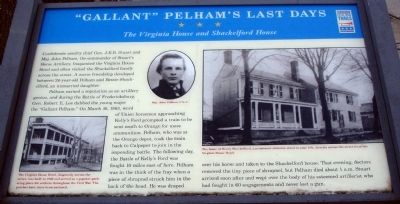
Pelham earned a reputation as an artillery genius, and during the Battle of Fredericksburg, Gen. Robert E. Lee dubbed the young major the “Gallant Pelham.” On March 16, 1863, word of Union horsemen approaching Kelly’s Ford prompted a train to be sent south to Orange for more ammunition. Pelham, who was at the Orange depot, took the train back to Culpeper to join in the impending battle. The following day, the Battle of Kelly’s Ford was fought 10 miles east of here. Pelham was in the thick of the fray when a piece of shrapnel struck him in the back of the head. He was draped over his horse and taken to the Shackelford house. That evening, doctors removed the tiny piece of shrapnel, but Pelham died about 1 a.m. Stuart arrived soon after and wept over the body of his esteemed artillerist who had fought in 60 engagements
this page online
Erected by Virginia Civil War Trails.
Topics and series. This historical marker is listed in this topic list: War, US Civil. In addition, it is included in the Virginia Civil War Trails series list. A significant historical month for this entry is March 1854.
Location. 38° 28.46′ N, 77° 59.739′ W. Marker is in Culpeper, Virginia, in Culpeper County. It is on North Main Street (Business U.S. 15), on the right when traveling north. Touch for map. Marker is in this post office area: Culpeper VA 22701, United States of America. Touch for directions.

Regionally, this marker is in the Washington Metropolitan Area and in Northern Virginia. It is also in the American South, specifically in the Upper South, and in the Mid-Atlantic. Globally, it is in North America, the Western Hemisphere, the Western World, and the Anglosphere. Historically, it finds itself in what was once the territory of the Mississippian Culture, one of the original Thirteen Colonies, one of the Confederate States of America, and the Antebellum South.
Other nearby markers. At least 8 other markers are within walking distance of this marker:
February 8, 2008
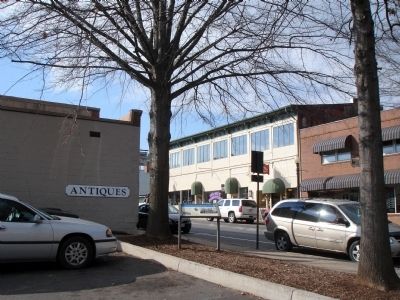
2. Virginia Civil War Trails Marker
Another marker is no longer nearby. A.P. Hill's Boyhood Home (was about 400 feet away but has been confirmed missing).
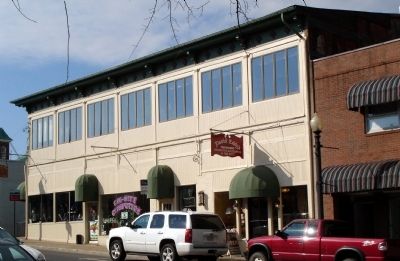
More about this marker. On the marker's lower left is a photo captioned, The Virginia House Hotel, diagonally across the street, was built in 1846 and served as a popular gathering place for soldiers throughout the Civil War. The porches have since been enclosed. On the right side of the marker is a photo captioned, The home of Henry Shackelford, a prominent attorney, stood to your left, directly across the street from the Virginia House Hotel. The
February 8, 2008
3. The former Virginia House Hotel
Also see . . .
1. John Pelham Biography. (Submitted on October 14, 2008.)
2. John Pelham Historical Association. Archival view. (Submitted on October 14, 2008.)
Photographed by Craig Swain, October 11, 2008
4. Plaque at the Site the House Stood
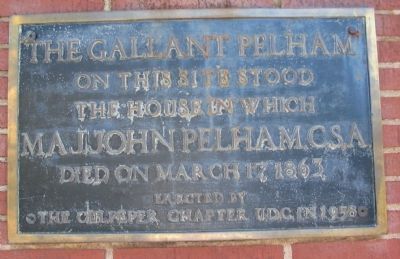
On this site stood
the house in which
Major John Pelham, C.S.A.
died on March 17, 1863
erected by
The Culpeper Chapter U.D.C. in 1958

Photographed by Craig Swain, October 11, 2008
5. Site of the Shackelford House
The site of the Shackelford house, where Pelham died is marked by a plaque, seen at the front corner post. The site is at the intersection of Cameron and Main Streets. The marker's location is to the north, or left in this view, in a parking lot.
Credits. This page was last revised on August 1, 2026. It was originally submitted on October 14, 2008. This page has been viewed 3,271 times since then and 103 times this year. Photos: 1, 2, 3. submitted on October 14, 2008. 4, 5. submitted on October 19, 2008, by Craig Swain of Leesburg, Virginia. • Craig Swain was the editor who published this page.
