Mackinaw City in Cheboygan County, Michigan — The American Midwest (Great Lakes)
The Dixie Highway
| — | Mackinaw City Historical Pathway | — |
Photographed by Cosmos Mariner, July 29, 2017
1. The Dixie Highway Marker
This marker has been replaced with a newer marker. See below.
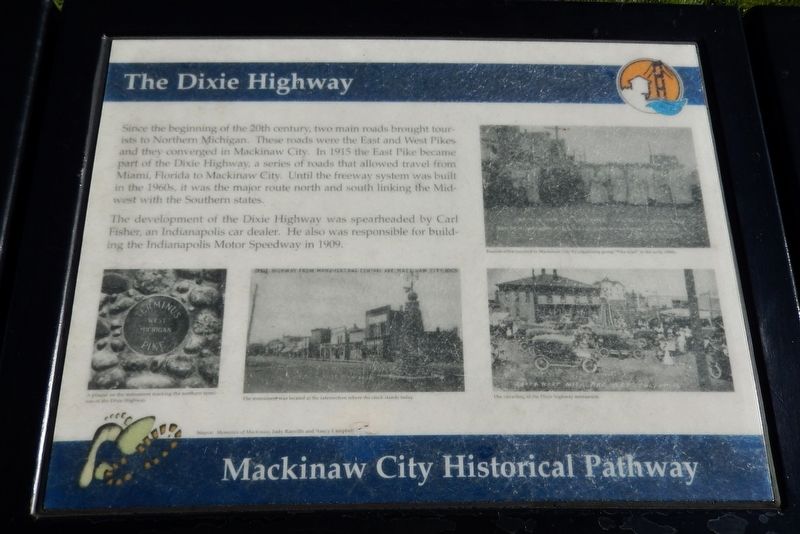
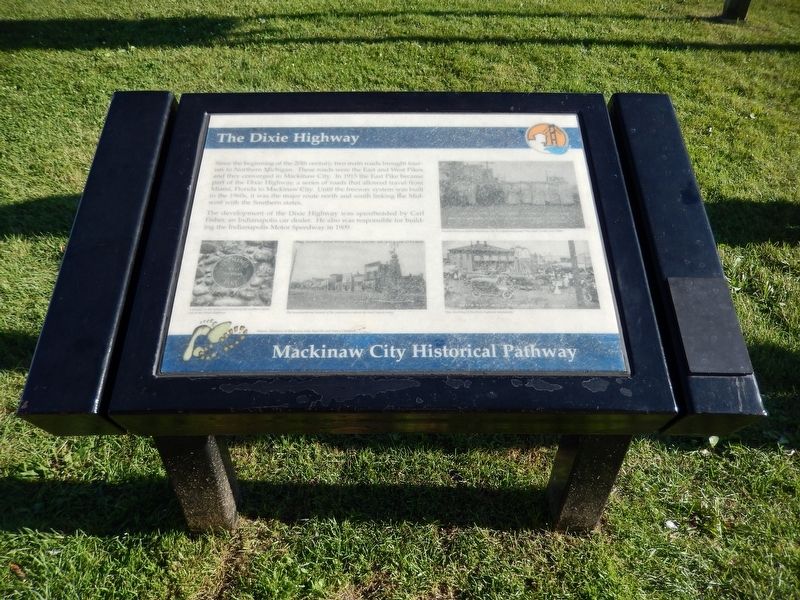
Since the beginning of the 20th century, two main roads brought tourists to Northern Michigan. These roads were the East and West Pikes and they converged in Mackinaw City. In 1915 the East Pike became part of the Dixie Highway, a series of roads that allowed travel from Miami, Florida to Mackinaw City. Until the freeway system was built in the 1960s, it was the major route north and south linking the Midwest with the Southern states.
The development of the Dixie Highway was spearheaded by Carl Fisher, an Indianapolis car dealer. He also was responsible for building the Indianapolis Motor Speedway in 1909.
Source: Memories of Mackinaw, Judy Ranville and Nancy Campbell
Topics. This historical marker is listed in these topic lists: Man-Made Features • Roads & Vehicles.
Location. This marker has been replaced by another marker nearby. It was located near 45° 46.899′ N, 84° 43.513′ W. Marker was in Mackinaw City, Michigan, in Cheboygan County. It was at the intersection of East Central Avenue and Langlade Street, on the right when traveling west on East Central
this page online

Regionally, this marker was in Northern Michigan Lower Peninsula, on the Straits of Mackinac, and in one of the Lake Huron Shore counties. It was also in the American Midwest. Globally, it was in North America, in the Great North Woods, on the Great Lakes, in the Western Hemisphere, in the Western World, and in the Anglosphere. Historically, it found itself in what was once the Northwest Territory.
Other nearby markers. At least 8 other markers are within walking distance of this location: A different marker also named The Dixie Highway (here, next to this marker); The Water Highway (a few steps from this marker); Historic Mackinaw City (within shouting distance of this marker); Mackinaw City (within shouting distance of this marker); Iron Horse (within shouting distance of this marker); Chief Wawatam (within shouting distance of this marker); a different marker also named The Algomah
Photographed by Cosmos Mariner, July 29, 2017
2. The Dixie Highway Marker (wide view)
Other markers no longer nearby. Historic Mackinaw City (was within shouting distance of this marker but has been replaced with another marker now near it); The Algomah (was within shouting distance of this marker but has been replaced with another marker now near it).
Also see . . .
1. Map of the Dixie Highway.
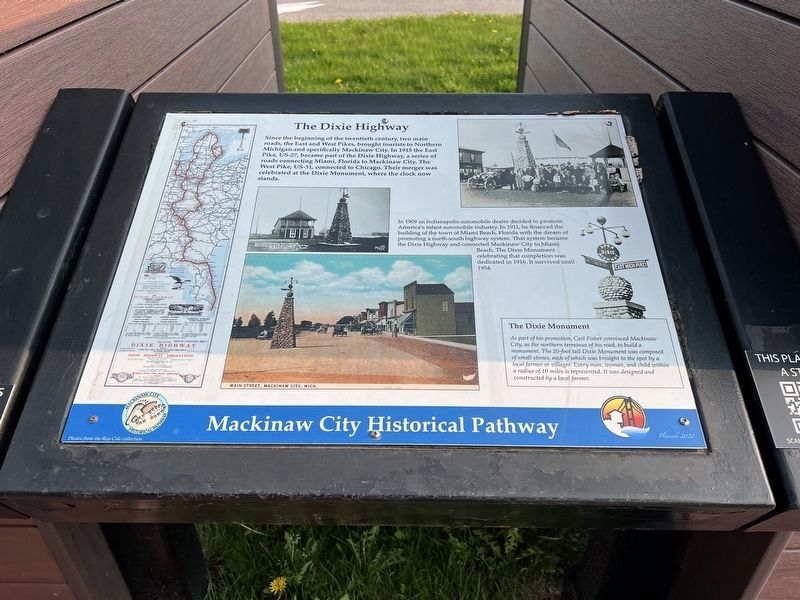
This map, issued by the NHA in 1915, shows the Dixie Highway, proposed by the Dixie Highway Association and endorsed by the NHA. The projected route runs from Mackinaw City, Michigan, to Miami, Florida. In order to traverse major cities of the Midwest, and especially Chicago and Detroit, part of the route is divided into eastern and western divisions. (Submitted on August 17, 2017, by Cosmos Mariner of Cape Canaveral, Florida.)
2. Carl Graham Fisher: Mr. Miami Beach. Carl Graham Fisher, an Indiana native, was the man who - among other accomplishments - conceived and built Miami Beach, Montauk Manor (on Long Island), the Indianapolis
Photographed by Sandra Hughes Tidwell, May 15, 2023
3. The Dixie Highway Marker
Photographed by Joel Seewald, August 19, 2019
4. The Dixie Highway Marker
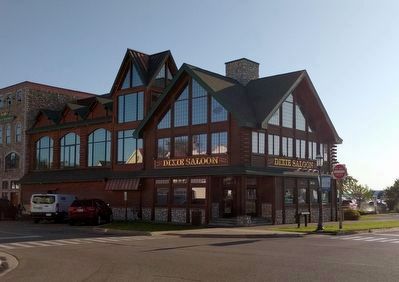
Marker is in front of the Dixie Saloon, next to the streetlight.
Credits. This page was last revised on May 28, 2025. It was originally submitted on August 17, 2017, by Cosmos Mariner of Cape Canaveral, Florida. This page has been viewed 1,134 times since then and 84 times this year. Last updated on October 28, 2018, by Cosmos Mariner of Cape Canaveral, Florida. Photos: 1, 2. submitted on August 17, 2017, by Cosmos Mariner of Cape Canaveral, Florida. 3. submitted on May 27, 2023, by Sandra Hughes Tidwell of Killen, Alabama, USA. 4. submitted on October 4, 2019, by Joel Seewald of Madison Heights, Michigan. • Andrew Ruppenstein was the editor who published this page.
