Greenville in Greenville County, South Carolina — The American South (South Atlantic)
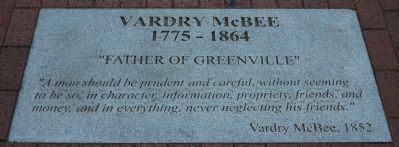
Vardry McBee
(1775–1864)
| — | “Father of Greenville” | — |
Photographed by Brian Scott, June 1, 2008
1. Vardry McBee (1775-1864) Marker
“A man should be prudent and careful, without seeming to be so, in character, information, propriety, friends, and money, and in everything, never neglecting his friends.” Vardry McBee, 1852.
this page online
Erected 2002 by Greenville County Historical Society.
Topics. This historical marker is listed in these topic lists: Industry & Commerce • Religion & Religious Structures • Settlements & Settlers. A significant historical year for this entry is 1852.
Location. 34° 50.923′ N, 82° 23.982′ W. Marker is in Greenville, South Carolina, in Greenville County. It is at the intersection of South Main Street and East Court Street, on the left when traveling south on South Main Street. The monument is located directly in front of the Old Record Building monument and across from the entrance to the Westin Poinsett Hotel in downtown Greenville, SC. Touch for map. Marker is in this post office area: Greenville SC 29601, United States of America. Touch for directions.

Regionally, this marker is in Upstate. It is also in the American South, specifically in the Deep South, in Appalachia, and specifically in Southern Appalachia. Globally, it is in North America, the Western Hemisphere, the Western World, and the Anglosphere. Historically, it finds itself in what was once the original Cherokee Nation, the territory
Photographed by Brian Scott, June 1, 2008
2. Vardry McBee (1775-1864) Marker
Other nearby markers. At least 8 other markers are within walking distance of this marker: The Old Record Building (here, next to this marker); Joel Roberts Poinsett (within shouting distance of this marker); a different marker also named Joel Roberts Poinsett (within shouting distance of this marker); Chamber of Commerce Building (within shouting distance of this marker); Poinsett's Spring (within shouting distance of this marker); a different marker also named Poinsett's Spring (within shouting distance of this marker); South Carolina's First National Bank (within shouting distance of this marker); a different marker also named South Carolina's First National Bank (about 300 feet away, measured in a direct line). Touch for a list and map of all markers in Greenville.
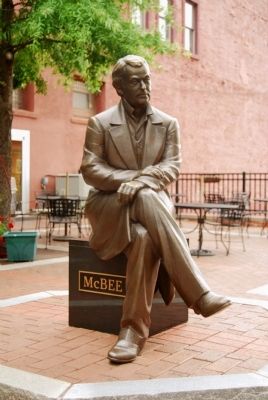
More about this marker. This statue and memorial is one of several located in downtown Greenville, honoring some of the famous people who called Greenville home.
Also see . . . Lemuel J. Alston. Lemuel James Alston
Photographed by Brian Scott, June 1, 2008
3. Vardry McBee (1775-1864) Marker
Additional commentary.
1. Vardry McBee
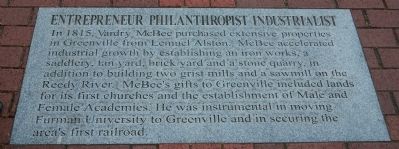
Vardry McBee was perhaps the most pivotal figure in the history of our city and Greenville County as a whole. thanks to his business acumen and impressive foresight for how the community could grow and prosper.
A product of the Carolina frontier, McBee was born in 1775 on the eve of the American Revolution, a conflict that would prove formative in his early years. Both his father and older brother fought with the Patriots, at King's Mountain and the Battle of Cowpens. McBee himself never fought for American independence, but instead used his considerable fortune to improve the lives of his fellow citizens, appropriating his land and fortunes to public projects.
McBee opened the first textile mill on the Reedy River, but he saw value in a diversified economy. In his private business life, that meant he owned two flour mills, a cotton factory, and wool and paper mills. Publicly, even as he approached his 80s, it led him to champion the construction
Photographed by Brian Scott, June 1, 2008
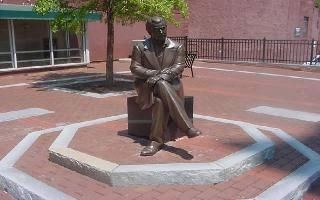
4. Vardry McBee Statue
The markers are placed around the statue.
— Submitted December 6, 2011, by Brian Scott of Anderson, South Carolina.
2. McBee's Tithe
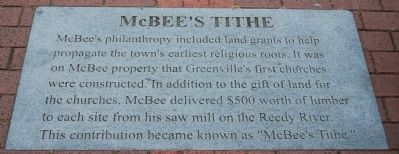
Vardry McBee, the father of Greenville, donated land and $500 worth of limber from his mill on the Reedy River to five congregations. This act was known as McBee's Tithe. These were the first five churches in downtown Greenville (and they contribute to Greenville's nickname: the Church City). The five churches are: First Baptist, First Presbyterian, Christ Church (Episcopal), St. Mary's Catholic, and Buncombe Street United Methodist.
— Submitted December 6, 2011, by Brian Scott of Anderson, South Carolina.
3. Lemuel James Alston (1760 - 1836)
Lemuel James Alston, a Representative from South Carolina; born in the eastern part of Granville (now Warren) County, N.C., in 1760; moved to South Carolina after the Revolutionary War and settled near Greens Mill,
Photographed by Stanley and Terrie Howard
5. Vardry McBee
Vardry McBee statue - The Sculptor for this project was T.J. Dixon of San Diego. The location is at Court Square on E. Court Street. He constructed 100 buildings in Greenville County and built a textile mill along the Reedy River. He gave land to five downtown churches, all of which gave $5,000 toward cost of the statue.
— Submitted December 6, 2011, by Brian Scott of Anderson, South Carolina.
Photographed by Brian Scott
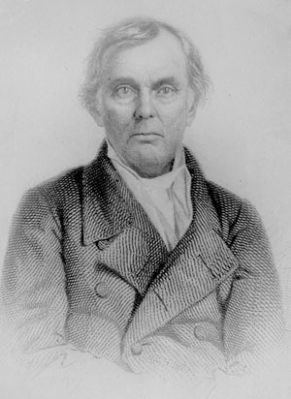
6. Vardry McBee
June 19, 1775 - Jan. 23, 1864
June 19, 1775 - Jan. 23, 1864
Photographed by Brian Scott, December 24, 2008
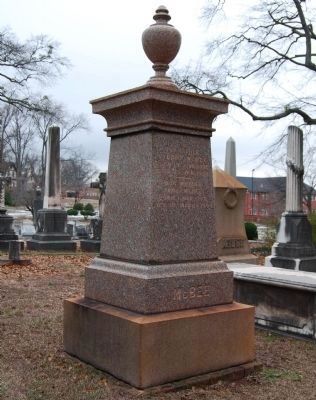
7. Vardry and Jane McBee Tombstone
Vardry McBee
Born 19 June 1776
Died 23 Jan 1854
----------
Our Mother
Jane McBee
Born 1 May 1783
Died 13 March 1864
Photographed by Brian Scott, circa 1900
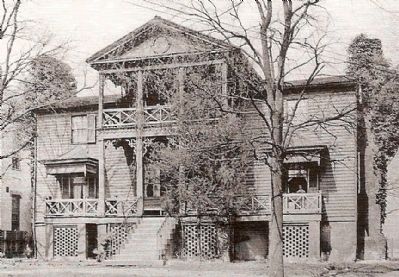
8. Prospect Hill
Home of Vardry McBee
Home of Vardry McBee
Prospect Hill was originally the home of Lemuel Alston, one of Greenville's earliest settlers. In 1815, Alston moved to Clarke County, Alabama, where he died in 1835. In 1836, McBee moved to Greenville from Lincolnton, North Carolina, and made Prospect Hill his home. He lived in the house until his death in 1864. The home was demolished in 1920.
Credits. This page was last revised on December 13, 2019. It was originally submitted on June 2, 2008, by Brian Scott of Anderson, South Carolina. This page has been viewed 5,980 times since then and 163 times this year. Last updated on October 30, 2018, by Bruce Guthrie of Silver Spring, Maryland. Photos: 1, 2, 3, 4. submitted on June 2, 2008, by Brian Scott of Anderson, South Carolina. 5. submitted on September 8, 2008, by Stanley and Terrie Howard of Greer, South Carolina. 6. submitted on December 6, 2011, by Brian Scott of Anderson, South Carolina. 7. submitted on January 11, 2009, by Brian Scott of Anderson, South Carolina. 8. submitted on April 13, 2009, by Brian Scott of Anderson, South Carolina. • Andrew Ruppenstein was the editor who published this page.
