Airport in Columbus in Franklin County, Ohio — The American Midwest (Great Lakes)
Original Port Columbus Airport Terminal
1929-1958
Photographed by William Fischer, Jr., October 17, 2008
1. Original Port Columbus Airport Terminal, 1929-1958 Marker
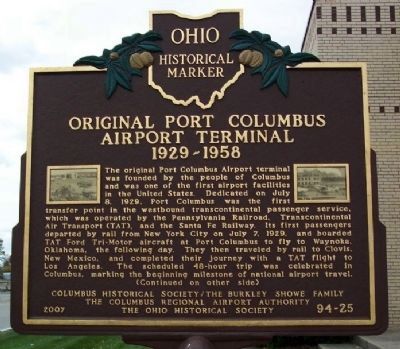
The original Port Columbus Airport terminal was founded by the people of Columbus and was one of the first airport facilities in the United States. Dedicated on July 8, 1929, Port Columbus was the first transfer point in the westbound transcontinental passenger service, which was operated by the Pennsylvania Railroad, Transcontinental Air Transport (TAT), and the Santa Fe Railway. Its first passengers departed by rail from New York City on July 7, 1929, and boarded TAT Ford Tri-Motor aircraft at Port Columbus to fly to Waynoka, Oklahoma, the following day. They then traveled by rail to Clovis, New Mexico, and completed their journey with a TAT flight to Los Angeles. The scheduled 48-hour trip was celebrated in Columbus, marking the beginning milestone of national airport travel.
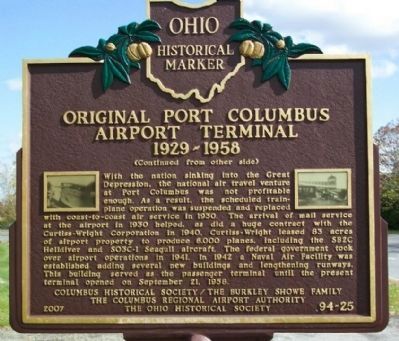
With the nation sinking into the Great Depression, the national air travel venture at Port Columbus was not profitable enough. As a result, the scheduled train-plane operation was suspended and replaced with coast-to-coast air service in 1930. The arrival of mail service at the airport in 1930 helped, as did a huge contract with the Curtiss-Wright
this page online
Erected 2007 by Columbus Historical Society /The Burkley Showe Family, The Columbus Regional Airport Authority, and The Ohio Historical Society. (Marker Number 94-25.)
Topics and series. This historical marker is listed in these topic lists: Air & Space • Industry & Commerce • Railroads & Streetcars. In addition, it is included in the Ohio Historical Society / The Ohio History Connection, and the Pennsylvania Railroad (PRR) series lists. A significant historical month for this entry is July 2008.
Location. 39° 59.206′ N, 82° 52.29′ W. Marker is in Columbus, Ohio, in Franklin County. It is in Airport. It is on Fifth Avenue, on the right when traveling east. Marker is near the southeast corner of the Port Columbus Airport
Photographed by William Fischer, Jr., October 25, 2008
2. Original Port Columbus Airport Terminal Marker

Regionally, this marker is in the Scioto Valley. It is also in the American Midwest and in the Corn Belt. Globally, it is in North America, the Western Hemisphere, the Western World, and the Anglosphere. Historically, it finds itself in what was once the Haudenosaunee (Iroquois) Confederacy, the territory of the Mississippian Culture, and the Northwest Territory.
Other nearby markers. At least 8 other markers are within 3 miles of this marker, measured as the crow flies: Norton Field (approx. one mile away); Forest Lawn Veterans Memorial (approx. 1.2 miles away); Columbus Depot (approx. 1½ miles away); Geroux Herb Gardens (approx. 1.9 miles away); War Memorial (approx. 1.9 miles away); Buckeye Tree (approx. 2 miles away); The Big Walnut Country Club / The Founding Members (approx. 2 miles away); John Clark House (approx. 2.2 miles away).
Photographed by William Fischer, Jr., October 17, 2008
3. Original Port Columbus Airport Terminal and Marker
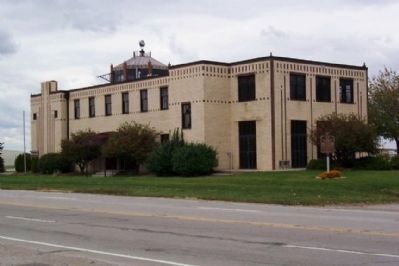
Taken from across Fifth Avenue, looking northeast.
Photographed by William Fischer, Jr., October 17, 2008
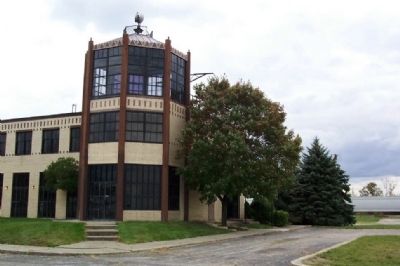
4. Original Port Columbus Airport Terminal
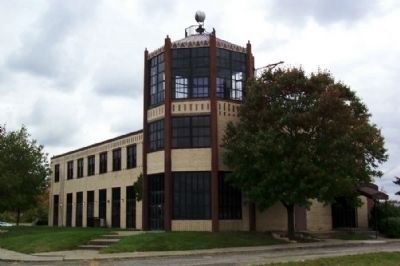
Note octagonal control tower with visibility in all directions.
Photographed by William Fischer, Jr., October 17, 2008
5. Original Port Columbus Airport Terminal and Railroad Tracks
Freight car on railroad tracks in far right background shows proximity of former Pennsylvania Railroad to terminal for air-rail transcontinental travel from 1929-1930.
Photographed by Alex Krempasky, March 5, 2023
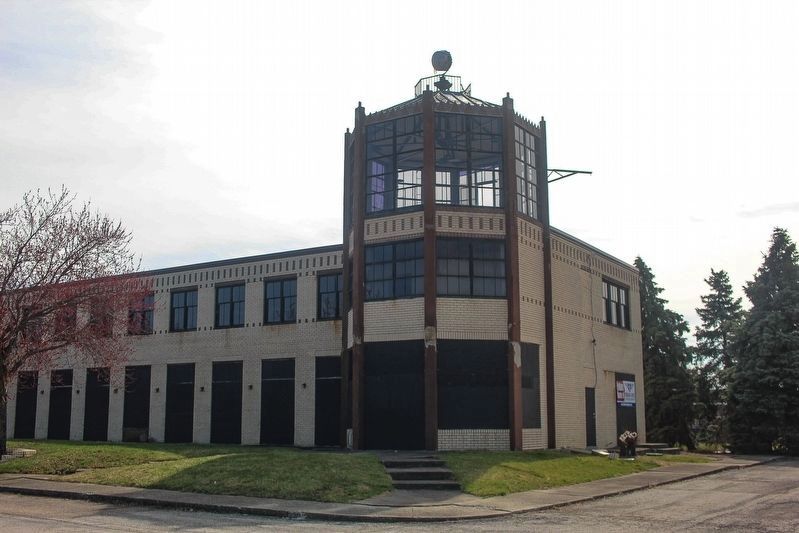
6. Original Port Columbus Airport Terminal
Supposed to become museum, but that has been a many years now.
Photographed by William Fischer, Jr., October 25, 2008
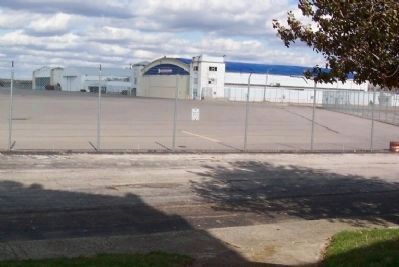
7. Port Columbus Hangars Near Original Terminal
Taken from steps of terminal building.
Credits. This page was last revised on October 31, 2025. It was originally submitted on October 20, 2008, by William Fischer, Jr. of Reynoldsburg, Ohio. This page has been viewed 4,189 times since then and 88 times this year. Photos: 1. submitted on October 20, 2008, by William Fischer, Jr. of Reynoldsburg, Ohio. 2. submitted on October 29, 2008, by William Fischer, Jr. of Reynoldsburg, Ohio. 3, 4, 5. submitted on October 20, 2008, by William Fischer, Jr. of Reynoldsburg, Ohio. 6. submitted on May 14, 2023, by Alex Krempasky of Obetz, Ohio. 7. submitted on October 29, 2008, by William Fischer, Jr. of Reynoldsburg, Ohio. • Kevin W. was the editor who published this page.
