
Rimouski in Rimouski-Neigette, Québec — Central Canada (French-Canadian)
La maison du commerce
⎯⎯⎯
The General Store
Photographed by William Fischer, Jr., August 16, 2018
1. La maison du commerce / The House of Commerce Marker

Français
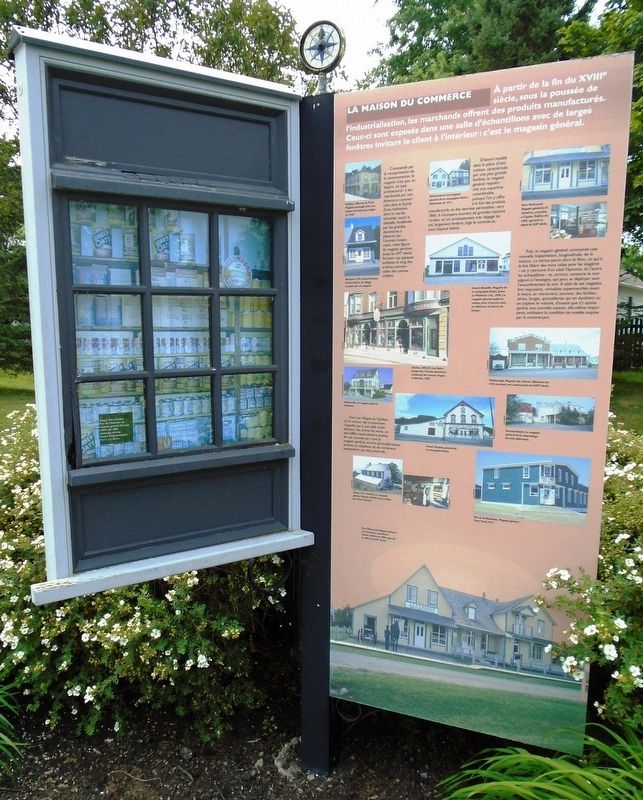
La maison du commerce
À partir de la fin du XVIIIe siècle, sous la poussée de l'industrialisation, les marchands offrent des produits manufacturés. Ceux-ci sont exposés dans une salle d'échantillons avec de larges fenêtres invitant le client à l'intérieur : c'est le magasin général.
Commandé par la réorganisation de la consommation, le magasin n'est pas, au départ, un type architectural : il est représenté par une devanture commerciale dans la façade d'une habitation, dont le rez-de-chaussée reçoit la clientèle. Améliorée par les grandes devantures à pilastres qui l'ouvrent totalement, cette figure du magasin perdure jusqu'au XXe siècle, formant ces typiques enfilades le long des artères commerciales des centres urbains.
Dans les villages du Québec, où le volume des transactions n'appelle pas à une telle multiplication des points de vente, un soul édifice reçoit plutôt la somme de ces commerces: c'est le magasin général, encore particulièrement prèsent en Gaspésie où de nombreux exemplaires ont été préserves.
D'abord installé dans la pièce d'un maison, caractérisée par une
this page online
Puis, le magasin général commande une nouvelle implantation, longitudinale, de la maison. La vitrine perce alors le flanc, ce qui à la fois libère des murs utiles pour les étagères — on y retrouve d'un côté l'épicerie, de l'autre les échantillons — et, surtout, consacre le mur pignon à l'enseigne, qui peut se déployer sans l'encombrement du toit. À côté de ces magasins fort imposants, véritables supermarchés avant la lettre, se retrouvent, souvent, des ferblanteries, forges, quincailleries qui en doublent ou en triplent le volume, d'autant que s'y ajoute parfois une nouvelle maison, elle-même importante, trahissant la condition de notable acquise par le commerçant.
[Légendes photo, en haut à gauche, dans le sens des aiguilles d'une montre, lisez]
• Québec. 380, rue du Pont. Magasin aménagé dans une maison
Photographed by William Fischer, Jr., August 16, 2018
2. La maison du commerce / The House of Commerce Marker
• Bonaventure. Le magasin général de la compagnie Robin, bâtiments de 1911.
• New Richmond. Magasin général J.-A. Gendron, autrefois à Caplan. Édifice de 1890, agrandi au début du XXe siècle.
• Anse-à-Beaufils. Magasin de la compagnie Robin, Jones et Whitman Ltd., 1928. Le magasin général quitte la maison pour s'inscrire dans un bâtiment en forme de hangar.
• Maskinongé. Magasin des Lebrun. Bâtiment de 1916 jouxtant une construction du XIXe siècle.
• Deschambault. Le magasin général Paré, assemblage de trois bâtiments.
• Percé. Magasin général de la compagnie Robin.
• Îles de la Madeleine. Magasin général Chez Fred, 1911.
• New Richmond, Magasin général J.-A. Gendron, autrefois à Caplan. Édifice de 1890, agrandi au début du XXe siècle.
• Gaspé. Parc Forillon. Le magasin général Hyman (1864) mis en valeur par Parcs Canada.
• Hébertville. Le magasin général Desbiens.
• Québec. 209-215, rue Saint-Joseph Est. Grande devanture à pilastres de Lorenzo Auger, architecte, 1922.
• Beauport. 639, avenue Royale Petite maison du village occupée par un magasin.
[La légende de la photo d'arrière-plan de la fenêtre se lit]
Gaspé, Parc Forillon
Vue de l'intérieur du magasin général Hyman, édifice de 1864 aménagé comme centre d'interprétation
The General Store
From the late 18th century onward, driven by industrialization, merchants offered manufactured goods. These were displayed in a showroom with large windows inviting customers inside: this was the general store.
Driven by the reorganization of consumption, the "store" was not initially an architectural type: it was represented by a shopfront on the facade of a house, with the ground floor serving customers. Improved by large, pilastered storefronts that completely opened, this store design persisted into the 20th century, forming the typical rows of shops along the commercial streets of urban centres.
In Québec villages, where business volume did not warrant such a diversity of retail outlets, a single building housed all these businesses: the general store, still particularly prevalent in the Gaspé Peninsula, where many examples have been preserved.
Initially housed in a room with a larger window, the "general store" quickly required considerable space, as it offered both manufactured goods and perishable items. Around 1860, it often occupied large rural houses, where the main floor, featuring numerous windows, housed the business beneath the living space.
Later, the general store evolved into a new, flatter layout. The shop window was extended along the side, freeing up walls for shelving — the groceries on one side, finished products on the other — and, most importantly, the gable displayed the store sign, leaving the roof uncluttered. Next to these very imposing stores, supermarkets of their time, there were often tinsmith shops, blacksmith shops, and hardware stores which doubled or tripled the volume of available goods, enhanced when a new shop, itself important, was added, to showcase the merchant's notable wares.
----- [Photo captions, clockwise from top left]
• 380 Rue du Pont, Québec City. Store in a suburban house built in 1846.
• Bonaventure. The Robin Company general store of 1911.
• New Richmond. J.A. Gendron General Store, formerly at Caplan. Built in 1890, expanded in the early 20th century.
• Anse-à-Beaufils. Robin, Jones and Whitman Ltd. Store, 1928. The general store moved from the house to a shack.
• Maskinongé. Lebrun store. A 1916 addition to a 19th century building.
• Deschambault. Paré General Store, assembly of three buildings.
• Percé. Robin Company General Store.
• Magdalen Islands. Chez Fred General Store, 1911.
• New Richmond, J.A. Gendron General Store, formerly at Caplan. Built in 1890, expanded in the early 20th century.
• Gaspé. Forillon Park. The Hyman General Store (1864), now used by Parks Canada.
• Hébertville. The Desbiens General Store.
• 209-215 Saint-Joseph Street East, Québec City. Large pilastered façade of architect Lorenzo Auger, 1922.
• 639 Royale Avenue, Beauport. Small village house serving as a store.
[Window background photo caption:]
Gaspé, Forillon Park
Interior view of the Hyman General Store, 1864 building converted into an interpretation centre
Topics. This historical marker is listed in these topic lists: Architecture • Industry & Commerce. A significant historical year for this entry is 1846.
Location. 48° 29.049′ N, 68° 29.741′ W. Marker is in Rimouski, Québec, in Rimouski-Neigette. It can be reached from boulevard du Rivage (Québec Route 132), on the right when traveling east. Marker is on the grounds of Maison Lamontagne House Historic Site. Touch for map. Marker is at or near this postal address: 707 boulevard du Rivage, Rimouski QC G5L, Canada. Touch for directions.

Regionally, this marker is in Eastern Québec & Gaspésie and in Bas-Saint-Laurent. It is also in Central Canada. Globally, it is in North America, the Western Hemisphere, and the Western World. Historically, it finds itself in what was once a British colony, the Viceroyalty of New France, the Haudenosaunee (Iroquois) Confederacy, and Rupert’s Land.
Other nearby markers. At least 8 other markers are within walking distance of this marker: Les maisons de colonisation / Settlement Houses (here, next to this marker); Maisons d'aujourd'hui / Today's Houses (a few steps from this marker); Les maisons de notables / Noteworthy Houses (a few steps from this marker); Maisons des faubourgs / Suburban Houses (a few steps from this marker); L'habitat ouvrier urbain / Urban Worker Housing (a few steps from this marker); La maison rurale du Bas-Canada / The Rural House of Lower Canada (a few steps from this marker); Villas et villégiature / Villas and Resorts (within shouting distance of this marker); La maison Londonienne / The London house (within shouting distance of this marker). Touch for a list and map of all markers in Rimouski.
Also see . . .
1. The old architecture of Quebec (Traquair, 1947). (Submitted on December 12, 2018, by William Fischer, Jr. of Reynoldsburg, Ohio.)
2. The Architecture of Old Quebec, or The History of a Palimpsest (Noppen and Morisett). (Submitted on December 12, 2018, by William Fischer, Jr. of Reynoldsburg, Ohio.)
Credits. This page was last revised on July 31, 2026. It was originally submitted on December 11, 2018, by William Fischer, Jr. of Reynoldsburg, Ohio. This page has been viewed 253 times since then and 20 times this year. Photos: 1, 2. submitted on December 12, 2018, by William Fischer, Jr. of Reynoldsburg, Ohio.
