
Invergarry in Highland, Scotland, United Kingdom — Northwestern Europe (the British Isles)
The Bridge of Oich
Photographed by Michael Herrick, August 27, 2018
1. The Bridge of Oich Marker
Inscription.
The Bridge of Oich. .
The Bridge of Oich.
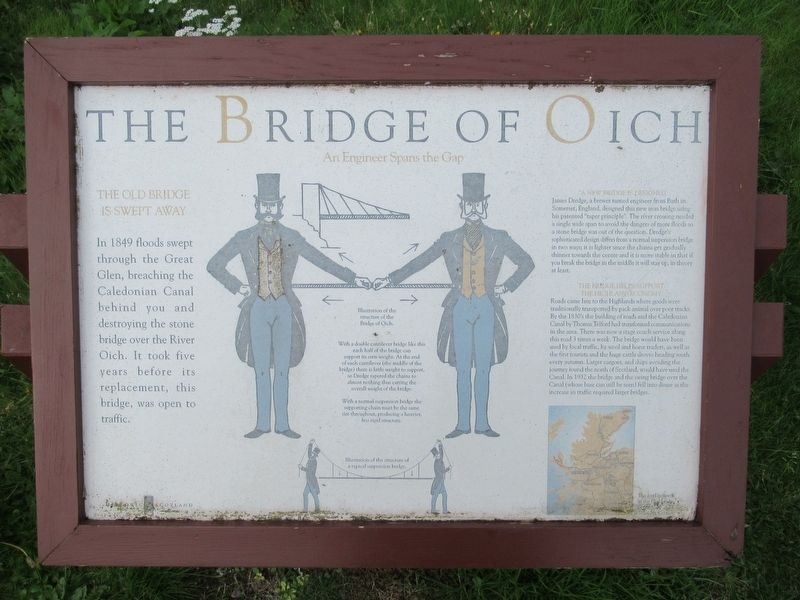
The Old Bridge Is Swept Away. In 1849 floods swept through the Great Glen, breaching the Caledonian Canal behind you and destroying the stone bridge over the River Oich. It took five years before its replacement, this bridge, was open to traffic. ,
An Engineer Spans the Gap. Illustration of the structure of the Bridge of Oich. , With a double cantilever bridge like this each half of the bridge can support its own weight. At the end of each cantilever (the middle of the bridge) there is little weight to support, so Dredge tapered the chains to almost nothing thus cutting the overall weight of the bridge. , With a normal suspension bridge the supporting chain must be the same size throughout, producing a heavier, less rigid structure. ,
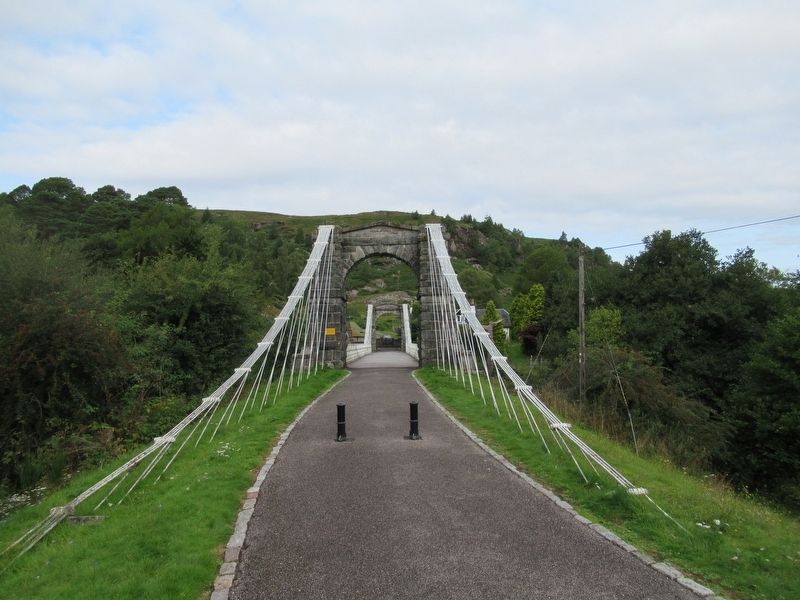
A New Bridge Is Designed. James Dredge, a brewer turned engineer from Bath in Somerset, England, designed this new iron bridge using his patented "taper principle. The river crossing needed a single wide span to avoid the dangers of more floods so a stone bridge was out of the question. Dredge's sophisticated design differs from a normal suspension bridge in two ways; it is lighter since the chains get gradually thinner towards the centre and it is more stable in that if you break the bridge in the middle it will stay up, in theory at least. ,
The Bridge Helps Support The Highland Economy. Roads came late to the Highlands where goods were traditionally transported by pack animal over poor tracks. By the 1830's the building of roads and the Caledonian Canal by Thomas Telford had transformed communications in the area. There was now a stage coach service along this road 3 times a week. The bridge would have been used by local traffic, by wool and horse traders, as well as the first tourists and the huge cattle droves heading south every autumn. Larger cargoes, and ships avoiding the journey round the north of Scotland, would have used the Canal. In 1932 the bridge and the swing bridge over the Canal (whose base can still be seen) fell into disuse as the increase in traffic required larger bridges. , ( photo captions ) - The road network in the Highlands in the mid-19th Century. - Illustration of the structure of a typical suspension bridge.
The Bridge of Oich
The Old Bridge Is Swept Away
In 1849 floods swept through the Great Glen, breaching the Caledonian Canal behind you and destroying the stone bridge over the River Oich. It took five years before its replacement, this bridge, was open to traffic.
An Engineer Spans the Gap
Illustration of the structure of the Bridge of Oich.
With a double cantilever bridge like this each half of the bridge can support its own weight. At the end of each cantilever (the middle of the bridge) there is little weight to support, so Dredge tapered the chains to almost nothing thus cutting the overall weight of the bridge.
With a normal suspension bridge the supporting chain must be the same size throughout, producing a heavier, less rigid structure.
A New Bridge Is Designed
James Dredge, a brewer turned engineer from Bath in Somerset, England, designed this new iron bridge using his patented "taper principle. The river crossing needed a single wide span to avoid the dangers of more floods so a stone bridge was out of the question. Dredge's sophisticated design differs from a normal suspension bridge in two ways; it is lighter since the chains get gradually thinner towards the centre and it is more stable in that if you break the
Click or scan to see this page online
bridge in the middle it will stay up, in theory at least.
The Bridge Helps Support
The Highland Economy
Roads came late to the Highlands where goods were traditionally transported by pack animal over poor tracks. By the 1830's the building of roads and the Caledonian Canal by Thomas Telford had transformed communications in the area. There was now a stage coach service along this road 3 times a week. The bridge would have been used by local traffic, by wool and horse traders, as well as the first tourists and the huge cattle droves heading south every autumn. Larger cargoes, and ships avoiding the journey round the north of Scotland, would have used the Canal. In 1932 the bridge and the swing bridge over the Canal (whose base can still be seen) fell into disuse as the increase in traffic required larger bridges.
( photo captions )
- The road network in the Highlands in the mid-19th Century.
- Illustration of the structure of a typical suspension bridge.
Topics. This historical marker is listed in this topic list: Bridges & Viaducts. A significant historical year for this entry is 1849.
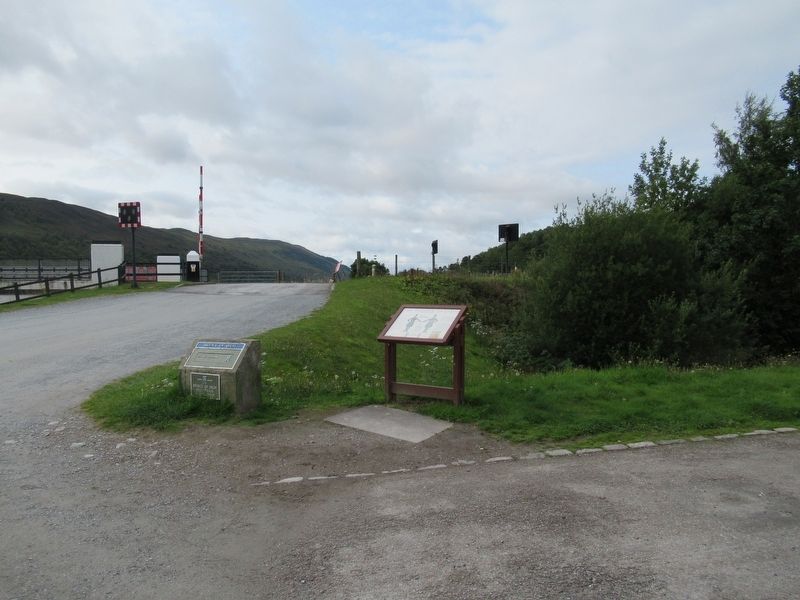
Location. 57° 5.588′ N, 4° 44.696′ W. Marker is in Invergarry, Scotland, in Highland. It is at the intersection of Scotland Route A82 and unamed road at the River Oich, on the right when traveling south on
Photographed by Michael Herrick, August 27, 2018
2. The Bridge of Oich Marker
Scotland Route A82. Touch for map. Marker is in this post office area: Invergarry, Scotland PH35 4HN, United Kingdom. Touch for directions.

Regionally, this marker is in Scotland’s Highlands. Globally, it is in the Atlantic Ocean, in the North Atlantic Region, on the Atlantic Arc, in Europe, on the Celtic Fringe, in Atlantic Europe, on one of the British Isles, in the Western World, and in the Anglosphere.
Other nearby markers. At least one other marker is within 26 kilometers of this marker, measured as the crow flies: The Commandos (approx. 24.9 kilometers away).
Also see . . . Bridge of Oich on Wikipedia. (Submitted on December 11, 2018, by Michael Herrick of Southbury, Connecticut.)
Photographed by Michael Herrick, August 27, 2018
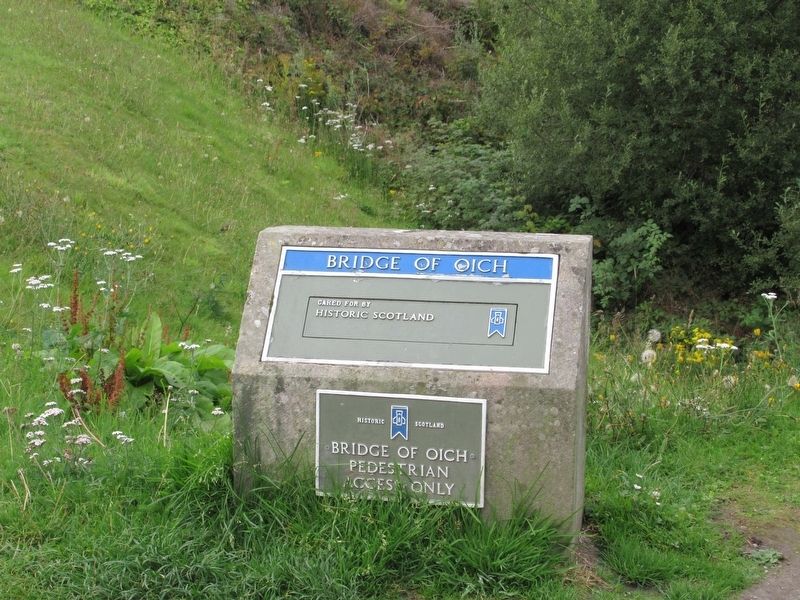
3. The Bridge of Oich - Historic Scotland
Photographed by Michael Herrick, August 27, 2018
4. The Bridge of Oich
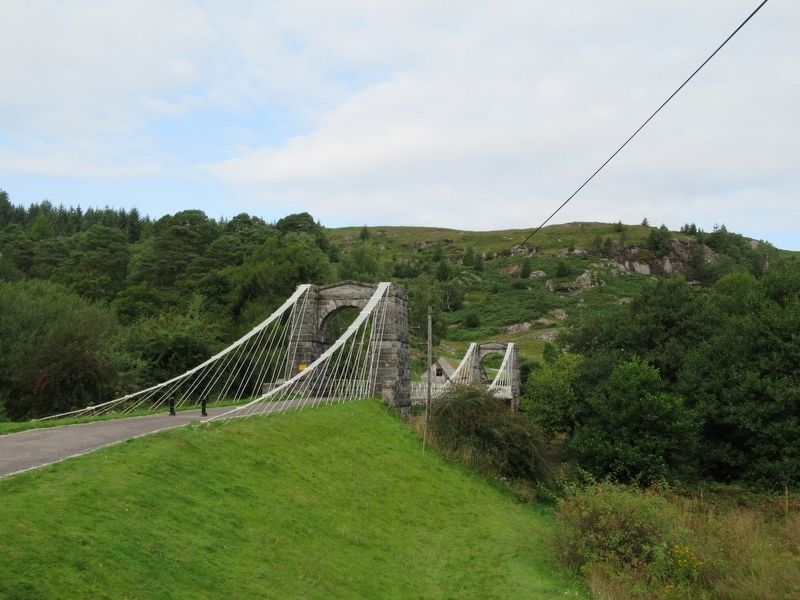
Photographed by Michael Herrick, August 27, 2018
5. The Bridge of Oich
Credits. This page was last revised on January 27, 2022. It was originally submitted on December 11, 2018, by Michael Herrick of Southbury, Connecticut. This page has been viewed 275 times since then and 34 times this year. Photos:1, 2, 3, 4, 5. submitted on December 11, 2018, by Michael Herrick of Southbury, Connecticut.
