Split in Opcina Split, Split-Dalmatia, Croatia — Central and Southeastern Europe
Jupiter Temple
(Baptistery of St. John)
Photographed by Barry Swackhamer, July 29, 2018
1. Jupiter Temple Marker
Description
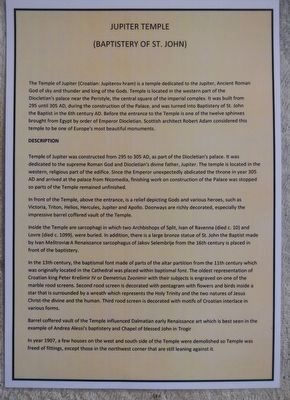
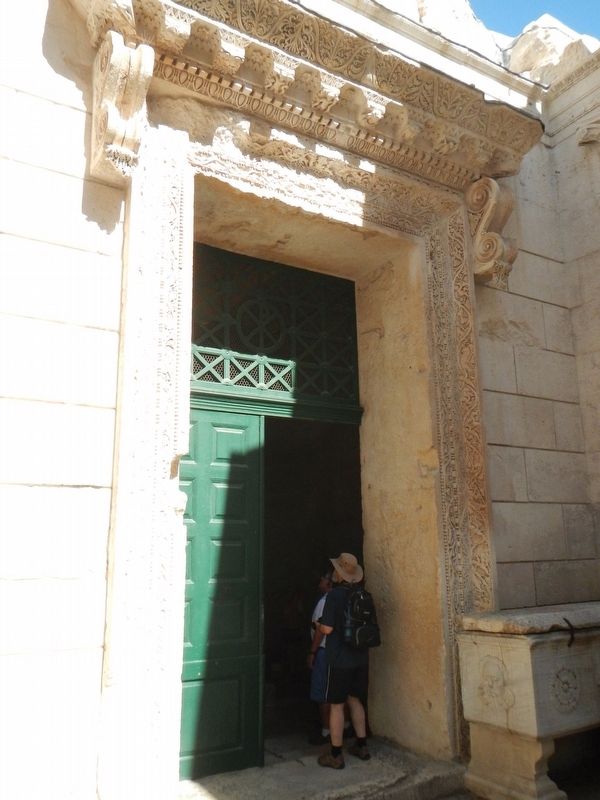
Temple of Jupiter was constructed from 295 to 305 AD, as part of the Diocletian's palace. It was dedicated to the supreme Roman God and Diocletian's divine father, Jupiter. The temple is located in the western, religious part of the edifice. Since the Emperor unexpectedly abdicated the throne in year 305 AD and arrived at the palace from Nicomedia, finishing work on construction of the Palace was stopped so parts of the Temple remained unfinished.
In front of the Temple,
this page online
Inside the Temple are sarcophagi in which two Archbishops of Split, Ivan of Ravenna (died c. 10) and Lovre (died c. 1099), were buried. In addition, there is a large bronze statue of St. John the Baptist made by Ivan Maštroviae A Renaissance sarcophagus of Jakov Selembrije from the 16th is placed in front of the baptistry.
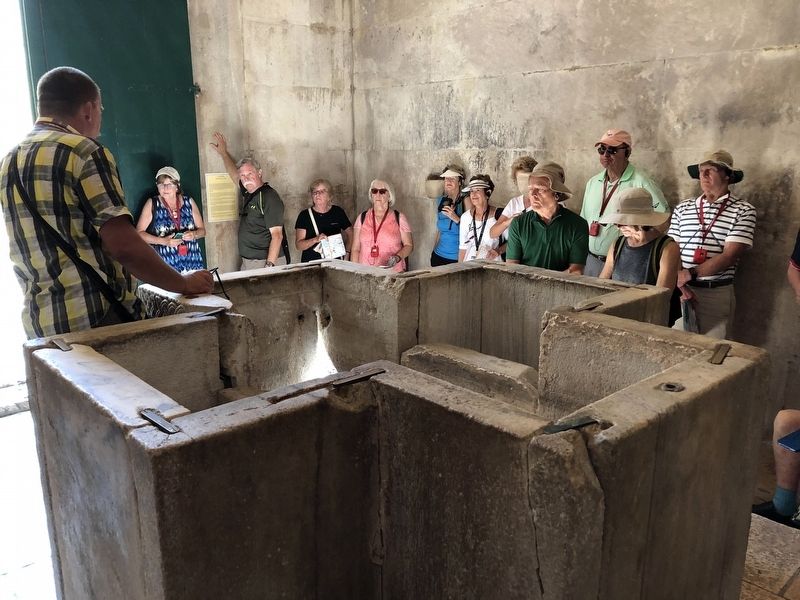
In the 13th century, the baptismal font made of parts of the altar partition from the 11th century which originally located in the Cathedral was place within the within the baptismal font. The oldest representation of Croatian king Peter Krešimir IV or Demetrius Zvonimir with their subjects is engraved on one of the marble rood screens. Second rood screen is decorated with pentagram with flowers and birds inside a star that is surrounded by a wreath which represents the Holy Trinity and the two natures of Jesus Christ-the divine and the human. Third rood screen is decorated with motifs of
Photographed by Barry Swackhamer, July 29, 2018
2. Entrance to the Jupiter Temple
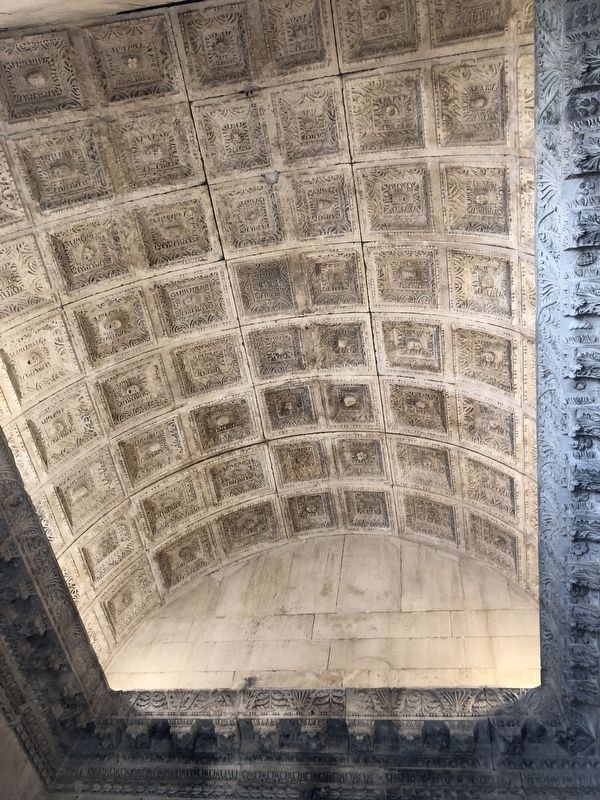
Barrel coffered vault of the Temple influenced Dalmatian early Renaissance art which is best seen in the examples of Andrea Alessi's baptistery and Chapel of blessed John in Trogir.
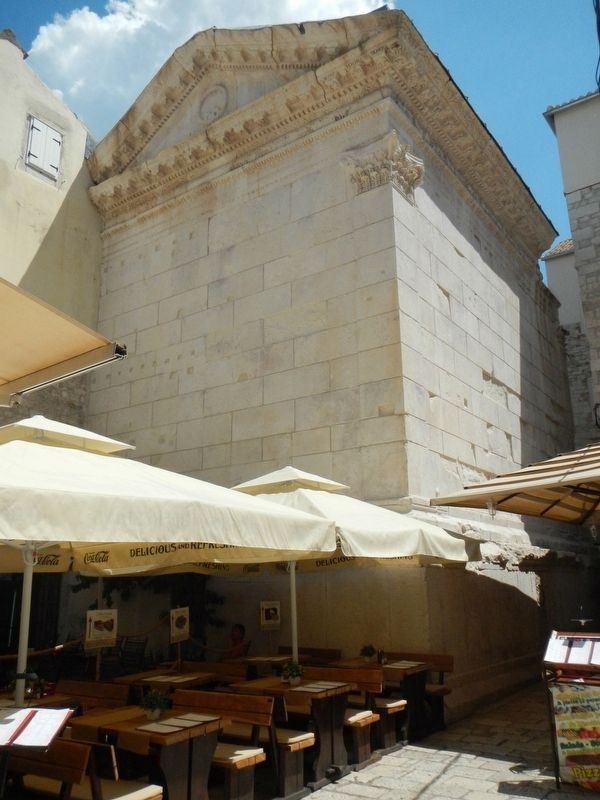
In year 1907, a few houses of the west and south side of the Temple were demolished so Temple was freed of fittings, except those in the northwest corner that are still leaning against it.
Topics. This historical marker is listed in these topic lists: Architecture • Religion & Religious Structures.
Location. 43° 30.499′ N, 16° 26.379′ E. Marker is in Split, Splitsko-dalmatinska (Split-Dalmatia), in Opcina Split. It can be reached from Ulica Kraj Svetog Ivana close to Adamova Ulica. Touch for map. Marker is at or near this postal address: Ulica Kraj Svetog Ivana 1, Split, Splitsko-dalmatinska 21000, Croatia. Touch for directions.

Regionally, it is in Europe, the European Union, the Balkans, the Schengen Area, a coastal Mediterranean country, and the Western World. Historically, it finds itself in what was once the Byzantine Empire, the Ottoman Empire,
Photographed by Barry Swackhamer, July 29, 2018
3. Ancient Graffiti
Other nearby markers. At least 8 other markers are within walking distance of this marker: Hramovi (a few steps from this marker); Church of Our Lady of the Bell Tower and the municipal clock (within shouting distance of this marker); The Iron Gate Palace (within shouting distance of this marker); The Grisogono Palace (within shouting distance of this marker); The Augubio Palace (within shouting distance of this marker); Diocletian's Mausoleum / Cathedral of St. Dujam (within shouting distance of this marker); The Church of St Roche (within shouting distance of this marker); The Ciprianis-Benedetti Palace (within shouting distance of this marker). Touch for a list and map of all markers in Split.
More about this marker. The Jupiter Temple is inside Diocletian's Palace. Only foot traffic is allowed on the grounds.
Photographed by Barry Swackhamer, July 29, 2018
4. Baptismal Font
Photographed by Barry Swackhamer, July 29, 2018
5. Barrel Vault
Photographed by Barry Swackhamer, July 29, 2018
6. The back of the Jupiter Temple
Credits. This page was last revised on January 10, 2024. It was originally submitted on December 13, 2018, by Barry Swackhamer of Brentwood, California. This page has been viewed 696 times since then and 115 times this year. Photos: 1, 2, 3, 4, 5, 6. submitted on December 13, 2018, by Barry Swackhamer of Brentwood, California.
