Jamaica in Queens in Queens County, New York — The American Northeast (Mid-Atlantic)
The Old Stone Church
Photographed by Andrew Ruppenstein, February 21, 2017
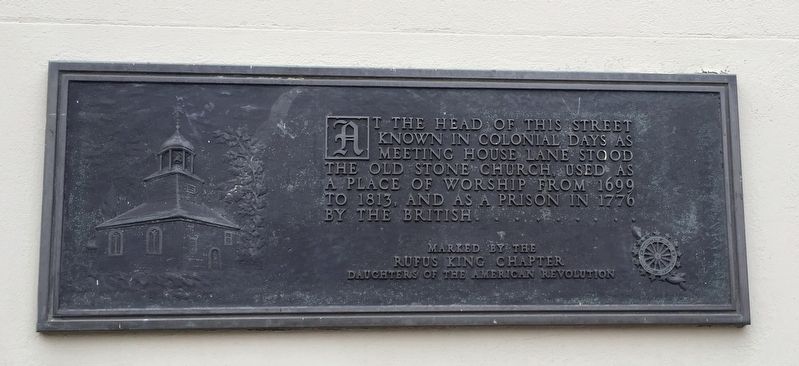
1. The Old Stone Church Marker
Inscription.
At the head of this street known in colonial days as Meeting House Lane stood the Old Stone Church, used as a place of worship from 1699 to 1813, and as a prison in 1776 by the British.
Erected by Daughters of the American Revolution Rufus King Chapter.
Location. 40° 42.241′ N, 73° 47.875′ W. Marker is in Queens, New York, in Queens County. It is in Jamaica. It is at the intersection of Union Hall Street and Jamaica Avenue, on the right when traveling north on Union Hall Street. Touch for map. Marker is in this post office area: Jamaica NY 11432, United States of America. Touch for directions.
Regionally, this marker is in New York City and on Long Island. It is also in the American Northeast, in the Mid-Atlantic, and on the Eastern Seaboard. Globally, it is in the North Atlantic Region, North America, the Western
Click or scan to see this page online
Hemisphere, the Western World, and the Anglosphere. Historically, it finds itself in what was once New Netherland and also one of the original Thirteen Colonies.
Another marker is no longer nearby. Jamaica Center Sidewalk Clock (was here, next to this marker but has been replaced with another marker now near it).
Also see . . . Sidewalk clock on Jamaica Avenue (Wikipedia). "The village of Jamaica, settled by a band of English people, was granted a charter for “Rustdorp” by Governor Stuyvesant
Photographed by Andrew Ruppenstein, February 21, 2017
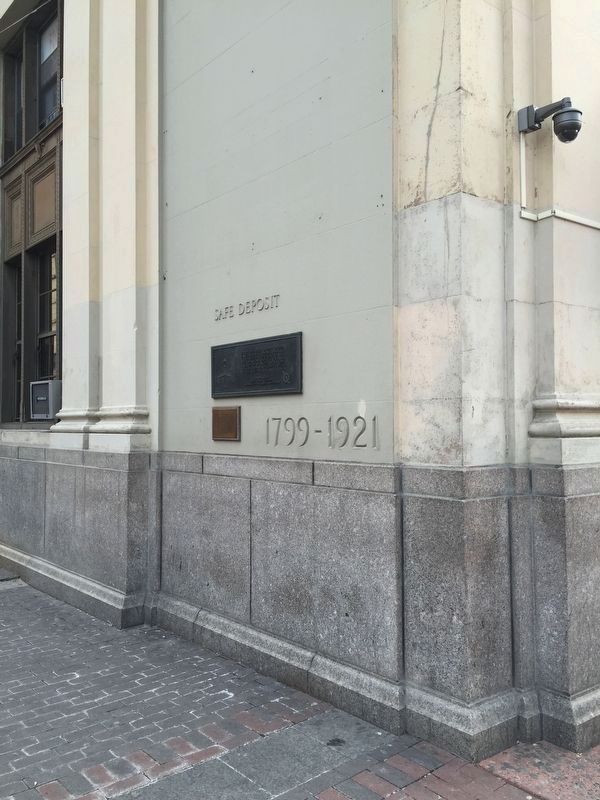
2. The Old Stone Church and Jamaica Center Sidewal Clock Markers
Oddly, the "1799-1921" date corresponds to nothing on either marker, and there is no further explanation of those dates nearby.
in 1656. Six years later, about 25 families of these settlers joined together to make this church. At a town meeting the same year it was voted to build a parsonage, 26 ft. long and 17 ft. wide, a large house for the time and place, the whole town being assessed for the cost. This parsonage served as the house for a few years until the town church was built in the last decade of the 17th century. The new meeting house was variously called : “The Town Church,” “The Stone Church” and “The Church.” It stood on the main street of the village not far from the present corner of Fulton Street and New York Avenue (Guy Brewer) at the head of Meeting House Lane (Union Hall St.)...It was used by all congregations for worship, as a town hall and as a court house for many years. For most of the 18th century the “Old Trail” along Jamaica avenue would make this area a trading post for farmers and their produce, with horse-drawn carts found up and down “Kings Highway”....When Lord Cornbury became governor, he placed the church and the parsonage at the disposal of the congregation of the Church
Photographed by Andrew Ruppenstein, February 21, 2017
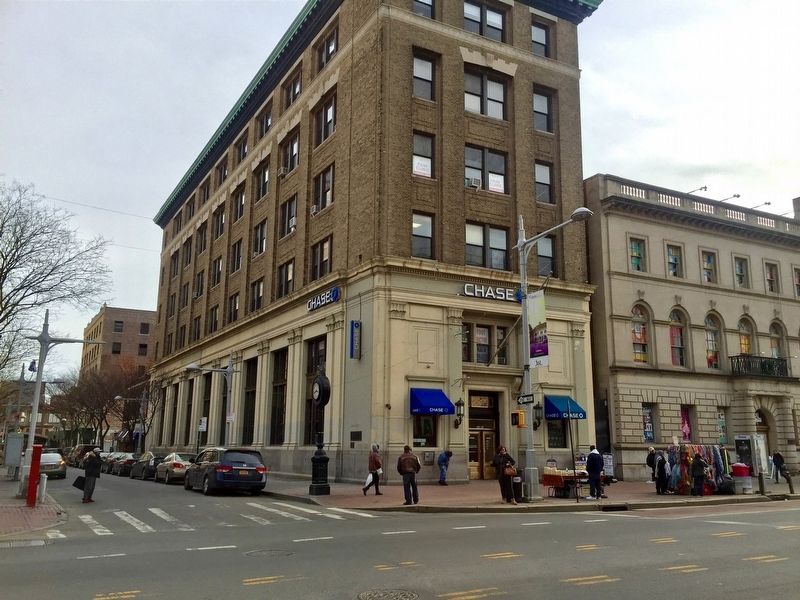
3. The Old Stone Church Marker - wide view
Visible here on the corner of the building.
of England on the grounds that the building had been paid for by public taxation. The Episcopalians then refused the other congregations the use of it. Whereupon, the Presbyterians brought suit and recovered both the parsonage and the church, which they continued to use until the new building was built in 1813. In the foundations of this building on 163rd st are some of the stones of the old church." (Submitted on December 14, 2018.)
Credits. This page was last revised on January 31, 2023. It was originally submitted on December 14, 2018, by Andrew Ruppenstein of Lamorinda, California. This page has been viewed 902 times since then and 71 times this year. Photos:1, 2, 3. submitted on December 14, 2018, by Andrew Ruppenstein of Lamorinda, California.