Inverness in Highland, Scotland, United Kingdom — Northwestern Europe (the British Isles)
Academy of Applied Science
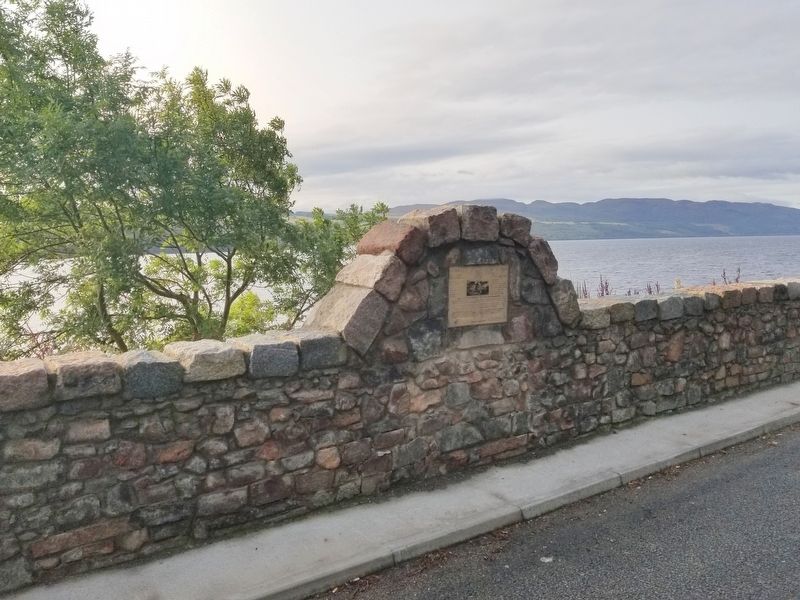
Photographed by Michael Herrick, August 27, 2018
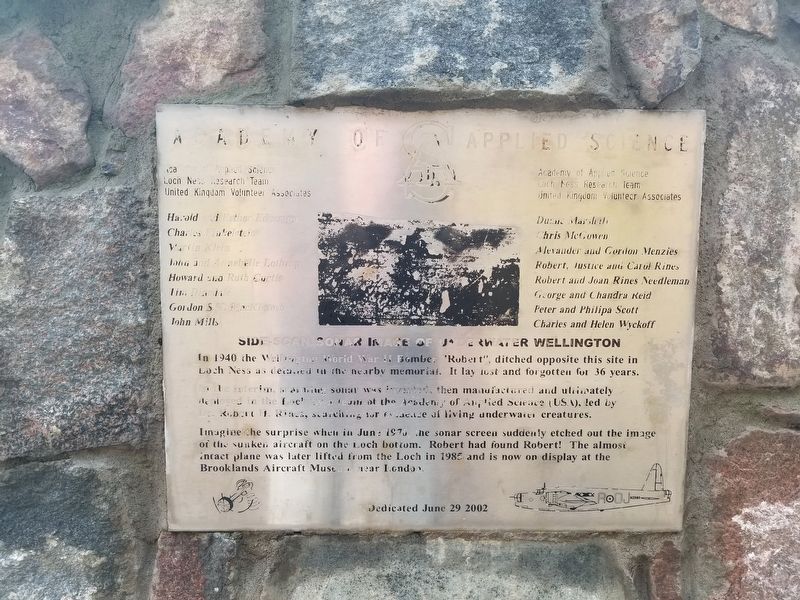
1. Academy of Applied Science Marker
Inscription.
Academy of Applied Science. .
Academy of Applied Science Academy of Applied Science Loch Ness Research Team United Kingdom Volunteer Associates. Harold and Esther Edgerton · Charles Finkelstein · Martin Klein · John and Annabelle Lothrop · Howard and Ruth Curtis · Tim Dinsdale · Gordon S.K. Mackintosh · John Mills · Duane Marshall · Chris McGowen · Alexander and Gordon Menzies · Robert, Justice and Carol Rines · Robert and Joan Rines Needleman · George and Sandra Reid · Peter and Philipa Scott · Charles and Helen Wyckoff
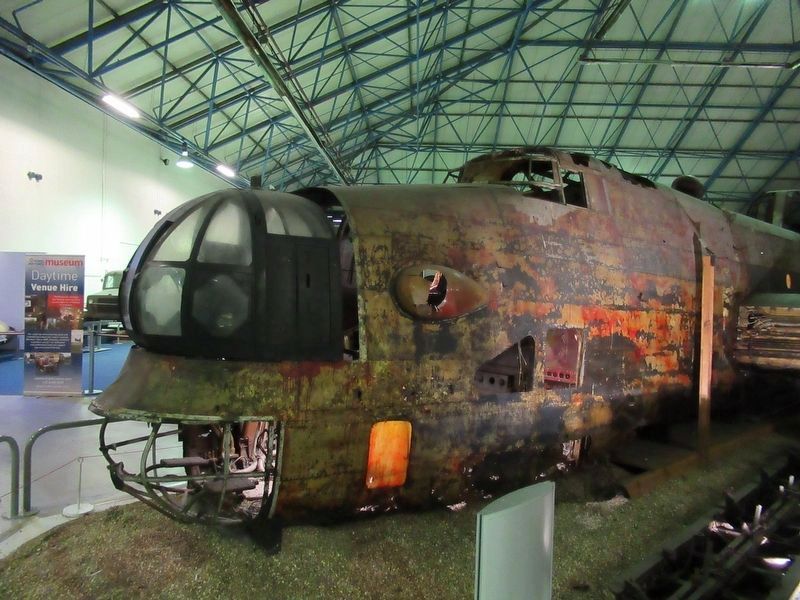
Side-scan Sonar Image of Underwater Wellington. In 1940 the Wellington World War II Bomber "Robert" ditched opposite this site in Loch Ness as detailed in the nearby memorial. It lay lost and forgotten for 36 years. In the interim, scanning sonar was invented, then manufactured and ultimately deployed in the Loch by a team of the Academy of Applied Science (USA), led by Dr. Robert H. Rines, searching for evidence of living underwater creatures. , Imagine the surprise when in June 1976, the sonar screen suddenly etched out the image of the sunken aircraft on the Loch bottom. Robert had found Robert! The almost intact plane was later lifted from the Loch in 1985 and is now on display at the Brooklands Aircraft Museum near London.
Dedicated June 29 2002.
Academy of Applied Science
Loch Ness Research Team
United Kingdom Volunteer Associates
Harold and Esther Edgerton · Charles Finkelstein · Martin Klein · John and Annabelle Lothrop · Howard and Ruth Curtis · Tim Dinsdale · Gordon S.K. Mackintosh · John Mills · Duane Marshall · Chris McGowen · Alexander and Gordon Menzies · Robert, Justice and Carol Rines · Robert and Joan Rines Needleman · George and Sandra Reid · Peter and Philipa Scott · Charles and Helen Wyckoff
Side-scan Sonar Image of Underwater Wellington
In 1940 the Wellington World War II Bomber "Robert" ditched opposite this site in Loch Ness as detailed in the nearby memorial. It lay lost and forgotten for 36 years. In the interim, scanning sonar was invented, then manufactured and ultimately deployed in the Loch by a team of the Academy of Applied Science (USA), led by Dr. Robert H. Rines, searching for evidence of living underwater creatures.
Imagine the surprise when in June 1976, the sonar screen suddenly etched out the image of the sunken aircraft on the Loch bottom. Robert had found Robert! The almost intact plane was
Click or scan to see this page online
later lifted from the Loch in 1985 and is now on display at the Brooklands Aircraft Museum near London.
Dedicated June 29 2002
Erected 2002.
Topics. This historical marker is listed in this topic list: Air & Space. A significant historical month for this entry is June 1976.
Location. 57° 23.87′ N, 4° 21.332′ W. Marker is in Inverness, Scotland, in Highland. It is on Scotland Route A82 10.1 kilometers south of General Booth Road, on the left when traveling south. Touch for map. Marker is in this post office area: Inverness, Scotland IV3 8LA, United Kingdom. Touch for directions.

Regionally, this marker is in Scotland’s Highlands. Globally, it is on the Atlantic Ocean, in the North Atlantic Region, on the Atlantic Arc, in Europe, on the Celtic Fringe, in Atlantic Europe, on one of the British Isles, in the Western World, and in the Anglosphere.
Other nearby markers. At least 8 other markers are within 10 kilometers of this marker, measured as the crow flies: The Majesty of Loch Ness (a few steps from this marker); The Magic of Loch Ness (within shouting distance of this marker); One of Our Aircraft (within shouting
The aircraft is now on display at the RAF Hendon Museum.
Credits. This page was last revised on January 27, 2022. It was originally submitted on December 14, 2018, by Michael Herrick of Southbury, Connecticut. This page has been viewed 198 times since then and 13 times this year. Photos:1, 2, 3. submitted on December 14, 2018, by Michael Herrick of Southbury, Connecticut.