Split in Opcina Split, Split-Dalmatia, Croatia — Central and Southeastern Europe
The Augubio Palace
Palača Augubio
Photographed by Barry Swackhamer, July 29, 2018
1. The Augubio Palace Marker
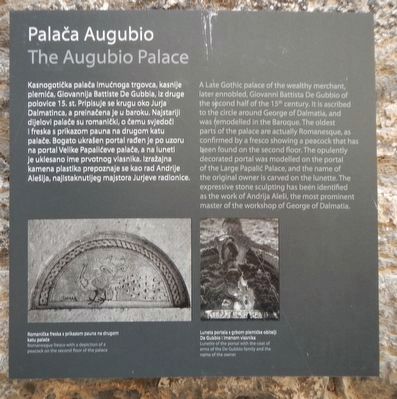
Captions: (left) Romanesque fresco with a depiction of a peacock on the second floor of the palace; (right) Lunette of the portal with the coat of arms of the De Gubbio family and the name of the owner.
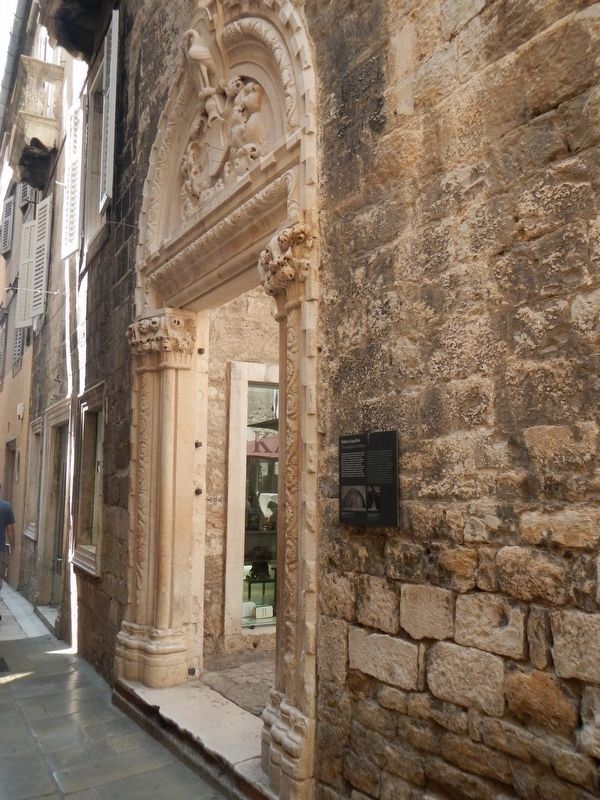
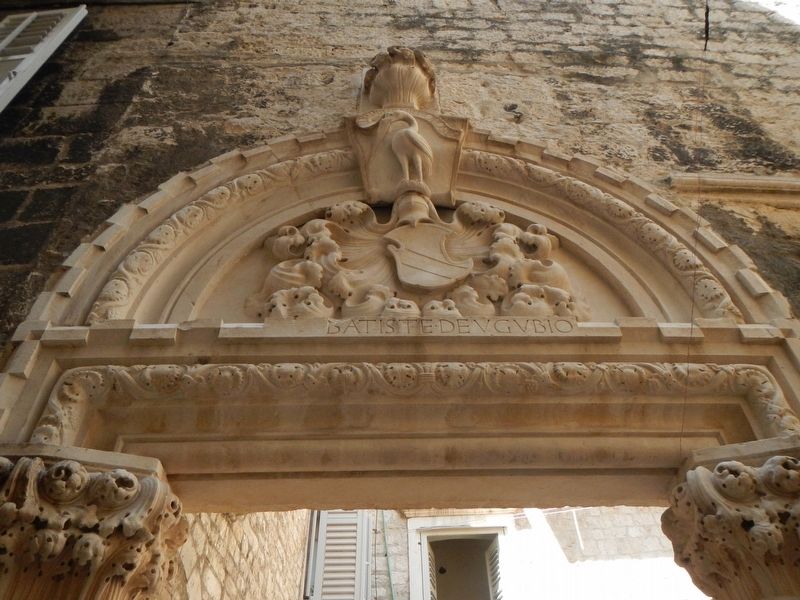
A Late Gothic palace of the wealthy merchant, later ennobled, Giovanni Battista De Gubbio of the second half of the 15th century. It is ascribed to the circle around George of Dalmatia, and was remodeled in the Baroque. The oldest parts of the palace are actually Romanesque, as confirmed by a fresco showing a peacock that has been found on the second floor. The opulently decorated portal was modelled (sic) on the portal of the Large Papalić Palace, and the name of the original owner is carved on the lunette. The expressive stone sculpting had been identified as the work of Andrija Aleši, the most prominent master of the workshop of George of Dalmatia.
Topics. This historical marker is listed in these topic lists: Architecture • Notable Buildings.
Location. 43° 30.506′ N, 16° 26.41′ E. Marker is in Split, Splitsko-dalmatinska (Split-Dalmatia), in Opcina Split. It is on Ulica kralja Petra Krešimira IV close to Try Peristil,
this page online

Regionally, it is in Europe, the European Union, the Balkans, the Schengen Area, a coastal Mediterranean country, and the Western World. Historically, it finds itself in what was once the Byzantine Empire, the Ottoman Empire, and specifically the Roman Empire.
Other nearby markers. At least 8 other markers are within walking distance of this marker: The Grisogono Palace (here, next to this marker); The Church of St Roche (a few steps from this marker); Diocletian's Mausoleum / Cathedral of St. Dujam (within shouting distance of this marker); Jupiter Temple (within shouting distance of this marker); The Dragišić (De Caris) Palace (within shouting distance of this marker); Church of Our Lady of the Bell Tower and the municipal clock (within shouting distance of this marker); The Iron Gate Palace (within shouting distance of this marker); Hramovi (within shouting distance of this marker). Touch for a list and map of all markers
Photographed by Barry Swackhamer, July 29, 2018
2. The entrance to Augubio Palace and Marker
More about this marker. Only foot traffic is allowed inside Diocletian's Palace
Also see . . . Giorgio da Sebenico -- Wikipedia. His work represents the golden age of Dalmatian medieval art. He was one of main artists of the Adriatic Renaissance, a tendency widespread during the late 15th century in Venice, Dalmatia and in some locations of the Italian Adriatic Coast, such as Ancona. (Submitted on December 19, 2018, by Barry Swackhamer of Brentwood, California.)
Photographed by Barry Swackhamer, July 29, 2018
3. The Work of Andrija Aleši
Photographed by Barry Swackhamer, July 29, 2018
4. The Augubio Palace
Credits. This page was last revised on February 10, 2022. It was originally submitted on December 19, 2018, by Barry Swackhamer of Brentwood, California. This page has been viewed 430 times since then and 42 times this year. Photos: 1, 2, 3, 4. submitted on December 19, 2018, by Barry Swackhamer of Brentwood, California.
