
Lairg in Highland, Scotland, United Kingdom — Northwestern Europe (the British Isles)
Ceannabeinne Township Trail
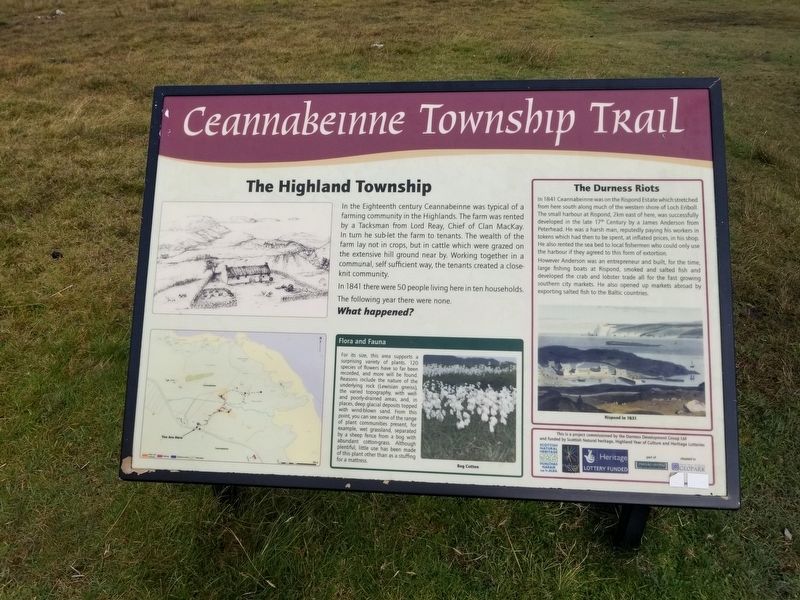
Photographed by Michael Herrick, August 30, 2018
1. Ceannabeinne Township Trail Marker
The Highland Township
What happened?
Flora and Fauna
For its size, this area supports a surprising variety of plants. 120 species of flowers have so far been recorded, and more will be found. Reasons include the nature of the underlying rock (Lewisian gneiss), the varied topography, with well- and poorly-drained areas, and, in places, deep glacial deposits topped with wind-blown sand. From this point, you can see some of the range of plant communities present, for example, wet grassland, separated by a sheep fence from a bog with abundant cotton-grass. Although plentiful, little use
this page online
The Durness Riots
In 1841 Ceannabeinne was on the Rispond Estate which stretched from here south along much of the western shore of Loch Eriboll. The small harbour at Rispond, 2km east of here, was successfully developed in the late 17th Century by a James Anderson from Peterhead. He was a harsh man, reputedly paying his workers in tokens which had then to be spent, at inflated prices, in his shop. He also rented the sea bed to local fishermen who could only use the harbour if they agreed to this form of extortion. However Anderson was an entrepreneur and built, for the time, large fishing boats at Rispond, smoked and salted fish and developed the crab and lobster trade all for the fast growing southern city markets. He also opened up markets abroad by exporting salted fish to the Baltic countries.
Erected by Durness Development Group.
Topics. This historical marker is listed in this topic list: Settlements & Settlers. A significant historical year for this entry is 1841.
Location. 58° 33.103′ N, 4° 41.305′ W. Marker is in Lairg, Scotland, in Highland. It is
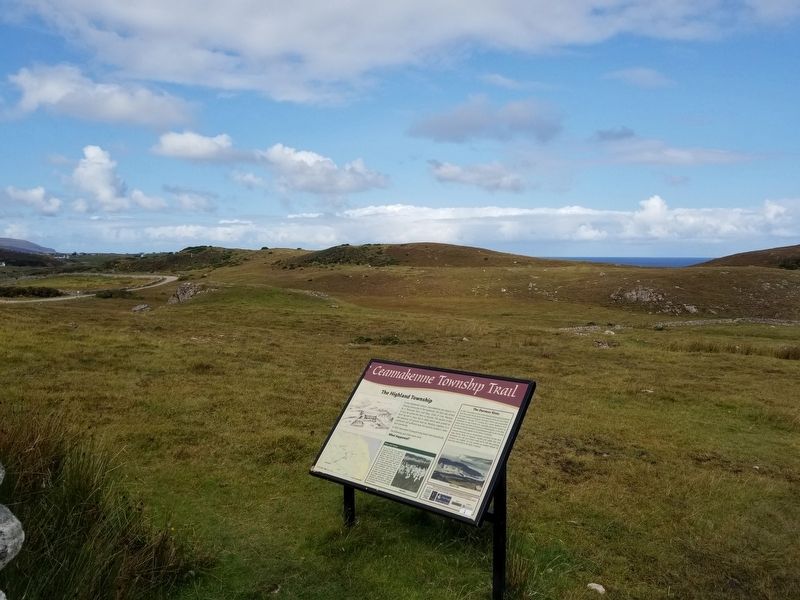
Photographed by Michael Herrick, August 30, 2018
2. Ceannabeinne Township Trail Marker

Regionally, this marker is in Scotland’s Highlands. Globally, it is on the Atlantic Ocean, in the North Atlantic Region, on the Atlantic Arc, in Europe, on the Celtic Fringe, in Atlantic Europe, on one of the British Isles, in the Western World, and in the Anglosphere.
Other nearby markers. At least 7 other markers are within 14 kilometers of this marker, measured as the crow flies: A different marker also named Ceannabeinne Township Trail (a few steps from this marker); Ceannabeinne (approx. 0.8 kilometers away); Durness War Memorial (approx. 3.9 kilometers away); Durness (approx. 3.9 kilometers away); Stories in sand (approx. 5.2 kilometers away); Keoldale Green (approx. 5.2 kilometers away); Mark of Gratitude (approx. 14.1 kilometers away).
Also see . . .
1. Ceannabeinne on Wikipedia. (Submitted on December 26, 2018, by Michael Herrick of Southbury, Connecticut.)
2. Highland Clearances on Wikipedia. (Submitted on December 26, 2018, by Michael Herrick of Southbury, Connecticut.)
Credits. This page was last revised on January 27, 2022. It was originally submitted on December 26, 2018, by Michael Herrick of Southbury, Connecticut. This page has been viewed 455 times since then and 41 times this year. Photos: 1, 2. submitted on December 26, 2018, by Michael Herrick of Southbury, Connecticut.
