
Scranton in Lackawanna County, Pennsylvania — The American Northeast (Mid-Atlantic)
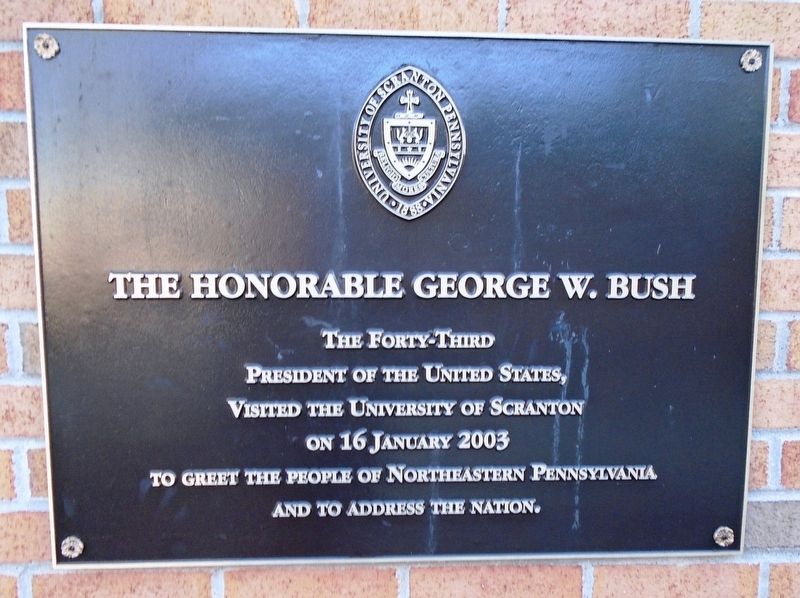
The Honorable George W. Bush
Photographed by William Fischer, Jr., December 27, 2018
1. The Honorable George W. Bush Marker
President of the United States,
Visited the University of Scranton
on 16 January 2003
to greet the people of
Northeastern Pennsylvania
and to address the nation.
Erected by University of Scranton.
Topics and series. This historical marker is listed in these topic lists: Education • Government & Politics. In addition, it is included in the Former U.S. Presidents: #43 George W. Bush series list. A significant historical date for this entry is January 16, 2003.
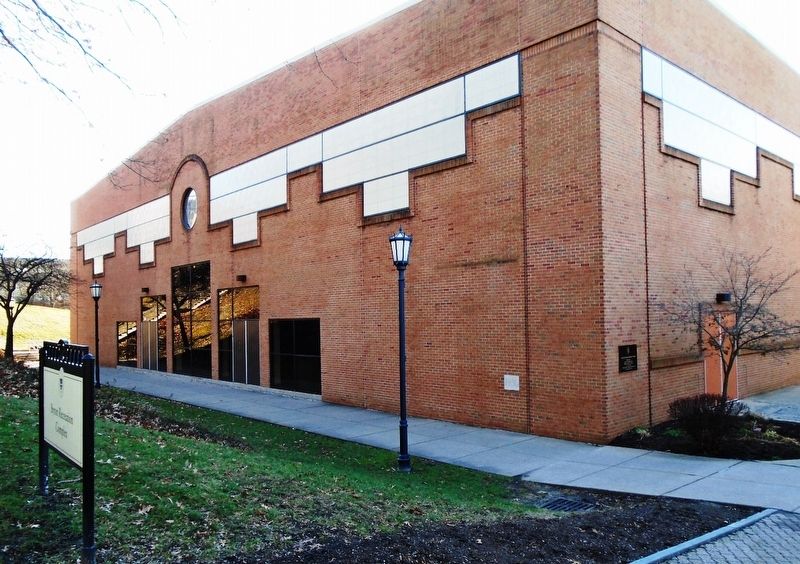
Location. 41° 24.309′ N, 75° 39.361′ W. Marker is in Scranton, Pennsylvania, in Lackawanna County. It can be reached from Linden Street. Marker is on the Byron Recreation Complex building, along The Commons walkway on the University of Scranton campus. Touch for map. Marker is in this post office area: Scranton PA 18510, United States of America. Touch for directions.

Regionally, this marker is in Pennsylvania’s Wyoming Valley. It is also in the American Northeast, in the Mid-Atlantic, in Appalachia, and specifically in Northern Appalachia. Globally, it is in North America, the Western Hemisphere, the Western World, and the Anglosphere.
this page online
Other nearby markers. At least 8 other markers are within walking distance of this marker: Jacob and the Angel (within shouting distance of this marker); Inigo Becomes St. Ignatius - 1491-1556 (within shouting distance of this marker); Catherine Manley Coffey (about 300 feet away, measured in a direct line); St. Thomas College "Old Main" Cornerstone (about 500 feet away); George H. Catlin Memorial House (about 600 feet away); William W. Scranton (about 600 feet away); Martyrs' Grove (approx. 0.2 miles away); Houlihan - McLean Center (approx. ¼ mile away). Touch for a list and map of all markers in Scranton.
Also see . . . President Bush Speaks to the Nation from the University. (Submitted on January 2, 2019, by William Fischer, Jr. of Reynoldsburg, Ohio.)
Photographed by William Fischer, Jr., December 27, 2018
2. The Honorable George W. Bush Marker on the Byron Recreation Complex
Photographed by Robert Anderson
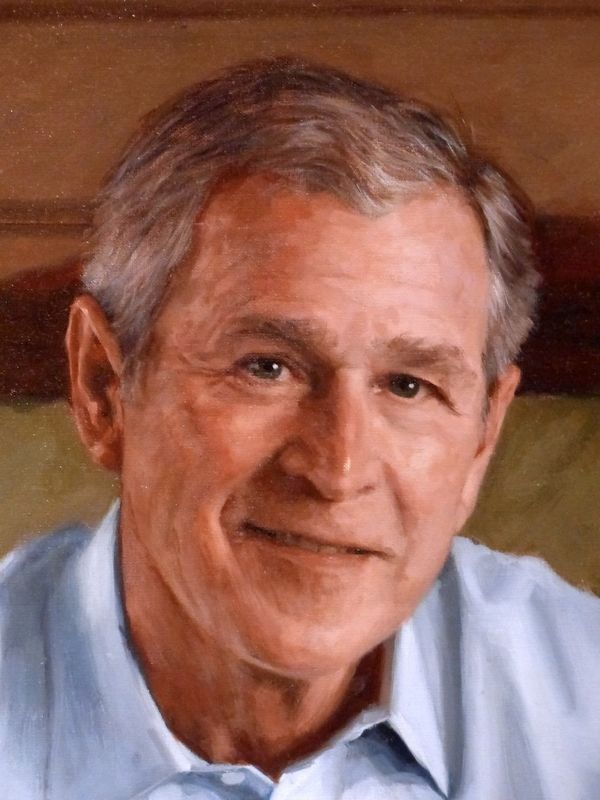
3. George W. Bush
This 2008 portrait of George W. Bush by Robert Anderson hangs in the National Portrait Gallery in Washington, DC.
“‘The biggest advantage and the biggest handicap I have,’ George W. Bush frankly admitted, ‘is my name.’ The grandson of a United States senator and the eldest son of a president, Bush was a popular governor of Texas who worked successfully with both Republicans and Democrats. In 2000, in an election so close that it required the intervention of the Supreme Court, Bush defeated Al Gore, the vice president during the previous administration. Expecting that the success of his presidency would hinge, as it had when he was governor, on his negotiating skills and ability to solve problems, Bush found his two terms in office instead marked by a series of cataclysmic events: the attacks on September 11, 2001; the wars in Afghanistan and Iraq; the devastation wrought by Hurricane Katrina; and a financial crisis during his last months in office.
The White House selected Robert Anderson, a Connecticut portraitist and a Yale classmate of the president, to create this painting for the National Portrait Gallery.’ – National Portrait Gallery
“‘The biggest advantage and the biggest handicap I have,’ George W. Bush frankly admitted, ‘is my name.’ The grandson of a United States senator and the eldest son of a president, Bush was a popular governor of Texas who worked successfully with both Republicans and Democrats. In 2000, in an election so close that it required the intervention of the Supreme Court, Bush defeated Al Gore, the vice president during the previous administration. Expecting that the success of his presidency would hinge, as it had when he was governor, on his negotiating skills and ability to solve problems, Bush found his two terms in office instead marked by a series of cataclysmic events: the attacks on September 11, 2001; the wars in Afghanistan and Iraq; the devastation wrought by Hurricane Katrina; and a financial crisis during his last months in office.
The White House selected Robert Anderson, a Connecticut portraitist and a Yale classmate of the president, to create this painting for the National Portrait Gallery.’ – National Portrait Gallery
Credits. This page was last revised on January 2, 2019. It was originally submitted on January 2, 2019, by William Fischer, Jr. of Reynoldsburg, Ohio. This page has been viewed 391 times since then and 17 times this year. Photos: 1, 2. submitted on January 2, 2019, by William Fischer, Jr. of Reynoldsburg, Ohio. 3. submitted on January 2, 2019, by Allen C. Browne of Silver Spring, Maryland.
