Edwards AFB in Kern County, California — The American West (Pacific Coastal)
Lockheed SR-71A Blackbird
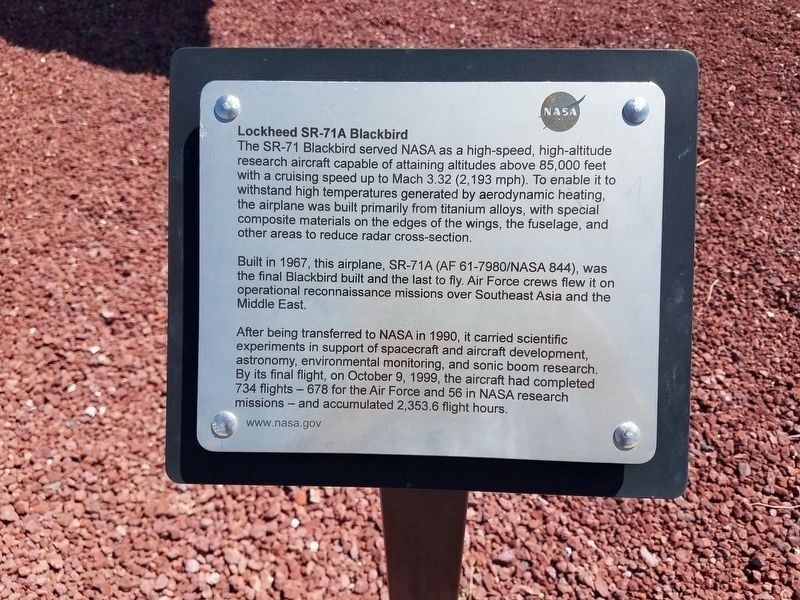
Photographed by Denise Boose, August 8, 2018
1. Lockheed SR-71A Blackbird Marker
The SR-71 Blackbird served NASA as a high-speed, high-altitude research aircraft capable of attaining altitudes above 85,000 feet with a cruising speed up to Mach 3.32 (2,193 mph). To enable it to withstand high temperatures generated by aerodynamic heating, the airplane was built primarily from titanium alloys, with special composite materials on the edges of the wings, the fuselage, and other areas to reduce radar cross-section.
Built in 1967, this airplane, SR-71A (AF 61-7980/NASA 844), was the final Blackbird built and the last to fly. Air Force crews flew it on operational reconnaissance missions over Southeast Asia and the Middle East.
After being transferred to NASA in 1990, it carried scientific experiments in support of spacecraft and aircraft development, astronomy, environmental monitoring, and sonic boom research. By its final flight, on October 9, 1999, the aircraft had completed 734 flights – 678 for the Air Force and 56 in NASA research missions – and accumulated 2,353.6 flight hours.
J58 Engine
The SR-71 was powered by two Pratt & Whitney J58 turbojet engines. Built to operate at cruising
this page online
Each engine provided 32,500 pounds of thrust. A variable geometry inlet diffuser and a complex bleed bypass system allowed for high efficiency in the Mach 2.0-3.2 flight regime. By controlling the location of the shockwave inside the inlet and allowing air to bypass the turbine section and go directly to the afterburner, the J58 could be operated as turbo-ramjet. During cruise, parts of the engine reached temperatures as high as 3,200 degrees Fahrenheit.
Erected by NASA Neil A. Armstrong Flight Research Center.
Topics. This historical marker is listed in this topic list: Air & Space. A significant historical date for this entry is October 9, 1999.
Location. 34° 57.142′ N, 117° 53.333′ W. Marker is in Edwards AFB, California, in Kern County. It is at the intersection of Lilly Avenue and Walker Avenue, on the left when traveling south on
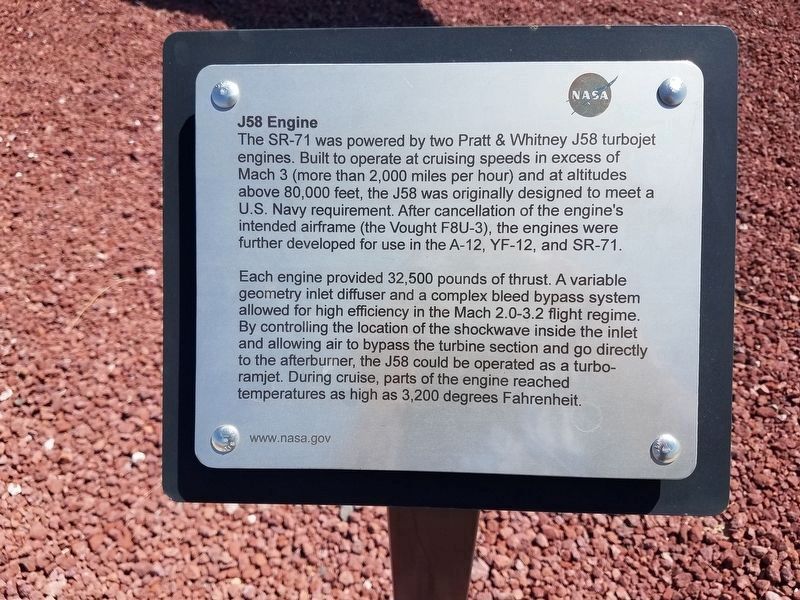
Photographed by Denise Boose, August 8, 2018
2. J58 Engine Marker

Regionally, this marker is in the San Joaquin Valley, specifically in the Central Valley, in the Mojave Desert, and in the Sierra Nevada. It is also on the American Pacific Coast. Globally, it is in North America, on the Ring of Fire, on the Pacific Rim, in the Western Hemisphere, in the Western World, and in the Anglosphere. Historically, it finds itself in what was once New Spain and also Mexico’s Alta California.
Other nearby markers. At least 8 other markers are within walking distance of this marker: X-29 (within shouting distance of this marker); Lockheed F-104 (within shouting distance of this marker); NF-15B (within shouting distance of this marker); F-8 DFBW (within shouting distance of this marker); F-8 Digital Fly-By-Wire Aircraft (within shouting distance of this marker); F-8 Supercritical Wing Aircraft (within shouting distance of this marker); HL-10 Lifting Body
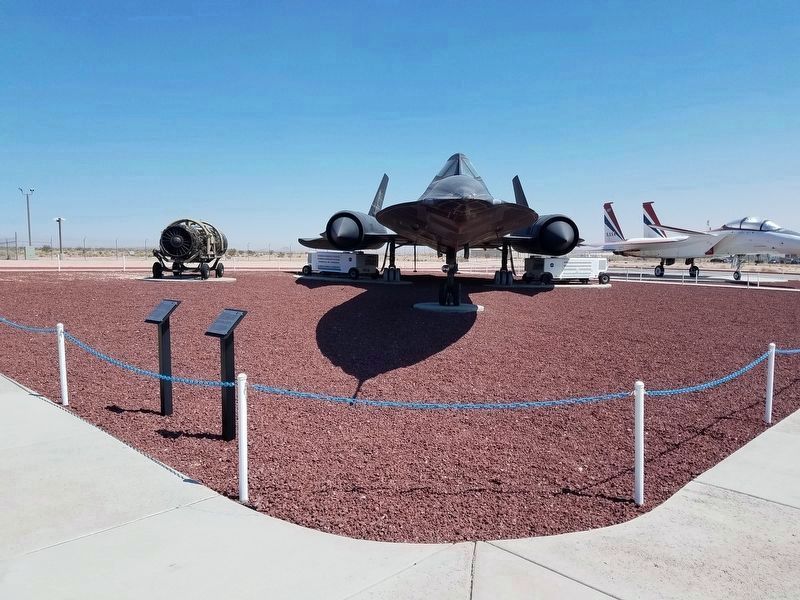
Photographed by Denise Boose, August 8, 2018
3. Lockheed SR-71A Blackbird and Markers
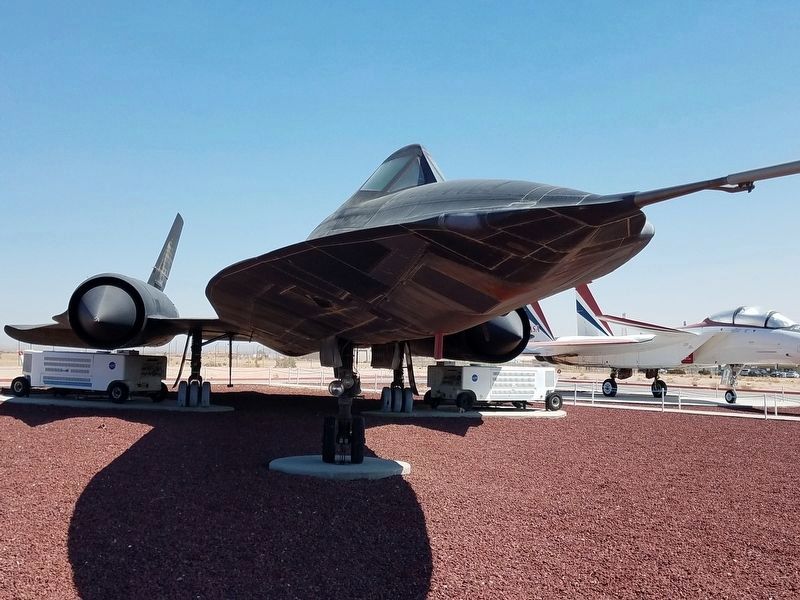
Photographed by Denise Boose, August 8, 2018
4. Lockheed SR-71A Blackbird
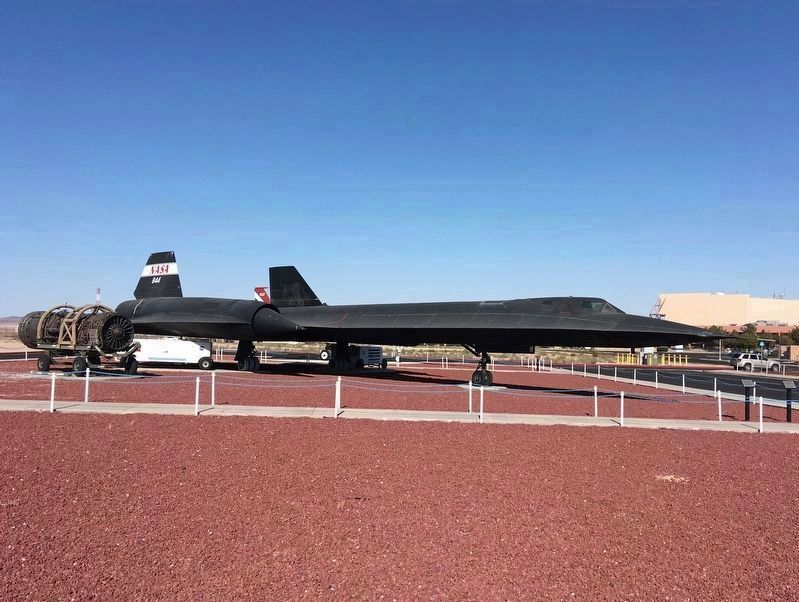
Photographed by Craig Baker, September 20, 2019
5. Lockheed SR-71A Blackbird and Markers
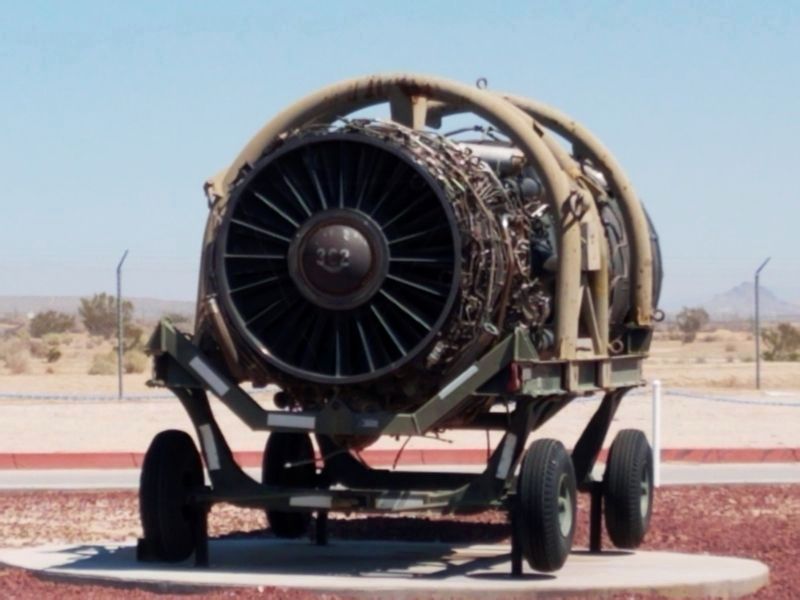
Photographed by Denise Boose, August 8, 2018
6. J58 Engine
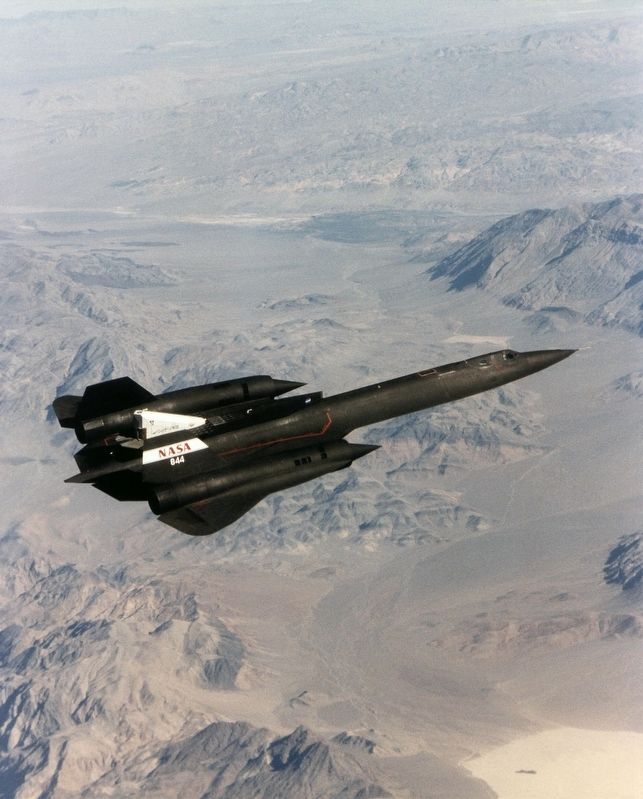
courtesy NASA
7. Lockheed SR-71A Blackbird #844
Credits. This page was last revised on February 22, 2026. It was originally submitted on August 11, 2018, by Denise Boose of Tehachapi, California. This page has been viewed 732 times since then and 90 times this year. Last updated on January 6, 2019, by Craig Baker of Sylmar, California. Photos: 1, 2, 3, 4. submitted on August 11, 2018, by Denise Boose of Tehachapi, California. 5. submitted on September 22, 2019, by Craig Baker of Sylmar, California. 6, 7. submitted on August 11, 2018, by Denise Boose of Tehachapi, California. • Andrew Ruppenstein was the editor who published this page.
