F.A.M.U. in Tallahassee in Leon County, Florida — The American South (South Atlantic)
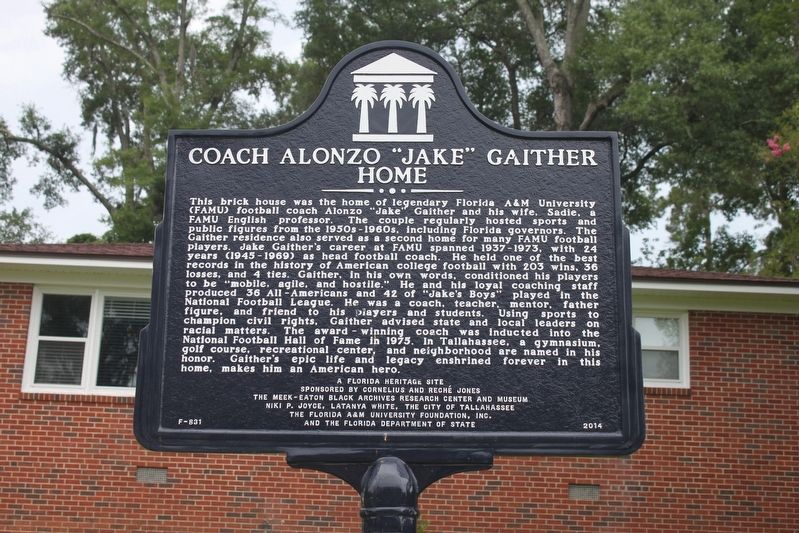
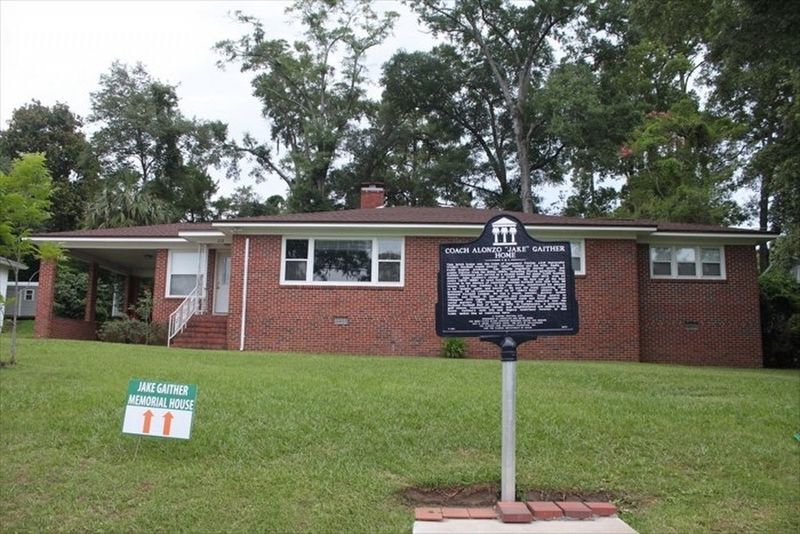
Coach Alonzo "Jake" Gaither Home
Photographed by Tim Fillmon, June 16, 2016
1. Coach Alonzo "Jake" Gaither Home Marker
this page online
Erected 2014 by Cornelius and Reche Jones, The Meek-Eaton Black Archives Research Center and Museum, Niki P. Joyce, Latanya White, The City of Tallahassee, The Florida A&M University Foundation, Inc. and the Florida Department of State. (Marker Number F-831.)
Topics and series. This historical marker is listed in these topic lists: African Americans • Education • Sports. In addition, it is included in the Historically Black Colleges and Universities series list.
Location. 30° 25.365′ N, 84° 17.011′ W. Marker is in Tallahassee, Florida, in Leon County. It is in F.A.M.U.. It is on Young Street 0.1 miles west of South Adams Street, on the right when traveling west. Touch for map. Marker is at or near this postal address: 212 Young Street, Tallahassee FL 32301, United States of America. Touch for directions.

Regionally, this marker is in North Florida. It is also in the American South and specifically in the Deep South. Globally, it is
Photographed by Tim Fillmon, June 16, 2016
2. Coach Alonzo "Jake" Gaither Home and marker
Other nearby markers. At least 8 other markers are within walking distance of this marker: The Florida A&M University Hospital (1911-1971) (approx. 0.2 miles away); Wilhelmina Jakes And Carrie Patterson: Initiators of The Tallahassee Bus Boycott (approx. ¼ mile away); Florida A&M University (approx. 0.3 miles away); a different marker also named The Florida A&M University Hospital (1911-1971) (approx. 0.3 miles away); a different marker also named Florida A&M University (approx. 0.3 miles away); Carnegie Library at Florida A&M University (approx. 0.4 miles away); Site of the Pittman Boarding House/Willie and Carrie Pittman (approx. 0.4 miles away); Gibbs Cottage (approx. 0.4 miles away). Touch for a list and map of all markers in Tallahassee.
Credits. This page was last revised on February 12, 2023. It was originally submitted on January 6, 2019, by Tim Fillmon of Webster, Florida. This page has been viewed 720 times since then and 65 times this year. Photos: 1, 2. submitted on January 6, 2019, by Tim Fillmon of Webster, Florida. • Bernard Fisher was the editor who published this page.
