Escondido in San Diego County, California — The American West (Pacific Coastal)
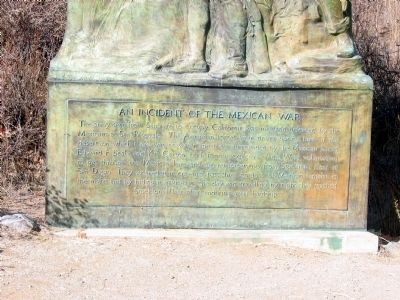
An Incident of the Mexican War
Photographed by Syd Whittle, November 25, 2006
1. An Incident of the Mexican War Marker
Topics. This historical marker is listed in this topic list: War, Mexican-American.
Location. 33° 5.361′ N, 116° 58.989′ W. Marker is in Escondido, California, in San Diego County. It can be reached from San Pasqual Valley Road. The marker is located on the path between the parking area and Visitor Center at the San Pasqual Battlefield State Historic Park. Touch for map. Marker is at or near this postal address: 15808 San Pasqual Valley Road, Escondido CA 92025, United States
this page online

Regionally, this marker is in the Peninsular Ranges. It is also in the American Borderlands and on the Pacific Coast. Globally, it is in North America, on the Ring of Fire, on the Pacific Rim, in the Western Hemisphere, in the Western World, and in the Anglosphere. Historically, it finds itself in what was once New Spain and also Mexico’s Alta California.
Other nearby markers. At least 8 other markers are within 8 miles of this marker, measured as the crow flies: San Pasqual (approx. 0.4 miles away); San Pasqual Battlefield (approx. half a mile away); Emergency Response Agencies and Zoological Society Employees (approx. 1.3 miles away); Mule Hill (approx. 5½ miles away); Veterans Memorial (approx. 7.4 miles away); Ramona Town Hall (approx. 7.6 miles away); Theophile Verlaque House (approx. 7.6 miles away); Verlaque House (1886) (approx. 7.6 miles away). Touch for a list and map of all markers in Escondido.
Related marker. Click here for another marker that is related to this marker.
Also see . . .
1. The California State Military Museum: The Battle of San Pasqual. (Submitted on October 23, 2008, by Syd Whittle of Mesa, Arizona.)
2. Find-A-Grave: San Pasqual Battlefield Monument.
Photographed by Syd Whittle, November 25, 2006
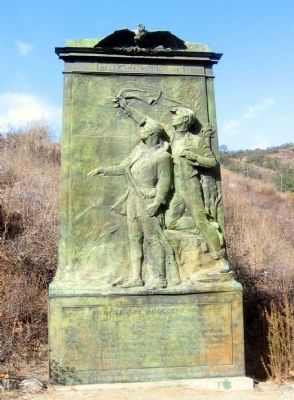
2. An Incident of the Mexican War Monument
Photographed by Syd Whittle, November 25, 2006
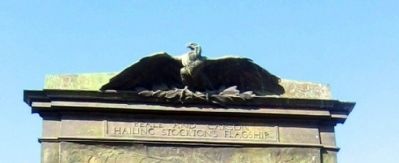
3. Inscription at Top of Monument
Photographed by Syd Whittle, November 25, 2006
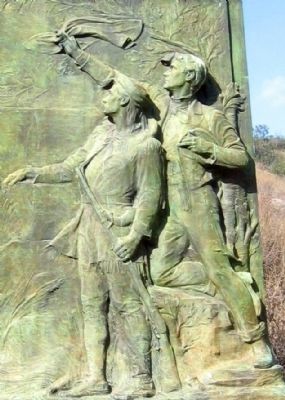
4. Close-Up of Sculpture on Monument
Photographed by Syd Whittle, November 25, 2006
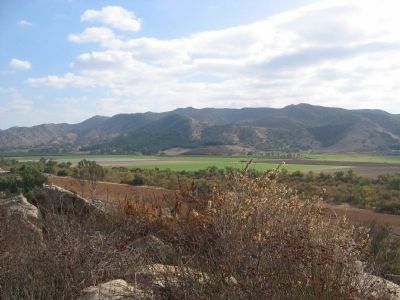
5. San Pasqual Valley - Scene of the Battle
Photographed by Syd Whittle, November 25, 2006
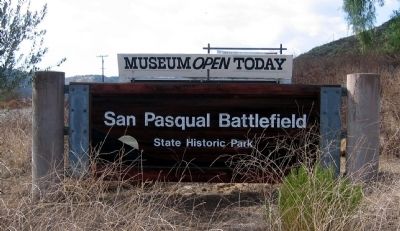
6. Entrance to San Pasqual Battlefield State Historic Park
Credits. This page was last revised on October 7, 2021. It was originally submitted on October 23, 2008, by Syd Whittle of Mesa, Arizona. This page has been viewed 2,773 times since then and 110 times this year. Photos: 1, 2, 3, 4, 5, 6. submitted on October 23, 2008, by Syd Whittle of Mesa, Arizona.
