Martin Mill in Kent, England, United Kingdom — Northwestern Europe (the British Isles)
Martin Mill
Photographed by Michael Herrick, September 8, 2018
1. Martin Mill Marker
Inscription.
Martin Mill. .
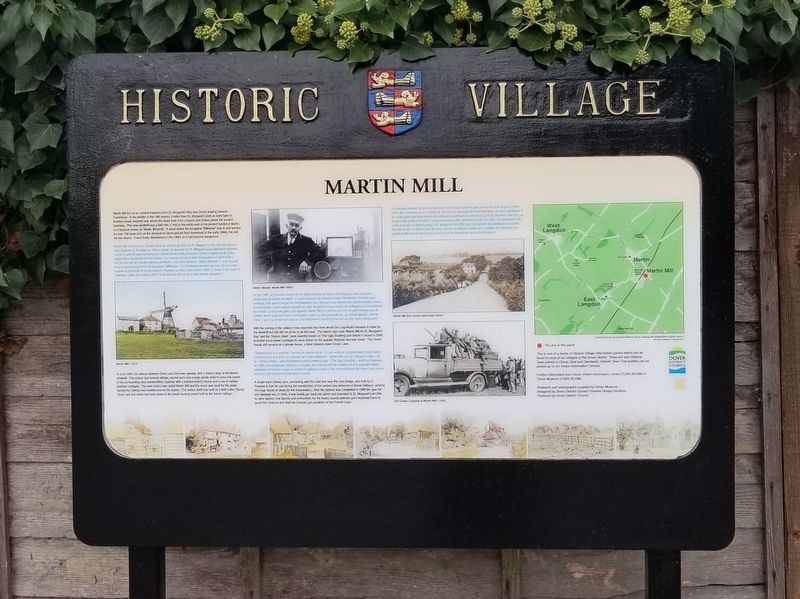
Historic Village Martin Mill . Martin Mill lies on-an ancient trackway from St. Margaret's Bay near Dover leading towards Canterbury. In the middle of the 18th century a miller from St. Margaret's built an early type of Kentish smock windmill near where the lanes from East Langdon and Solton joined the ancient trackway. This new windmill was a half mile (1 km) to the south-east of the ancient hamlet of Martin, so it became known as ‘Martin Windmill’. It stood where the bungalow "Millstone" now is and worked for over 150 years but, as the demand for stone-ground flour decreased in the early 1900s, the mill fell into disuse. It was finally demolished in the 1960s as it had become dangerous. , In June 1881 the railway between Dover and Deal was opened, with a station close to the Martin windmill. The station had several sidings, animal pens and a large goods shed to serve the needs of the surrounding rural communities, together with a stationmaster's house and a row of railway workers' cottages. The new station was called Martin Mill and the name was used for the small hamlet the railway had created around the station. The station itself was built on a field called 'Barley Close' and this name has been given to the small housing estate built on the former sidings. , With the coming of the railway it was expected that there would be a significant increase in trade for the windmill but this did not prove to be the case. The station sign read "Martin Mill for St. Margaret's Bay" and the 'Station Hotel', more recently known as 'The Ugly Duckling' pub before it closed in 2009, provided horse-drawn carriages to carry visitors to the popular Victorian sea-side resort. The Coach House still remains as a private house, a short distance down Green Lane. , A single-track railway spur, connecting with the main line near the road bridge, was built by S. Pearson and Son for use during the construction of the eastern sea defences of Dover Harbour, carrying the huge blocks of stone for the breakwaters. After the harbour was completed in 1909 the spur fell into disrepair but, in 1940, it was hastily put back into action and extended to St. Margaret's-at-Cliffe to carry spares, new barrels and ammunition for the heavy coastal defence guns deployed there to guard the Channel and shell the German gun positions on the French coast. , This is one of a series of Historic Village information panels which can be found in most of our villages in the Dover district. There are also Historic Town panels in Dover, Deal and Sandwich. Historic Town Trail leaflets can be picked up in our Visitor Information Centres Further information from Dover Visitor Information Centre or Dover Museum Research and photographs supplied by Dover Museum. Designed by Dover District Council Creative Design Services. Produced by Dover District Council. , ( photo captions ) - Martin Mill c. 1910 - Station Master, Martin Mill 1950s - Martin Mill from Dover-Deal Road 1920s - Girl Guides Camping at Martin Mill c.1935
Historic Village
Martin Mill
Martin Mill lies on-an ancient trackway from St. Margaret's Bay near Dover leading towards Canterbury. In the middle of the 18th century a miller from St. Margaret's built an early type of Kentish smock windmill near where the lanes from East Langdon and Solton joined the ancient trackway. This new windmill was a half mile (1 km) to the south-east of the ancient hamlet of Martin, so it became known as ‘Martin Windmill’. It stood where the bungalow "Millstone" now is and worked for over 150 years but, as the demand for stone-ground flour decreased in the early 1900s, the mill fell into disuse. It was finally demolished in the 1960s as it had become dangerous.
In June 1881 the railway between Dover and Deal was opened, with a station close to the Martin windmill. The station had several sidings, animal pens and a large goods shed to serve the needs of the surrounding rural communities, together with a stationmaster's house and a row of railway workers' cottages. The new station was called Martin Mill and the name was used for the small hamlet the railway had created around the station. The station itself was built on a field called 'Barley Close' and this name has been given to the small housing estate built on the former sidings.
With the coming of the railway it
Click or scan to see this page online
was expected that there would be a significant increase in trade for the windmill but this did not prove to be the case. The station sign read "Martin Mill for St. Margaret's Bay" and the 'Station Hotel', more recently known as 'The Ugly Duckling' pub before it closed in 2009, provided horse-drawn carriages to carry visitors to the popular Victorian sea-side resort. The Coach House still remains as a private house, a short distance down Green Lane.
A single-track railway spur, connecting with the main line near the road bridge, was built by S. Pearson & Son for use during the construction of the eastern sea defences of Dover Harbour, carrying the huge blocks of stone for the breakwaters. After the harbour was completed in 1909 the spur fell into disrepair but, in 1940, it was hastily put back into action and extended to St. Margaret's-at-Cliffe to carry spares, new barrels and ammunition for the heavy coastal defence guns deployed there to guard the Channel and shell the German gun positions on the French coast.
This is one of a series of Historic Village information panels which can be found in most of our villages in the Dover district. There are also Historic Town panels in Dover, Deal and Sandwich. Historic Town Trail leaflets can be picked up in our Visitor Information Centres
Further information from Dover Visitor Information Centre or Dover Museum
Photographed by Michael Herrick, September 8, 2018
2. Martin Mill Marker
Research and photographs supplied by Dover Museum.
Designed by Dover District Council Creative Design Services.
Produced by Dover District Council.
( photo captions )
- Martin Mill c. 1910
- Station Master, Martin Mill 1950s
- Martin Mill from Dover-Deal Road 1920s
- Girl Guides Camping at Martin Mill c.1935
Topics and series. This historical marker is listed in this topic list: Settlements & Settlers. In addition, it is included in the Windmills series list. A significant historical month for this entry is June 1881.
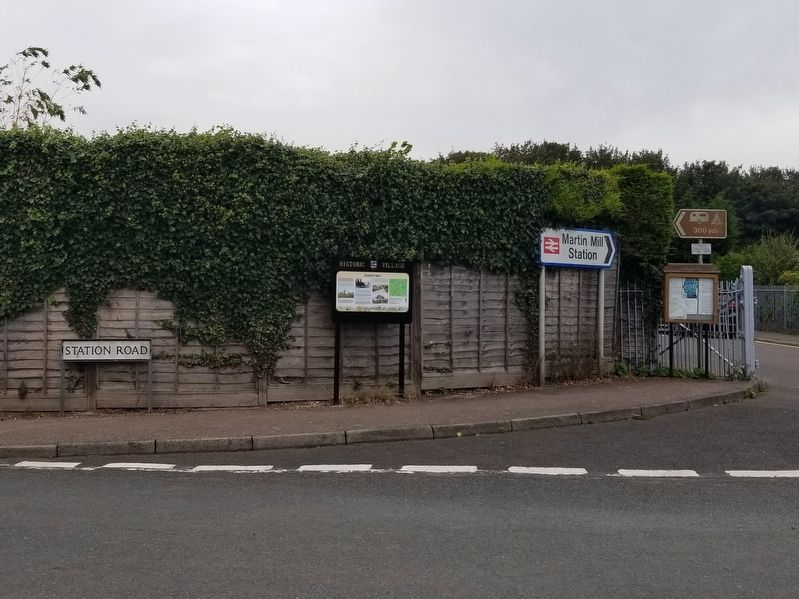
Location. 51° 10.213′ N, 1° 20.977′ E. Marker is in Martin Mill, England, in Kent. It is at the intersection of Station Approach and Station Road, on the left when traveling south on Station Approach. Touch for map. Marker is in this post office area: Martin Mill, England CT15 5JX, United Kingdom. Touch for directions.
Regionally, this marker is in the Greater South East. Globally, it is in the Atlantic Ocean, in the North Atlantic Region, in Europe, in Atlantic Europe, on one of the British Isles, in the Western World, and in the Anglosphere. Historically, it finds itself in what was once the Roman Empire.
Also see . . . Martin Mill on Wikipedia. (Submitted on January 15, 2019, by Michael Herrick of Southbury, Connecticut.)
Credits. This page was last revised on January 27, 2022. It was originally submitted on January 15, 2019, by Michael Herrick of Southbury, Connecticut. This page has been viewed 667 times since then and 52 times this year. Photos:1, 2. submitted on January 15, 2019, by Michael Herrick of Southbury, Connecticut.