
Downtown Los Angeles in Los Angeles County, California — The American West (Pacific Coastal)
Fort Moore
Pioneer Memorial and Park
Photographed by Sandra Hughes, June 1, 2010
1. Fort Moore Pioneer Memorial and Park
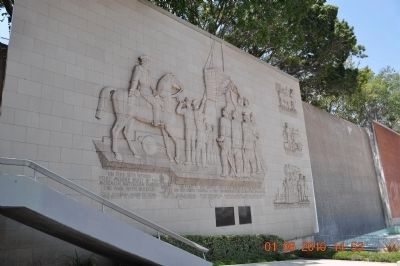
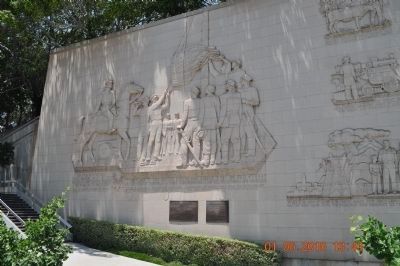
On this site stood Fort Moore built by the Mormon Battalion during the War with Mexico.
This memorial honors the troops who helped to win the South West.
The Flag of the United States was raised here on July 4th 1847 by United States Troops at the First Independence Celebration in Los Angeles.
The United States 1st Dragoons who fought at San Pasqual.
The New York Volunteers who came by sea.
The Mormon Battalion which made one of the longest and most arduous infantry marches in history.
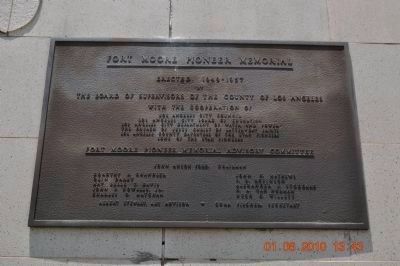
Erected 1949 by The Board of Supervisors of the County of Los Angeles.
Topics and series. This historical marker is listed in these topic lists: Forts and Castles • War, Mexican-American. In addition, it is included in the Daughters of Utah Pioneers, and the Mormon Battalion series lists. A significant historical month for this entry is July 1863.
Location. 34° 3.455′ N, 118° 14.535′ W. Marker is in Los Angeles, California, in Los Angeles County. It is in Downtown Los Angeles. It is on North Hill Street, on the right when traveling north. Marker is located between China Town and the downtown District of Los Angeles. Touch for map.
this page online

Regionally, this marker is in California’s Transverse Ranges. It is also on the American Pacific Coast. Globally, it is in North America, on the Ring of Fire, in the Pacific Rim, in the Western Hemisphere, in the Western World, and in the Anglosphere. Historically, it finds itself in what was once New Spain and also Mexico’s Alta California.
Other nearby markers. At least 8 other markers are within walking distance of this marker: El Pueblo (about 700 feet away, measured in a direct line); Pio Pico (about 700 feet away); Los Angeles Settlers (about 700 feet away); Los Angeles History (about 700 feet away); Forced Removal of Mexican Americans (about 800 feet away); Welcome to Chinatown (approx. 0.2 miles away); The Aliso Tree (approx. 0.2 miles away); Land of the Tongva (approx. 0.2 miles away). Touch for a list and map of all markers in Los Angeles.
Regarding Fort Moore. On January 10, 1847, American forces defeated the Mexicans and took the pueblo of Los Angeles. Two days later the American troops built
Photographed by Sandra Hughes, June 1, 2010
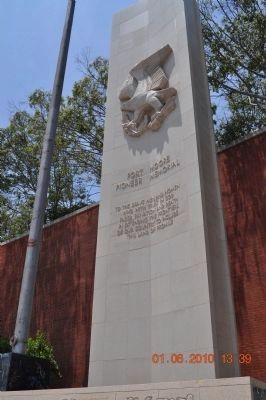
2. Fort Moore Pioneer Memorial and Park
To the brave men and women who with trust in God faced privation and death in extending the frontier of our country to include This Land of Promise.
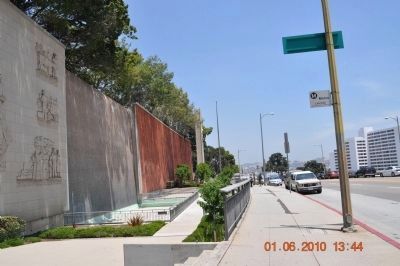
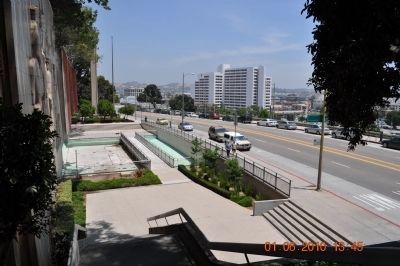
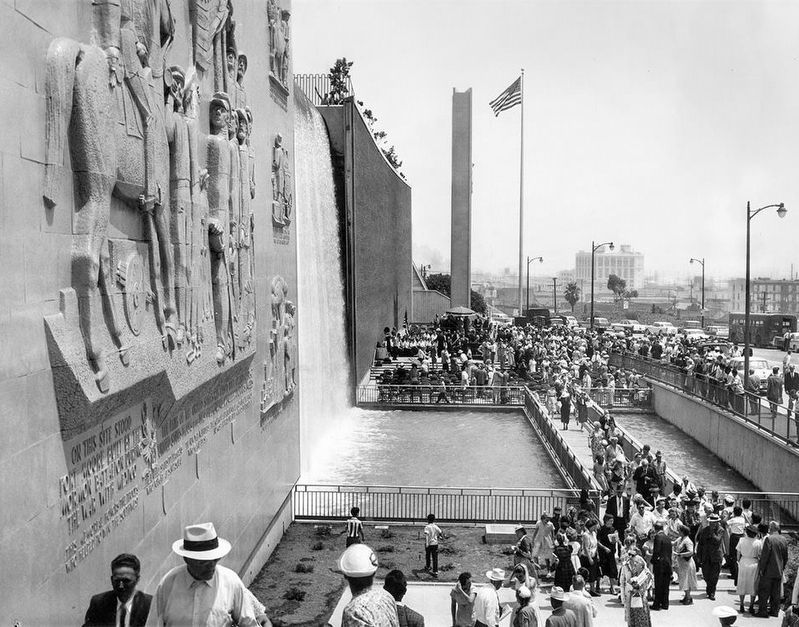
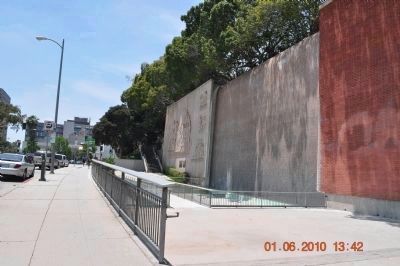
The City of Los Angeles opened a memorial on the site in 1957. It is the largest bas-relief military monument in the United States. The 400-foot wide monument includes a 47-foot-high, 80-foot-wide waterfall. In 1977 the waterfall was turned off during drought conditions. In January 2019 it was turned back on.
Also see . . .
1. Fort Moore. Building Fort Moore was a proposition that progressed in direct proportion to the enemy threat. It started in a state of siege, had a short but eventful history, and then quietly disappeared from the Army rolls. (Submitted on February 12, 2012.)
2. The Siege of Los Angeles and Fort Moore. The material for the fort was obtained from timber in the San Gabriel mountains, with the volunteer Mormon battalion doing most of the work. (Submitted on February 12, 2012.)
Photographed by Sandra Hughes, June 1, 2010
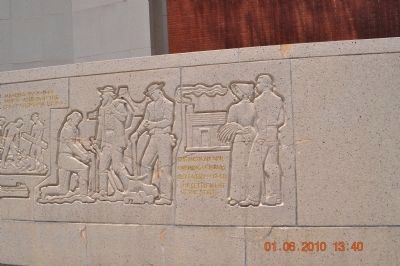
3. The Mexican War
Opening of Roads
Discovery of Gold
The Settlement of the State
Discovery of Gold
The Settlement of the State
Photographed by Sandra Hughes, June 1, 2010
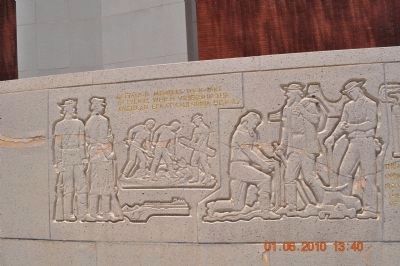
4. Battalion Members
took part in events which ushered in the American Era of California History.
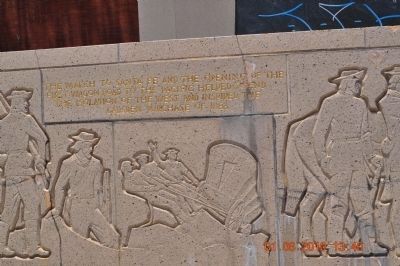
Photographed by Sandra Hughes, June 1, 2010
5. The March to Santa Fe
and the opening of The First Wagon Road to the Pacific helped to end the isolation of the west and inspired the Gadsen Purchase of 1853.
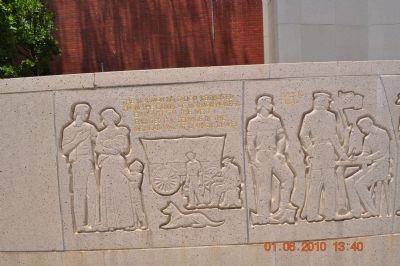
Photographed by Sandra Hughes, June 1, 2010
6. July 16, 1846
The Mormon Battalion Recruited from camps of Mormon pioneers enroute to the west enlisted for service in the Mexican War at Council Bluffs.
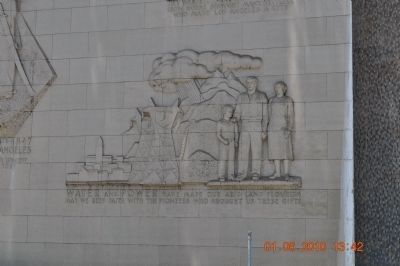
Photographed by Sandra Hughes, June 1, 2010
7. Water and Power
have made our arid land flourish.
May we keep faith with the pioneers who brought us these gifts.
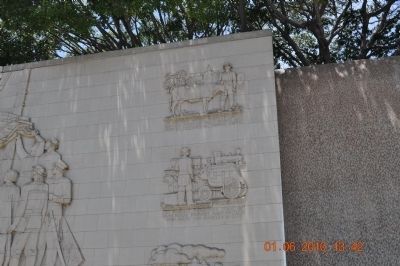
Photographed by Sandra Hughes, June 1, 2010
8. Ranchos, Schooners
On Ranchos where herds of cattle ranged, pioneers built homes and planted vineyards and orange groves.
The Prairie Schooners stage and iron horse brought many settlers who made Los Angeles a City.
Photographed by Sandra Hughes, June 1, 2010
9. Fort Moore Pioneer Memorial and Park
Photographed by Sandra Hughes, June 1, 2010
10. Fort Moore Pioneer Memorial and Park
Photographed by Sandra Hughes, June 1, 2010
11. Fort Moore Pioneer Memorial and Park
July 3, 1958
12. Opening Day
Photographed by Sandra Hughes, June 1, 2010
13. Fort Moore Pioneer Memorial and Park
Photographed by Sandra Hughes, June 1, 2010
14. Fort Moore Pioneer Memorial and Park
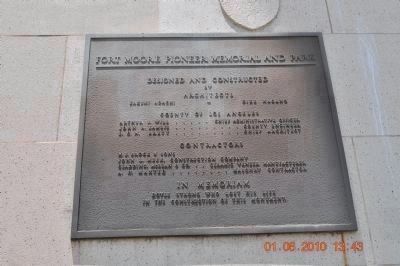
by
Architects
Kazumi Adachi and Dike Nagano
County of Los Angeles
John A. Lambte - County Engineer
E.C.N. Brett - Chief Architect
John L. Meek, Construction Company
Gadding, McBean & Co - Ceramic Veneer Manufacturer
A.H. Maxted - Masonry Contractor
Photographed by Sandra Hughes, June 1, 2010
15. Fort Moore Pioneer Memorial
by The Board of Supervisors of the county of Los Angeles
with the cooperation of
Los Angeles City Council
Los Angeles city Board of Education
Los Angeles City Department of Water and Power
Los Angeles County Daughter of the Utah Pioneers
Sons of the Utah Pioneers
----------------------
Fort Moore Pioneer Memorial Advisory Committee
John Anson Ford, Chairman
Dorothy B Chandler
Olin Darby
May Bedle T Davis
John F Howells, Jr.
Charles O. Matcham, Albert Stewart, Art Advisor
John H Mathews
S.B. Robinson
Alexander J. Stoddard
H. A Van Norman
Hugh C. Willett
Cora Fischer, Secretary
Credits. This page was last revised on July 31, 2023. It was originally submitted on February 10, 2012, by Sandra Hughes Tidwell of Killen, Alabama, USA. This page has been viewed 2,094 times since then and 68 times this year. Last updated on January 19, 2019, by Craig Baker of Sylmar, California. Photos: 1, 2, 3, 4, 5, 6, 7, 8, 9, 10, 11. submitted on February 10, 2012, by Sandra Hughes Tidwell of Killen, Alabama, USA. 12. submitted on September 22, 2018, by Craig Baker of Sylmar, California. 13, 14, 15. submitted on February 10, 2012, by Sandra Hughes Tidwell of Killen, Alabama, USA. • Andrew Ruppenstein was the editor who published this page.
