Maggie Valley in Haywood County, North Carolina — The American South (South Atlantic)
Kirk's Raid
Unwanted Intruders
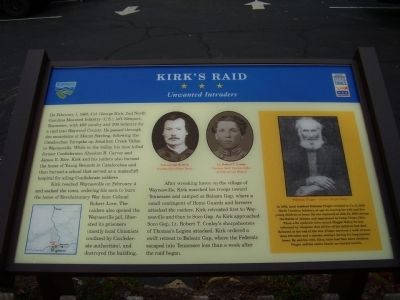
Photographed by Stanley and Terrie Howard, October 17, 2008
1. Kirk's Raid Marker
On February 1, 1865, Col. George Kirk, 2nd North Carolina Mounted Infantry (U.S.), left Newport, Tennessee, with 400 cavalry and 200 infantry for a raid into Haywood County. He passed through the mountains at Mount Sterling, following the Cataloochee Turnpike up Jonathan Creek Valley to Waynesville. While in the valley, his men killed former Confederates Absolom B. Carver and James E. Rice. Kirk and his raiders also burned the home of Young Bennett in Cataloochee and then burned a school that served as a makeshift hospital for ailing Confederate soldiers.
Kirk reached Waynesville on February 4 and sacked the town, ordering his men to burn the home of Revolutionary War hero Colonel Robert Love. The raiders also opened the Waynesville jail, liberated its prisoners (mostly local Unionists confined by Confederate authorities), and destroyed the building.
After wreaking havoc on the village of Waynesville, Kirk marched his troops toward Tennessee and camped at Balsam Gap, where a small contingent of Home Guards and farmers attacked the raiders. Kirk retreated first to Waynesville and then to Soco Gap. As Kirk approached Soco
this page online
Sidebar: In 1863, local resident Solomon Finger enlisted in Co. E, 29th North Carolina Infantry, at age 44, leaving his wife and five young children at home. He was captured on July 22, 1864, during the Battle of Atlanta and imprisoned in Camp Chase, Ohio. When a flu epidemic later struck Maggie Valley, he was informed by telegram that all five of his children had died. Released at the end of the war, Finger survived a walk of more than 100 miles and a murder attempt during his long journey home. He and his wife, Eliza, later had four more children. Finger and his entire family are buried nearby.
Erected by North Carolina Civil War Trails.
Topics and series. This historical marker is listed in this topic list: War, US Civil. In addition, it is included in the North Carolina Civil War Trails series list. A significant historical date for this entry is February 1, 1865.
Location. 35° 31.266′ N, 83° 6.403′ W. Marker is in Maggie Valley, North Carolina,
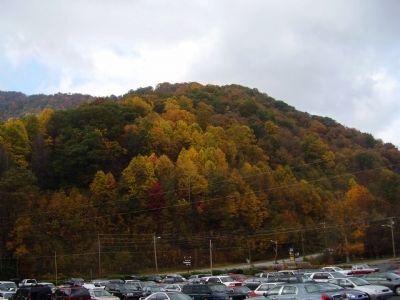
Photographed by Stanley and Terrie Howard, October 18, 2008
2. Hills in the area around the marker

Regionally, this marker is in the Mountains, specifically in Greater Asheville, and in the Great Smoky Mountains. It is also in the American South, specifically in the Upper South, in Appalachia, and specifically in Southern Appalachia. Globally, it is in North America, the Western Hemisphere, the Western World, and the Anglosphere. Historically, it finds itself in what was once the original Cherokee Nation, the territory of the Mississippian Culture, one of the original Thirteen Colonies, one of the Confederate States of America, and the Antebellum South.
Other nearby markers. At least 8 other markers are within 6 miles of this marker, measured as the crow flies: Felix Walker (approx. 2.3 miles away); Qualla Boundary (approx. 3.3 miles away); The Masonic Marker (approx. 3.8 miles away); Plott Balsam (approx. 3.9 miles away); An Ancient and Settled Landscape (approx. 4.7 miles away); Qualla Indian Reservation (approx. 4.7 miles away); Browning Knob (approx. 4.8 miles away); Rutherford Trace (approx. 5.9 miles away). Touch for a list and map of all markers in Maggie Valley.
More about this marker. In the upper center are portraits of Col. George W. Krick and Lt. Robert T. Conley. A portrait of Solomon Finger is inside the sidebar. A map of the Maggie Valley area is on the lower left.
Credits. This page was last revised on November 8, 2024. It was originally submitted on October 23, 2008, by Stanley and Terrie Howard of Greer, South Carolina. This page has been viewed 3,645 times since then and 167 times this year. Photos: 1, 2. submitted on October 23, 2008, by Stanley and Terrie Howard of Greer, South Carolina. • Craig Swain was the editor who published this page.
