Near Chehalis in Lewis County, Washington — The American West (Northwest)
Claquato Church
Photographed by Cosmos Mariner, July 19, 2015
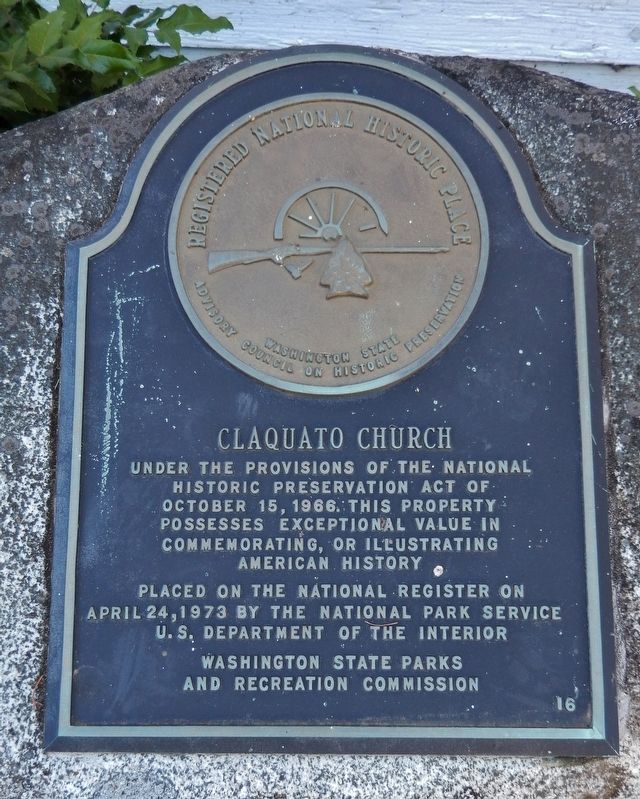
1. Claquato Church Marker
Historic Preservation Act of
October 15, 1966, this property
possesses exceptional value in
commemorating, or illustrating
American History
Placed on the National Register on
April 24, 1973 by the National Park Service
U.S. Department of the Interior
Washington State Parks
and Recreation Commission
Registered National Historic Place
Washington State
Advisory Council on Historic Preservation
Erected by Washington State Parks and Recreation Commission. (Marker Number 16.)
Topics. This historical marker is listed in these topic lists: Religion & Religious Structures • Settlements & Settlers. A significant historical date for this entry is April 24, 1973.
Location. 46° 38.557′ N, 123° 1.304′ W. Marker is near Chehalis, Washington, in Lewis County. It can be reached from Water Steet 0.1 miles south of Stearns Road, on the left when traveling south. Located at the northwest corner of the Claquato Church building. Touch for map. Marker is at or near this postal address: 125 Water St, Chehalis WA 98532, United States of America. Touch for directions.

Regionally, this marker is in Southwest Washington State.
this page online
Other nearby markers. At least 8 other markers are within 12 miles of this marker, measured as the crow flies: The Old Oregon Trail (here, next to this marker); Claquato (approx. ¼ mile away); Claquato Pioneer Fir (approx. ¼ mile away); Borst House (approx. 5.6 miles away); Oregon Trail (approx. 5.6 miles away); George Washington (approx. 6.1 miles away); a different marker also named Oregon Trail (approx. 10.1 miles away); a different marker also named Oregon Trail (approx. 11½ miles away). Touch for a list and map of all markers in Chehalis.
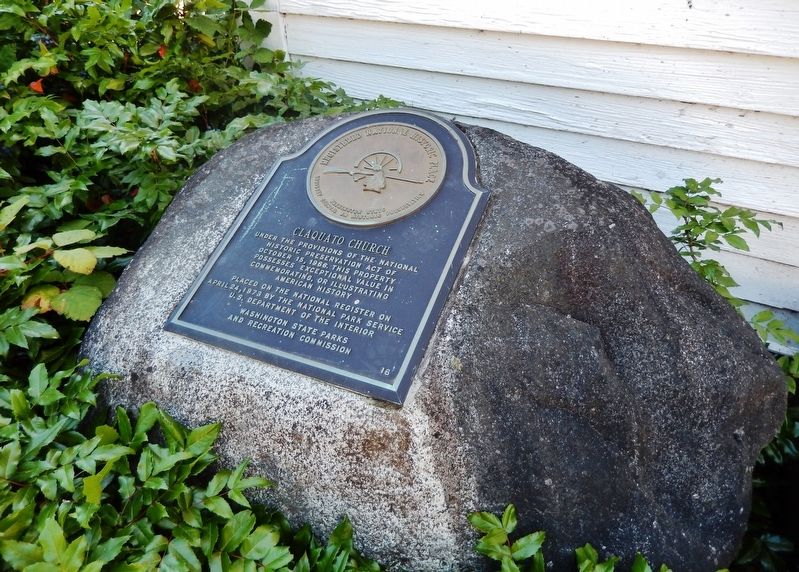
More about this marker. Marker is a large metal tablet, mounted at ground-level on a large boulder at the northwest corner of the church.
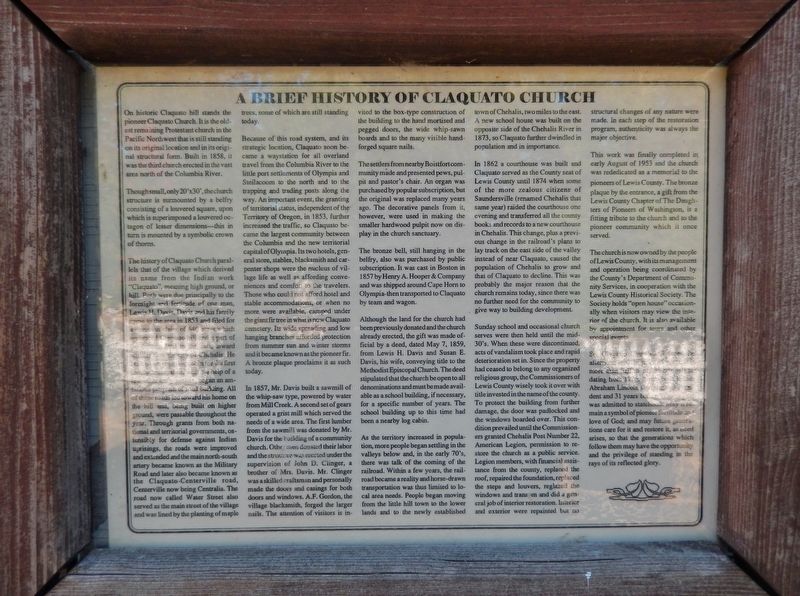
Regarding Claquato Church. (from interpretive panel mounted to left of front door) On historic Claquato hill stands the pioneer Claquato Church. It is the oldest remaining
Photographed by Cosmos Mariner, July 19, 2015
2. Claquato Church Marker (wide view)
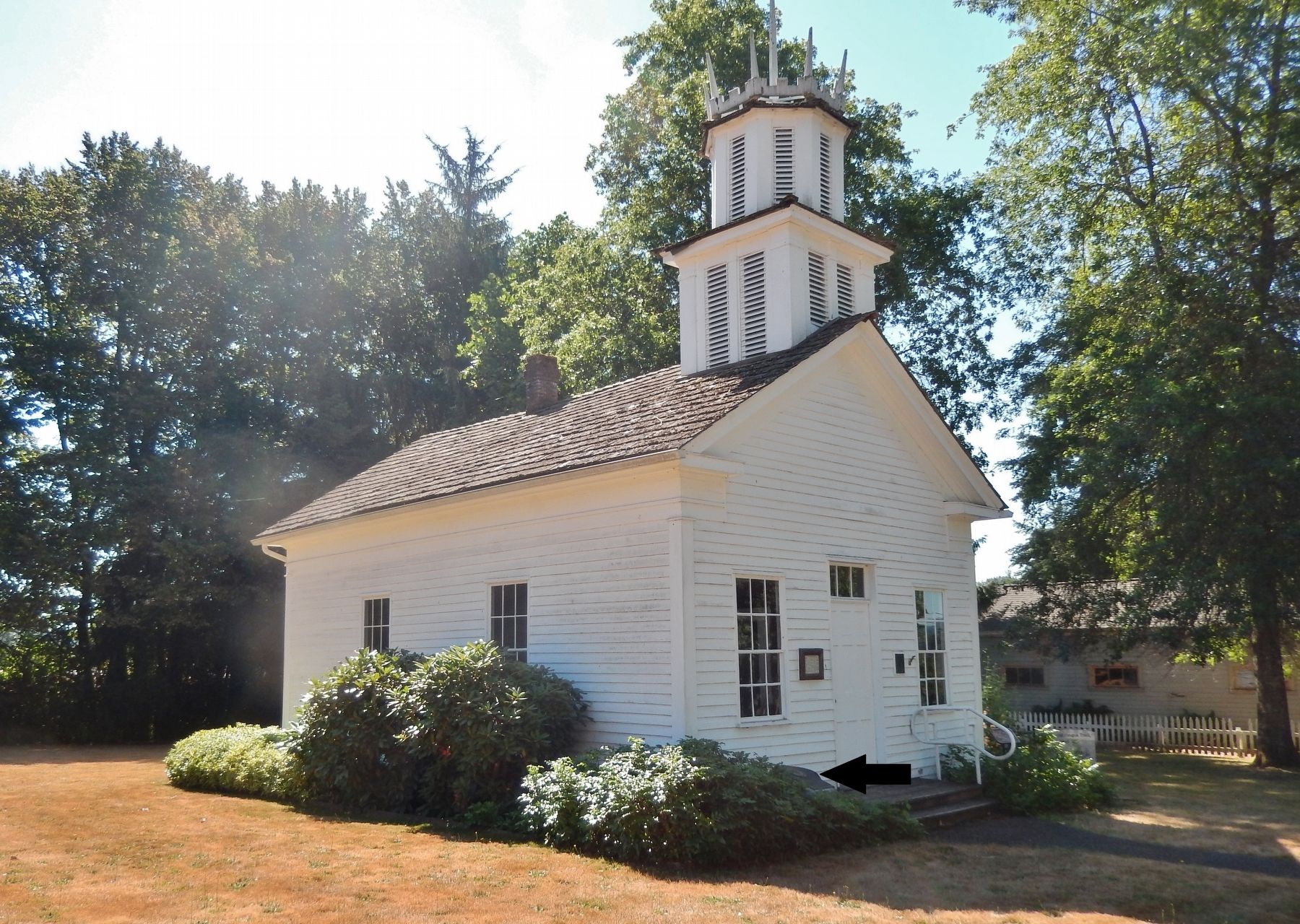
Though small, only 20’x30', the church structure is surmounted by a belfry consisting of a louvered square, upon which is superimposed a louvered octagon of lesser dimensions — this in turn is surmounted by a symbolic crown of thorns.
The history of Claquato Church parallels that of the village which derived its name from the Indian work “Claquato,” meaning high ground, or hill. Both were due principally to the foresight and fortitude of one man, Lewis H. Davis. Davis and his family came to the area in 1853 and filed for a donation claim of 640 acres which embraced Claquato hill and a part of the bottom land to the east, toward which is now the city of Chehalis. He built one small log cabin for the first family home then, with the help of a few other early settlers, began an ambitious program of road building. All of these roads led toward his home on the hill and, being built on higher ground, were passable throughout
Photographed by Cosmos Mariner, July 19, 2015
3. Claquato Church (northwest corner view; marker visible near corner)
Because of this road system, and its strategic location, Claquato soon became a waystation for all overland travel from the Columbia River to the little port settlements of Olympia and Steilacoom to the north and to the trapping and trading posts along the way. An important event, the granting of territorial status, independent of the Territory of Oregon, in 1853, further increased the traffic, so Claquato became the largest community between the Columbia and the new territorial capital of Olympia. Its two hotels, general store, stables, blacksmith and carpenter shops were the nucleus of village life as well as affording conveniences and comfort to the travelers.
Photographed by Cosmos Mariner, July 19, 2015
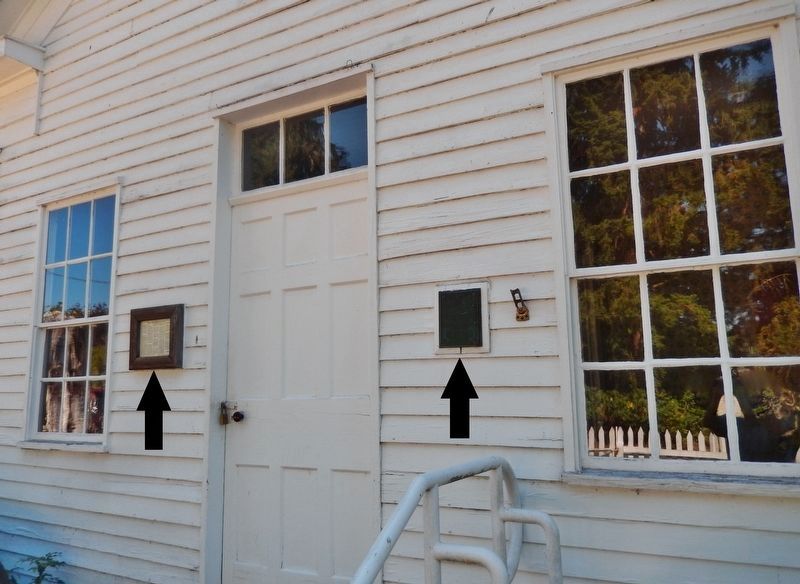
4. Claquato Church Entrance (Church history panel on left; Chuch centennial plaque on right)
In 1857, Mr. Davis built a sawmill of the whip-saw type, powered by water from Mill Creek. A second set of gears operated a grist mill which served the needs of a wide area. The first lumber from the sawmill was donated by Mr. Davis for the building of a community church. Other men donated their labor and the structure was erected under the supervision of John D. Clinger, a brother of Mrs. Davis. Mr. Clinger was a skilled craftsman and personally made the doors and casings for both doors and windows. A.F. Gordon, the village blacksmith, forged the larger nails. The attention of visitors is invited to the box-type construction of the building, to the hand mortised and pegged doors, the wide whip-sawn boards and to the many visible hand-forged square nails.
The settlers from nearby Boistfort community
Photographed by Cosmos Mariner, July 19, 2015
5. A Brief History of Claquato Church (interpretive panel mounted on left side of front door)
The bronze bell, still hanging in the belfry, also was purchased by public subscription. It was cast in Boston in 1857 by Henry A. Hooper & Company and was shipped around Cape Horn to Olympia - then transported to Claquato by team and wagon.
Although the land for the church had been previously donated and the church already erected, the gift was made official by a deed, dated May 7, 1859, from Lewis H. Davis and Susan E. Davis, his wife, conveying title to the Methodist Episcopal Church. The deed stipulated that the church be open to all denominations and must be made available as a school building, if necessary, for a specific number of years. The school building up to this time had been a nearby log cabin.
As the territory increased in population, more people began settling in the valleys below and, in the early 70's, there was talk of the coming of the railroad.
Photographed by Cosmos Mariner, July 19, 2015
6. Claquato Church Centennial Plaque (mounted on right side of front door)
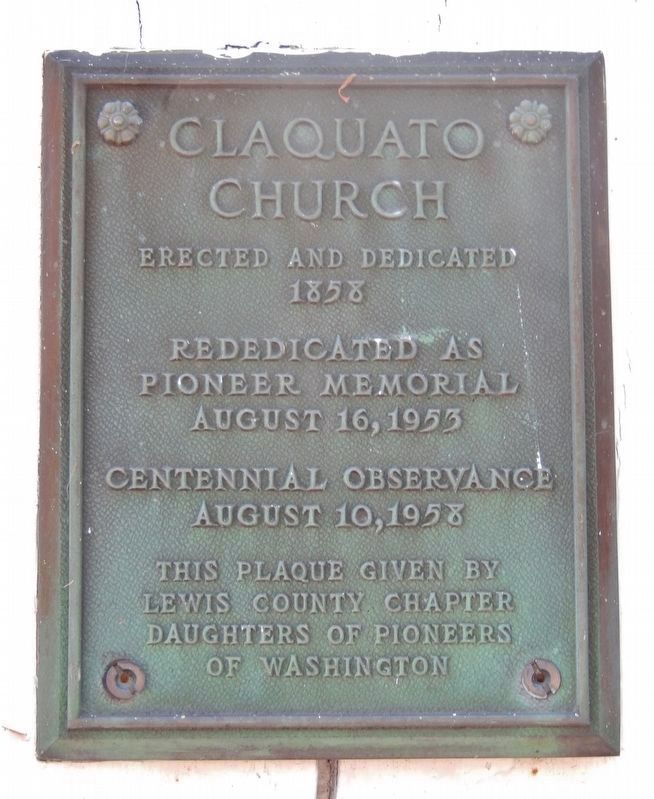
Erected and dedicated
1858
Rededicated as
Pioneer Memorial
August 16, 1953
Centennial Observance
August 10, 1958
This plaque given by
Lewis County Chapter
Daughters of Pioneers
of Washington
In 1862 a courthouse was built and Claquato served as the County seat of Lewis County until 1874 when some of the more zealous citizens of Saundersville (renamed Chehalis that same year) raided the courthouse one evening and transferred all the county books and records to a new courthouse in Chehalis. This change, plus a previous change in the railroad's plans to lay track on the east side of the valley instead of near Claquato, caused the population of Chehalis to grow and that of Claquato to decline. This was probably the major reason that the church remains today, since there was no further need for the community to give way to building development.
Sunday school and occasional church services were then held until the mid-30's. When these were discontinued, acts of vandalism took place and deterioration set in. Since the property had ceased to belong to any organized religious group, the Commissioners of Lewis County wisely took it over with title invested in the name of the county. To protect the building from further damage, the door was padlocked and the windows boarded over. This condition prevailed until the Commissioners granted Chehalis Post Number 22, American Legion, permission to restore the church as a public service. Legion members, with financial assistance from the county replaced the roof, repaired the foundation, replaced the steps and louvers, reglazed the windows and transom and did a general job of interior restoration. Interior and exterior were repainted but no structural changes of any nature were made. In each step of the restoration program, authenticity was always the major objective.
This work was finally completed in early August of 1953 and the church was rededicated as a memorial to the pioneers of Lewis County. The bronze plaque by the entrance, a gift from the Lewis County Chapter of The Daughters of Pioneers of Washington, is a fitting tribute to the church and to the pioneer community which it once served.
The church is now owned by the people of Lewis County, with its management and operation being coordinated by the County's Department of Community Services, in cooperation with the Lewis County Historical Society. The Society holds "open house" occasionally when visitors may view the interior of the church. It is also available by appointment for tours and other special events.
So, Claquato Church still faces the afternoon sun. It point of years, it is more than half as old as our nation, dating from 1776. It was built before Abraham Lincoln first became President and 31 years before Washington was admitted to statehood. May it remain a symbol of pioneer fortitude and love of God; and may future generations care for it and restore it, as need arises, so that the generations which follow them may have the opportunity and the privilege of standing in the rays of its reflected glory.
Related markers. Click here for a list of markers that are related to this marker. The Pioneer Town of Claquato, Washington
Credits. This page was last revised on January 14, 2024. It was originally submitted on January 26, 2019, by Cosmos Mariner of Cape Canaveral, Florida. This page has been viewed 803 times since then and 51 times this year. Photos: 1, 2, 3, 4, 5, 6. submitted on January 26, 2019, by Cosmos Mariner of Cape Canaveral, Florida. • Andrew Ruppenstein was the editor who published this page.
