Near Pleasant Plains in Sangamon County, Illinois — The American Midwest (Great Lakes)
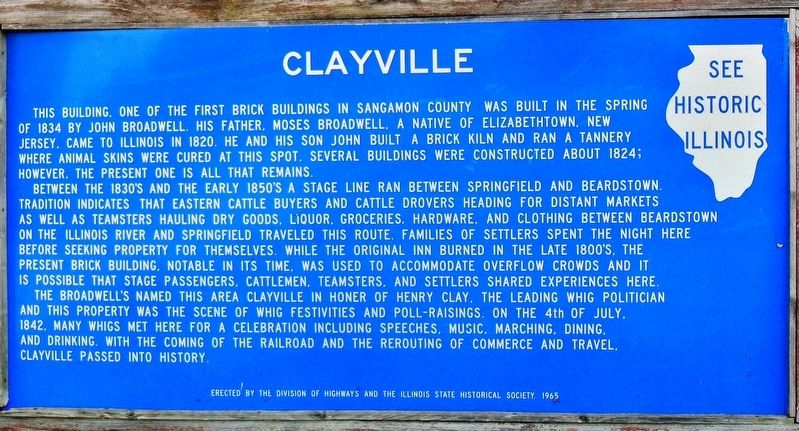
Clayville
Photographed by Cosmos Mariner, July 23, 2012
1. Clayville Marker
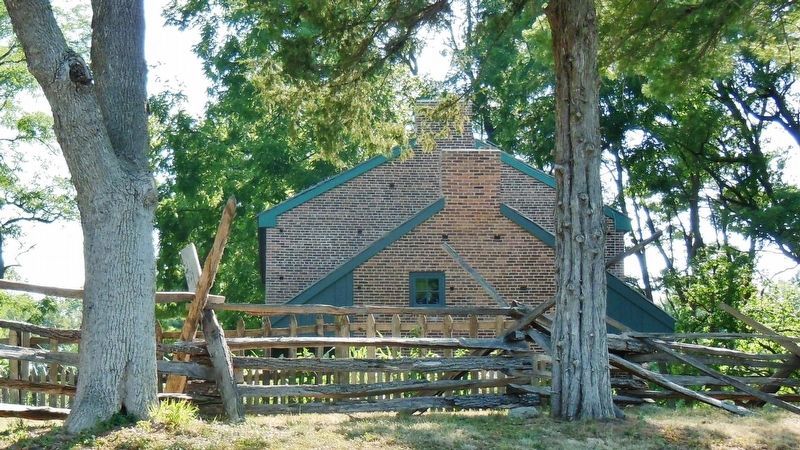
This building, one of the first brick buildings in Sangamon County, was built in the spring of 1834 by John Broadwell. His father, Moses Broadwell, a native of Elizabethtown, New Jersey, came to Illinois in 1820. He and his son John built a brick kiln and ran a tannery where animal skins were cured at this spot. Several buildings were constructed about 1824; however, the present one is all that remains.
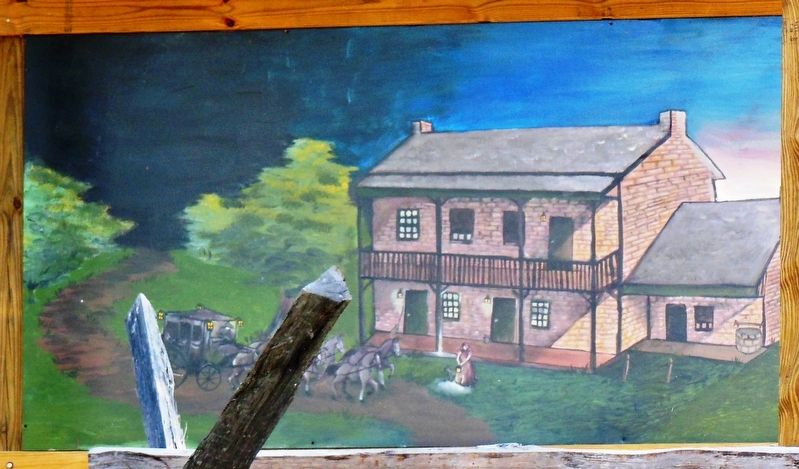
Between the 1830's and the early 1850's a stage line ran between Springfield and Beardstown. Tradition indicates that eastern cattle buyers and cattle drovers heading for distant markets as well as teamsters hauling dry goods, liquor, groceries, hardware, and clothing between Beardstown on the Illinois River and Springfield traveled this route. Families of settlers spent the night here before seeking property for themselves. While the original inn burned in the late 1800's, the present brick building, notable in its time, was used to accommodate overflow crowds and it is possible that stage passengers, cattlemen, teamsters, and settlers shared experiences here.
The Broadwell's named this area Claysville in honor of Henry
this page online
Erected 1965 by Illinois Division of Highways and Illinois State Historical Society.
Topics and series. This historical marker is listed in these topic lists: Government & Politics • Industry & Commerce • Settlements & Settlers. In addition, it is included in the Illinois State Historical Society, and the See Historic Illinois series lists. A significant historical year for this entry is 1834.
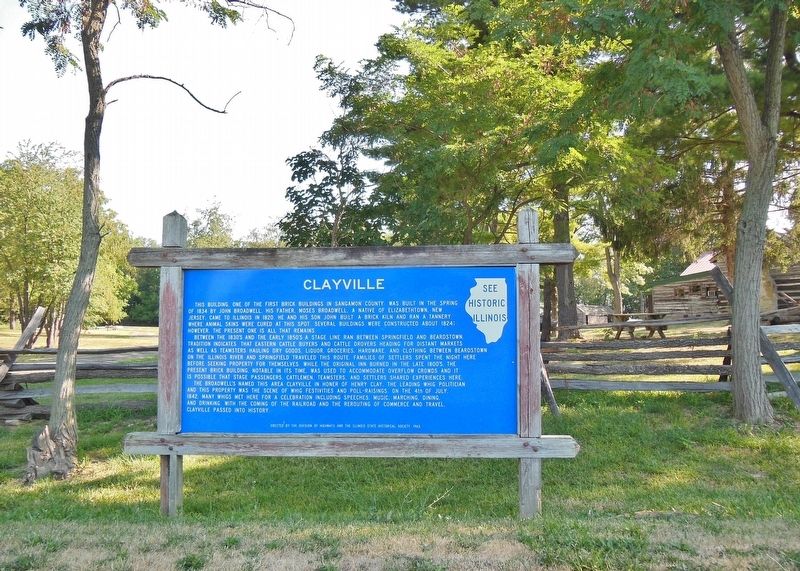
Location. 39° 52.002′ N, 89° 53.784′ W. Marker is near Pleasant Plains, Illinois, in Sangamon County. It is on Illinois Route 125 west of Clayville Road, on the right when traveling east. Marker is located in a pull-out and parking lot on the south side of the highway, at the entrance to the Clayville Historical Site. Touch for map.
Photographed by Cosmos Mariner, July 23, 2012
2. Clayville Marker (wide view; Clayville Historical Site in background)

Regionally, this marker is in Central Illinois and in Greater Springfield. It is also in the American Midwest and in the Corn Belt. Globally, it is in North America, the Western Hemisphere, the Western World, and the Anglosphere. Historically, it finds itself in what was once the territory of the Mississippian Culture and also the Northwest Territory.
Other nearby markers. At least 8 other markers are within 6 miles of this marker, measured as the crow flies: Clayville Tavern (a few steps from this marker); Peter Cartwright (approx. 1.2 miles away); Mentor Graham (approx. 5.9 miles away); The Wayside Hawthorn (approx. 6 miles away); New Salem (approx. 6 miles away); Sangamon River (approx. 6 miles away); Historic Tree (approx. 6 miles away); Prairie Land (approx. 6 miles away). Touch for a list and map of all markers in Pleasant Plains.
Another marker is no longer nearby. Lincoln’s Store Partner (was approx. 4.9 miles away but has been confirmed missing).
More about this marker.
Photographed by Cosmos Mariner, July 23, 2012
3. 1834 Clayville Tavern, Clayville Historic Site (north side; view from near marker)
Regarding Clayville. Clayville Tavern, 1834, National Register of Historic Places #73000718 (1973)
Also see . . . Clayville History. Clayville Historic Site website entry:
As the Broadwells were prominent members of the Whig political party, Clayville hosted a grand Fourth of July celebration in 1842 to mark the birthday of the Republic. A grand day of speeches, music and general celebration saw many prominent local persons walking or riding from Springfield and surrounding towns, including a rising young local Whig politician and lawyer named Abraham Lincoln. While there is no certain proof of other visits by the future President Lincoln to the Broadwell Inn, it seems almost certain that he would have visited often as he traveled the road to Virginia, Beardstown and beyond many times on the judicial circuit. Moreover he was John Broadwell’s attorney, representing him and other family members in at least four cases. (Submitted on January 27, 2019, by Cosmos Mariner of Cape Canaveral, Florida.)
Photographed by Cosmos Mariner, July 23, 2012
4. Painting of 1834 Clayville Tavern (located near marker)
Credits. This page was last revised on January 26, 2026. It was originally submitted on January 27, 2019, by Cosmos Mariner of Cape Canaveral, Florida. This page has been viewed 577 times since then and 44 times this year. Photos: 1, 2, 3, 4. submitted on January 27, 2019, by Cosmos Mariner of Cape Canaveral, Florida. • Bill Pfingsten was the editor who published this page.
