South Los Angeles in Los Angeles County, California — The American West (Pacific Coastal)
Information Please: The USC Libraries
| — | University of Southern California | — |
Photographed by J. J. Prats, November 29, 2018
1. Information Please: The USC Libraries Interpretive Panel
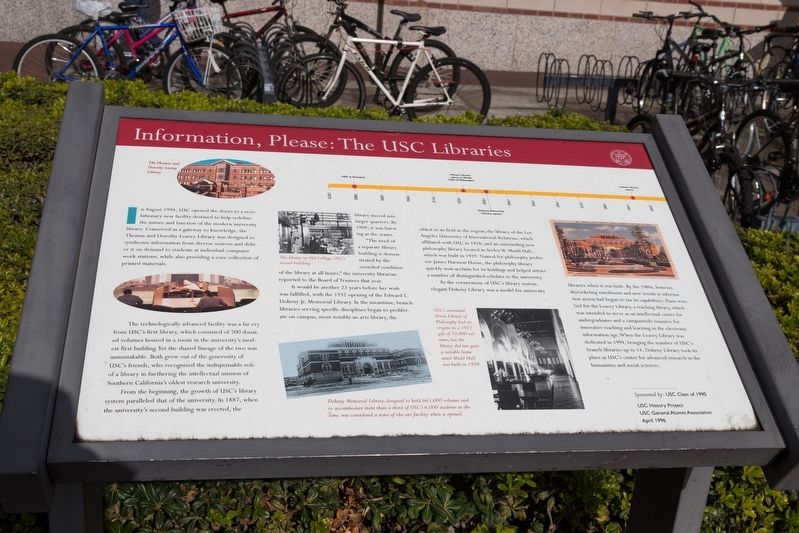
The technologically advanced facility was a far cry from USC’s first library, which consisted of 700 donated volumes housed in a room in the university’s modest first building. Yet the shared lineage of the two was unmistakable. Both grew out of the generosity of USC’s friends, who recognized the indispensable role of a library in furthering the intellectual mission of Southern California’s oldest research university.
From the beginning, the growth of USC’s library system paralleled that of the university. In 1887, when the university’s second building was erected, the library moved into larger quarters. By 1909, it was bursting at the seams.
“The need of a separate library building is
this page online
It would be another 23 years before her wish was fulfilled, with the 1932 opening of the Edward L. Doheny Jr. Memorial Library. In the meantime, branch libraries serving specific disciplines began to proliferate on campus, most notably an arts library, the oldest in its field in the region; the library of the Los Angeles University of International Relations, which affiliated with USC, in 1928; and an outstanding new philosophy library located in Seeley W. Mudd Hall, which was built in 1929. Named for philosophy professor James Harmon Hoose, the philosophy library quickly won acclaim for its holdings and helped attract a number of distinguished scholars to the university.
As the cornerstone of USC’s library system, elegant Doheny Library was a model for university libraries when it was built. By the 1980s, however, skyrocketing enrollment and new trends in information access had begun to tax its capabilities. Plans were laid for the Leavey Library, a teaching library, which was intended
Photographed by J. J. Prats, November 29, 2018
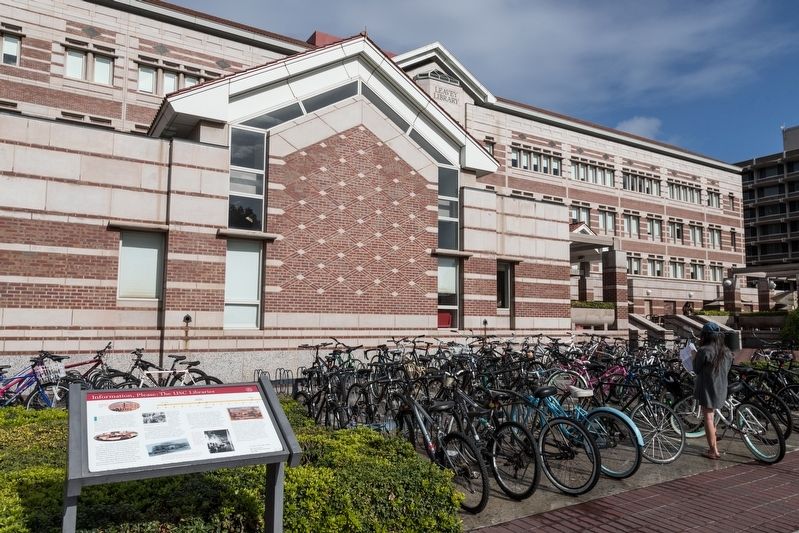
2. Interpretive Panel at Bike Stand at Leavey Library
Erected 1996 by USC History Project, USC Alumni Association. Sponsored by USC Class of 1990.
Topics. This historical marker is listed in this topic list: Education. A significant historical month for this entry is August 1994.
Location. 34° 1.308′ N, 118° 16.97′ W. Marker is in Los Angeles, California, in Los Angeles County. It is in South Los Angeles. It can be reached from McCarthy Quad. It is behind the Leavey Library facing McCarthy Quad. Touch for map. Marker is at or near this postal address: 651 W 35 St, Los Angeles CA 90089, United States of America. Touch for directions.

Regionally, this marker is in the Transverse Ranges. It is also on the American Pacific Coast. Globally, it is in North America, on the Ring of Fire, on the Pacific Rim, in the Western Hemisphere,
Photographed by J. J. Prats, November 29, 2018
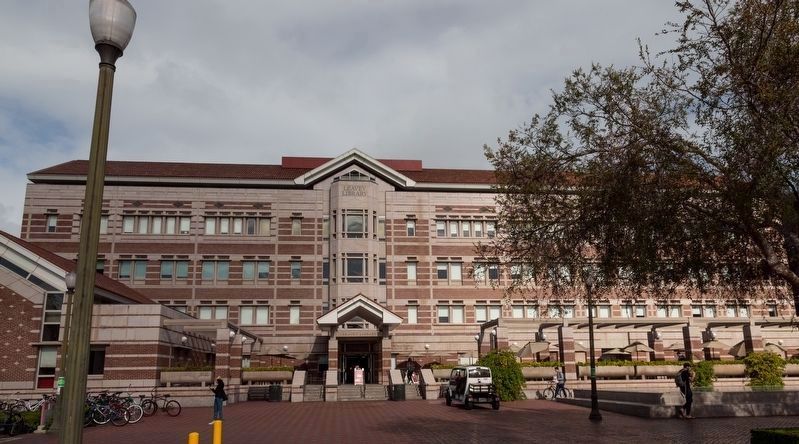
3. USC’s Thomas and Dorothy Leavey Library
View is from McCarthy Quad
Other nearby markers. At least 8 other markers are within walking distance of this marker: Founders’ Fountain (about 400 feet away, measured in a direct line); Shrine Auditorium & Expo Center (about 400 feet away); An International University (about 400 feet away); Dr. Joseph Medicine Crow (about 500 feet away); Public Service (about 500 feet away); A Changing Campus (about 500 feet away); The Trojan Column (about 500 feet away); University of Southern California (about 500 feet away). Touch for a list and map of all markers in Los Angeles.
More about this marker. This panel shows a timeline from 1870 to 2000 marking when USC was founded, Hoosd Library opened in Mudd Hall, Doheny Memorial Library opened, and Leavy Library opened. It has a number of illustrations (clockwise from top left) beginning with “the Thomas and Dorothy Leavy Library;” “the library in Old College, USC’s second building;” a postcard view of Doheny Memorial Library; “USC’s renowned Hoose Library of Philosophy had its
Photographed by J. J. Prats, November 29, 2018
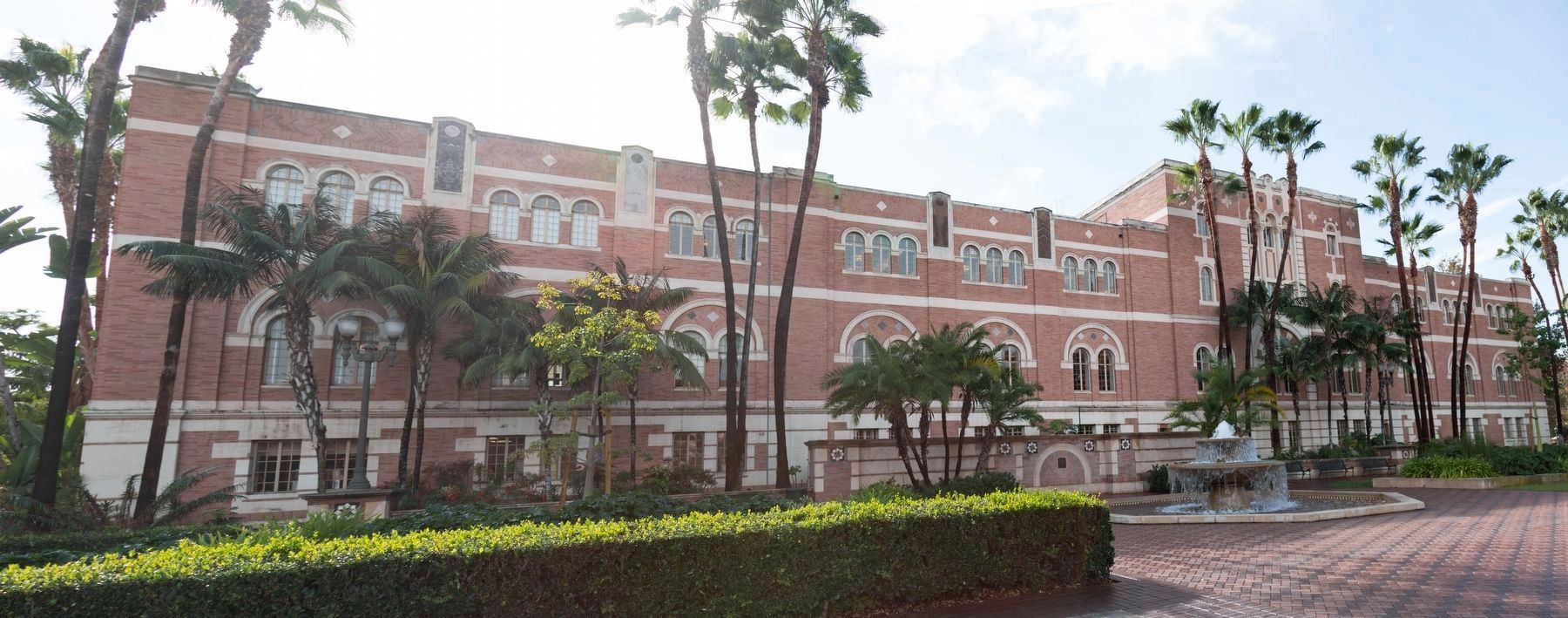
4. USC’s Edward L. Doheny Memorial Library
View is from McCarthy Quad. Fountain is the Carolyn Craig Franklin Fountain.
Credits. This page was last revised on October 27, 2023. It was originally submitted on February 23, 2019, by J. J. Prats of Powell, Ohio. This page has been viewed 746 times since then and 66 times this year. Photos: 1, 2, 3, 4. submitted on February 23, 2019, by J. J. Prats of Powell, Ohio.
