Galveston in Galveston County, Texas — The American South (West South Central)
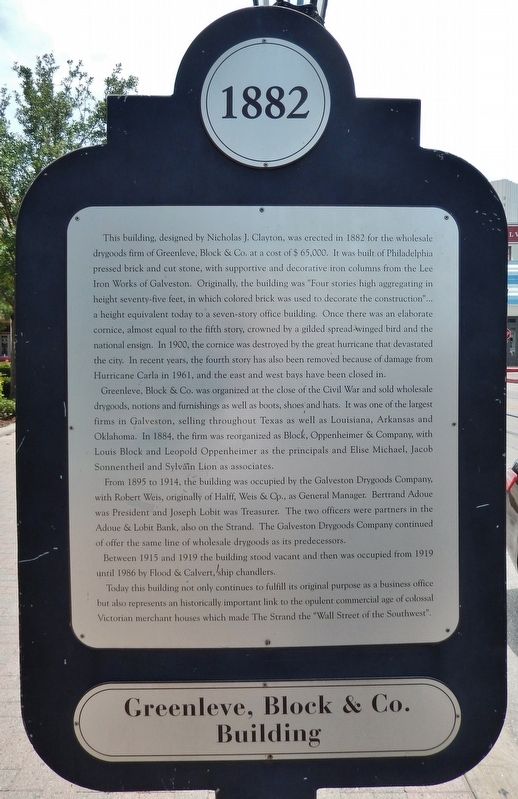
Greenleve, Block & Co. Building
1882
Photographed by Cosmos Mariner, May 14, 2018
1. Greenleve, Block & Co. Building Marker
Greenleve, Block & Co. was organized at the close of the Civil War and sold wholesale drygoods, notions and furnishings as well as boots, shoes and hats. It was one of the largest firms in Galveston, selling throughout Texas as well as Louisiana, Arkansas and Oklahoma. In 1884, the firm was reorganized as Block, Oppenheimer & Company, with Louis Block and Leopold Oppenheimer as the principals and Elise Michael, Jacob Sonnentheil and Sylvain Lion as associates.
From 1895 to 1914, the building was occupied by the Galveston Drygoods Company, with Robert Weis, originally of Halff, Weis & Co., as General Manager. Bertrand Adoue was President and Joseph Lobit was Treasurer. The two officers were partners in the Adoue & Lobit Bank, also on the Strand. The Galveston Drygoods Company continued to offer the same line of wholesale drygoods as its predecessors.
Between 1915 and 1919 the building stood vacant and then was occupied from 1919 until 1986 by Flood
this page online
Today this building not only continues to fulfill its original purpose as a business office but also represents an historically important link to the opulent commercial age of colossal Victorian merchant houses which made The Strand the "Wall Street of the Southwest.”
Topics. This historical marker is listed in these topic lists: Architecture • Industry & Commerce. A significant historical year for this entry is 1882.
Location. 29° 18.427′ N, 94° 47.694′ W. Marker is in Galveston, Texas, in Galveston County. It is on Strand Street west of 23rd Street, on the right when traveling west. Marker is located along the sidewalk on the north side of Strand Street, just west of Saengerfest Park, directly in front of the subject building. Touch for map. Marker is at or near this postal address: 2314 Strand Street, Galveston TX 77550, United States of America. Touch for directions.

Regionally, this marker is in the Houston Metropolitan Area. It is also in the American South and on the Gulf Coast. Globally, it is in North America, a Gulf of Mexico state, the Western Hemisphere, the Western World, and
Photographed by Cosmos Mariner, May 14, 2018
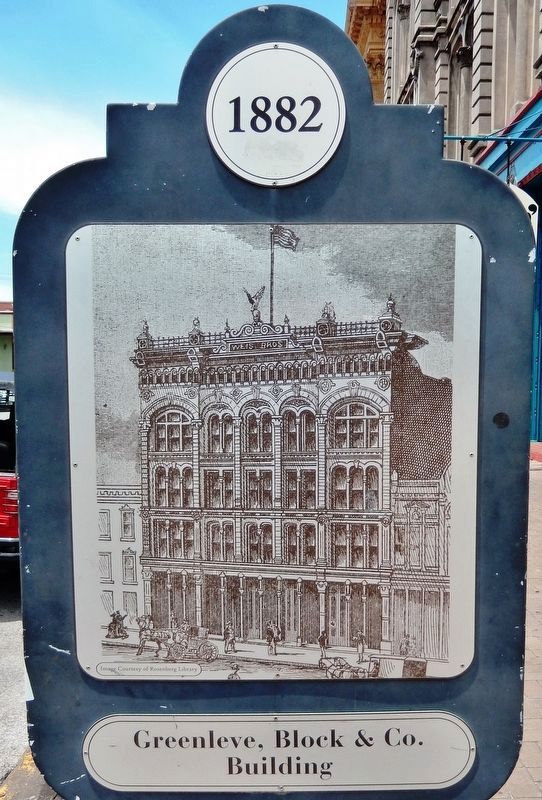
2. Greenleve, Block & Co. Building Marker (side 2)
Image Courtesy of Rosenberg Library.
Other nearby markers. At least 8 other markers are within walking distance of this marker: Magale Building (a few steps from this marker); 1871 Thomas Jefferson League Building (within shouting distance of this marker); Merchants Mutual Insurance Company Building (within shouting distance of this marker); Hutchings, Sealy & Co. (within shouting distance of this marker); Saengerfest Park (within shouting distance of this marker); Thomas Jefferson League Building (within shouting distance of this marker); Hutchings, Sealy & Co. Buildings (within shouting distance of this marker); Nicholas J. Clayton (within shouting distance of this marker). Touch for a list and map of all markers in Galveston.
More about this marker. Marker consists of two large laser-printed metal plaques, one with text and one with an historic photo, mounted on either side of a five-foot tall post.
Also see . . . Nicholas J. Clayton. Clayton was responsible for so many of the major public, commercial, and residential buildings constructed in Galveston during the 1870s, 1880s, and 1890s that this period in the city's history has been described as the "Clayton Era." Clayton was a High Victorian architect. His buildings were exuberant in shape, color, texture, and detail. He excelled at decorative brick and iron work. (Submitted on February 28, 2019, by Cosmos Mariner of Cape Canaveral, Florida.)
Photographed by Cosmos Mariner, May 14, 2018
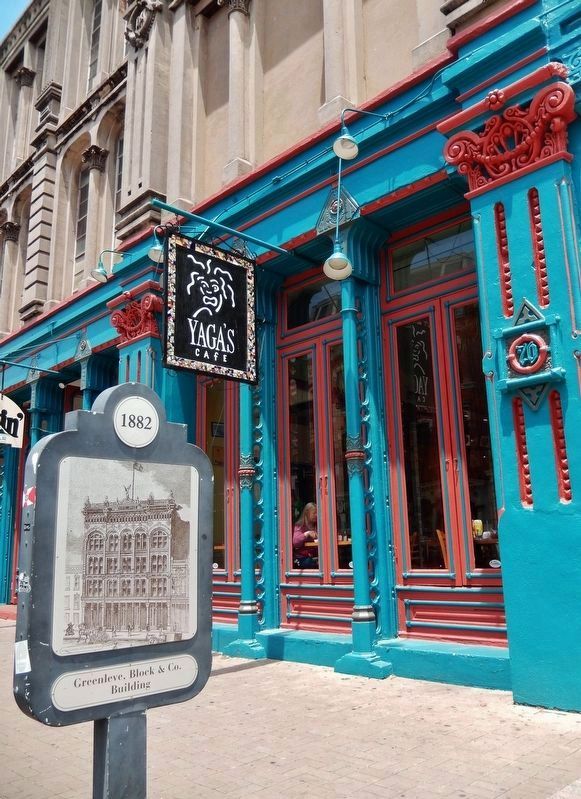
3. Greenleve, Block & Co. Building Marker
(tall view; building front detail on right)
(tall view; building front detail on right)
Photographed by Cosmos Mariner, May 14, 2018
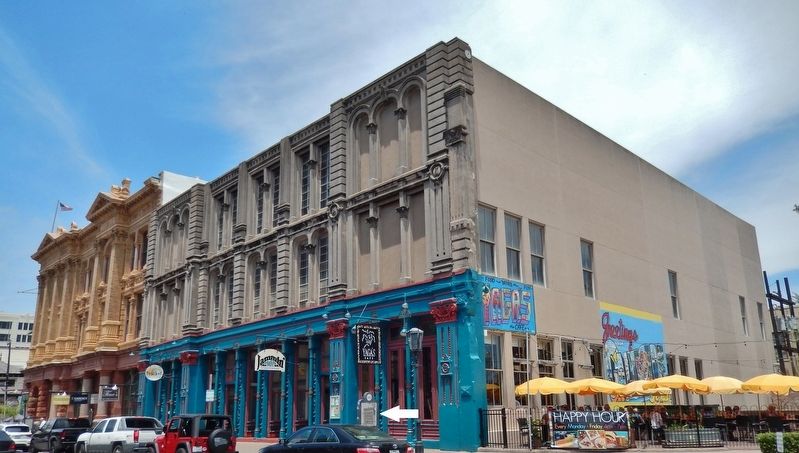
4. Greenleve, Block & Co. Building (marker visible along sidewalk at right)
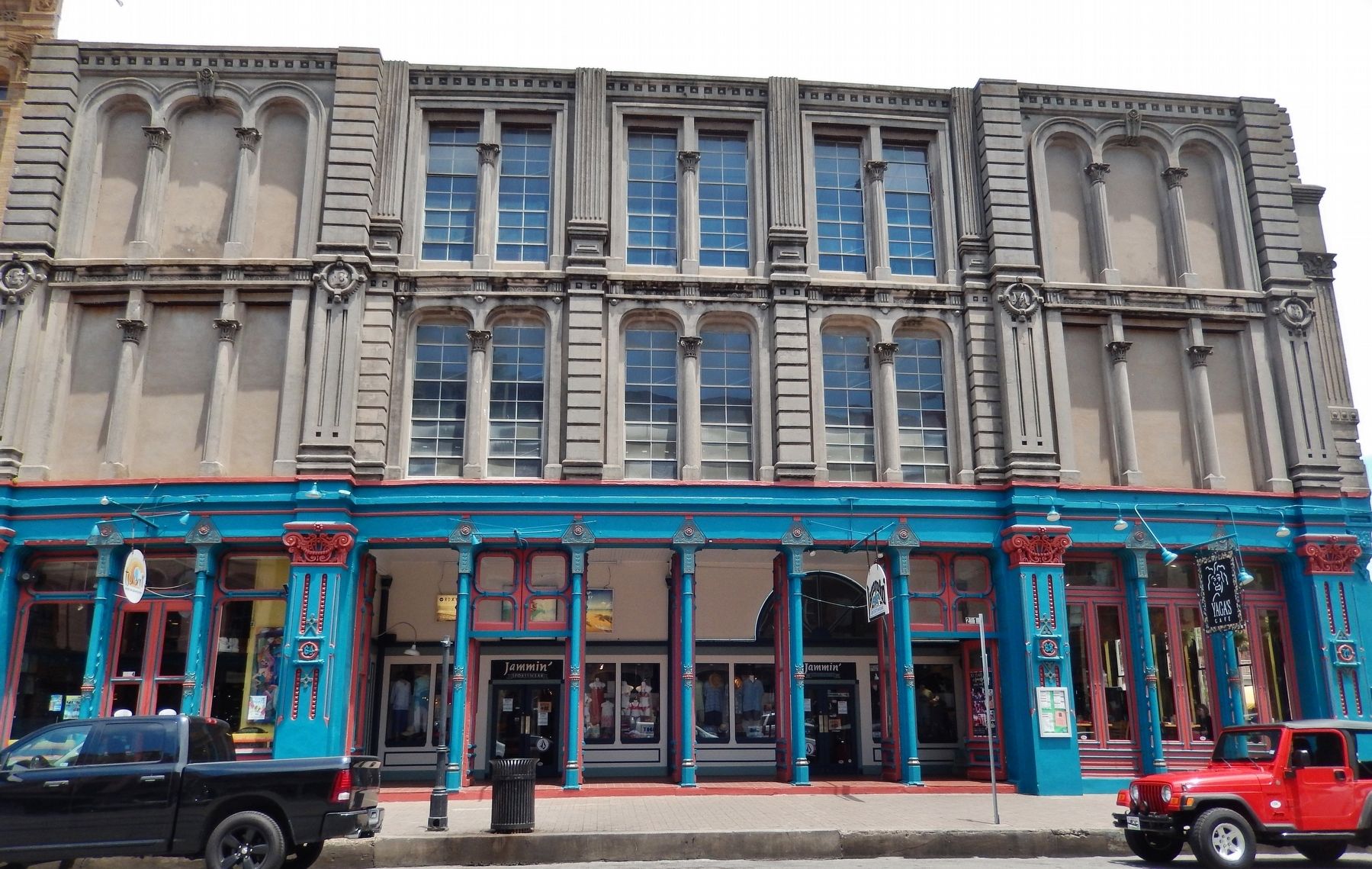
Photographed by Cosmos Mariner, May 14, 2018
5. Greenleve, Block & Co. Building
Credits. This page was last revised on March 1, 2019. It was originally submitted on February 27, 2019, by Cosmos Mariner of Cape Canaveral, Florida. This page has been viewed 706 times since then and 85 times this year. Photos: 1, 2, 3, 4, 5. submitted on February 27, 2019, by Cosmos Mariner of Cape Canaveral, Florida. • Andrew Ruppenstein was the editor who published this page.
