
White Creek in Washington County, New York — The American Northeast (Mid-Atlantic)
A Log Church
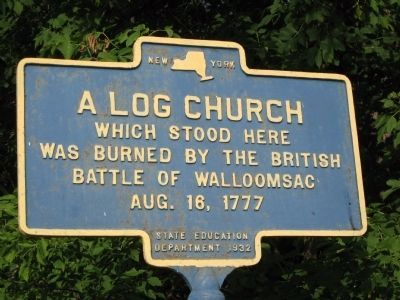
Photographed by Virginia McGreevy, August 16, 2012
1. A Log Church Marker
Erected 1932 by New York State Education Department.
Topics. This historical marker is listed in this topic list: War, US Revolutionary. A significant historical date for this entry is August 16, 1777.
Location. 42° 57.371′ N, 73° 19.104′ W. Marker is in White Creek, New York, in Washington County. It is at the intersection of North Hoosic Road and County Route 68, on the right when traveling north on North Hoosic Road. Touch for map. Marker is at or near this postal address: 171 North Hoosic Rd, Eagle Bridge NY 12057, United States of America. Touch for directions.

Regionally, this marker is in Upstate New York and in the Capital District. It is also in the American Northeast and in the Mid-Atlantic. Globally, it is in North America, the Great North Woods, the Western Hemisphere, the Western World, and the Anglosphere. Historically, it finds itself in what was once the Viceroyalty of New France, New Netherland, and one of the original Thirteen Colonies.
Other nearby markers. At least 8 other markers are within 2 miles
this page online
Additional commentary.
1. Was the Log Church really burned?
Neither myself, a historian at the Battlefield and another at the Saratoga Battlefield have found any evidence that the church was ever burned. There are mentions that the congregation outgrew the building by 1784 and eventually built a larger new one in Center White Creek and sold the log building by 1790. There is nothing in British records of burning a church, and the British were hoping Loyalists would join them and would be unlikely to antagonize them in such a way. The Native Americans could have (against orders) as they fled, but they were in a hurry to get out of
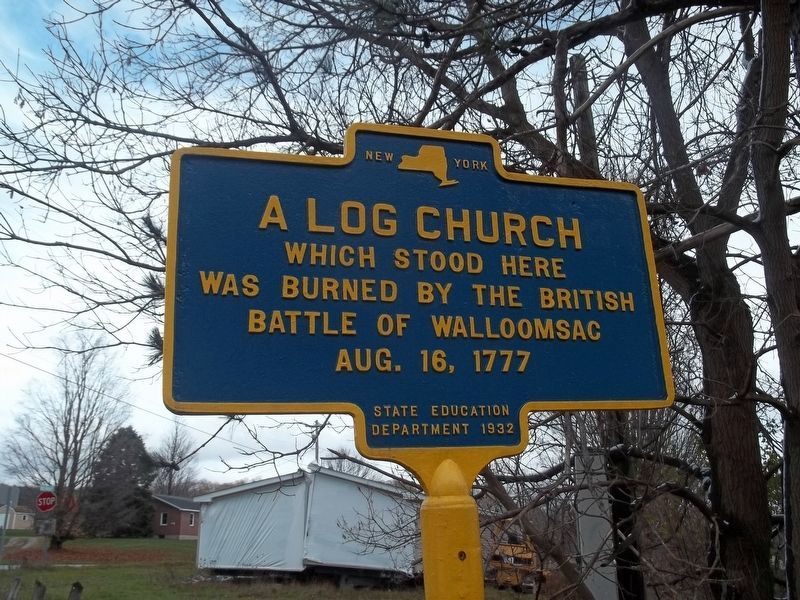
Photographed by Theodore Rice, October 30, 2020
2. A Log Church Marker after being stripped and repainted (2020).
— Submitted October 3, 2024, by Theodore Rice of Eagle Bridge, New York.
Additional keywords. Burgoyne Campaign, Bennington Battle, 1777
Credits. This page was last revised on October 4, 2024. It was originally submitted on August 17, 2012, by Tom McGreevy of Averill Park, New York. This page has been viewed 736 times since then and 29 times this year. Last updated on March 1, 2019, by Steve Stoessel of Niskayuna, New York. Photos: 1. submitted on August 17, 2012, by Tom McGreevy of Averill Park, New York. 2. submitted on October 3, 2024, by Theodore Rice of Eagle Bridge, New York. • Andrew Ruppenstein was the editor who published this page.
