Locust Point Industrial Area in Baltimore, Maryland — The American Northeast (Mid-Atlantic)
Baltimore Immigration History
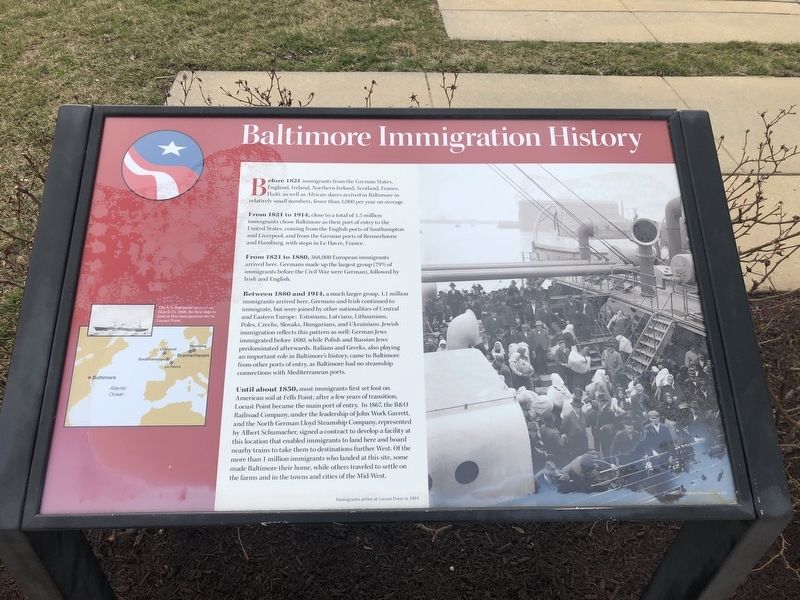
Before 1821 immigrants from the German States, England, Ireland, Northern Ireland, Scotland, France, Haiti, as well as African slave arrived in Baltimore in relatively small numbers, fewer than 1,000 per year on average.
From 1821 to 1914, close to a total of 1.5 million immigrants chose Baltimore as their port of entry to the United States, coming from the English ports of Southampton and Liverpool, and from the German ports of Bremerhaven and Hamburg, with stops in Le Havre, France.
From 1821 to 1880, 368,000 European immigrants arrived here. Germans made up the largest group (79% of immigrants before the Civil War were German), followed by Irish and English.
Between 1880 and 1914, a much larger group, 1.1 million immigrants arrived here. Germans and Irish continued to immigrate, but were joined by other nationalities of Central and Eastern Europe: Estonians, Latvians, Lithuanians, Poles, Czechs, Slovaks, Hungarians, and Ukrainians. Jewish immigration reflects this pattern as well; German Jews immigrated before 1880, while Polish and Russian Jews predominated afterwards. Italians and Greeks, also playing an
this page online
Until about 1850, most immigrants first set foot on American soil at Fells Point; afer a few years of transition, Locust Point became the main port of entry. In 1867, the B&O Railroad Company, under the leadership of John Work Garrett, and the North German Lloyd Steamship Company, represented by Albert Schumacher, signed a contract to develop a facility at this location that enabled immigrants to land here and board nearby trains to take them to destinations further West. Of the more than 1 million immigrants who landed at this site, some made Baltimore their home, while others traveled to settle on the farms and in the towns and cities of the Mid-West.
[Captions:]
The S. S. Baltimore arrived on March 23, 1868, the first ship to land at this immigration site in Locust Point.
Immigrants arrive at Locust Point in 1904
Topics. This historical marker is listed in these topic lists: Immigration • Religion & Religious Structures • Settlements & Settlers • Waterways & Vessels. A significant historical date for this entry is March 23, 1868.
Location. 39° 16.528′ N,
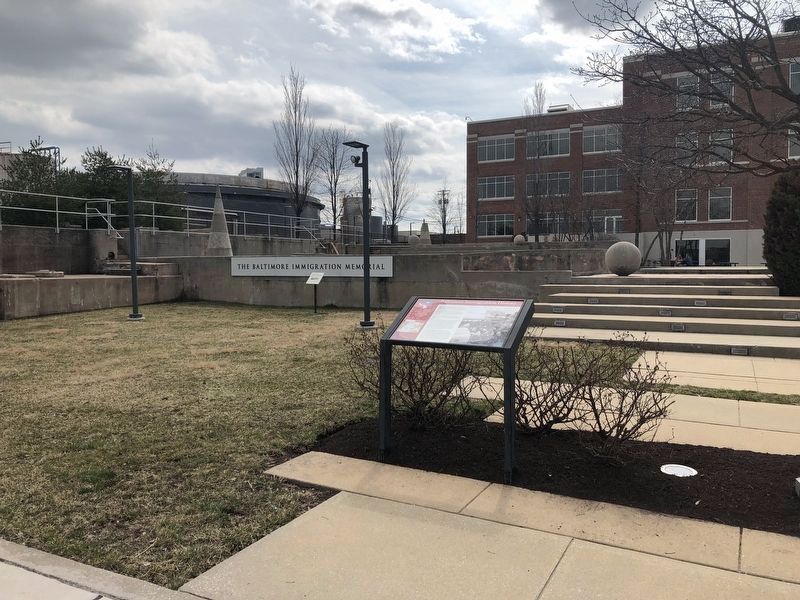

Regionally, this marker is in Central Maryland. It is also in the American Mid-Atlantic, in the Chesapeake Bay Region, and on the Eastern Seaboard. Globally, it is in the North Atlantic Region, North America, the Western Hemisphere, the Western World, and the Anglosphere. Historically, it finds itself in what was once one of the original Thirteen Colonies and also the Antebellum South.
Other nearby markers. At least 8 other markers are within walking distance of this marker: Locust Point Immigration Depot (a few steps from this marker); Merchant Ship Cannon (approx. 0.4 miles away); Welcome to the Frederick Douglass - Isaac Myers Maritime Park & Museum (approx. 0.4 miles away); Lady Maryland (approx. 0.4 miles away); Sigsbee (approx. 0.4 miles away); 931 Fell Street (approx. 0.4 miles away); The Black Caulkers of Fells Point (approx. 0.4 miles away); Frederick Douglass Sculpture (approx. 0.4 miles away). Touch for a list and map of all markers in Baltimore.
Another marker is no longer nearby. The Black Shipbuilders of the Chesapeake Bay (was approx. 0.4 miles away but has been replaced with another marker now near it).
Credits. This page was last revised on July 7, 2025. It was originally submitted on March 16, 2019, by Devry Becker Jones of Washington, District of Columbia. This page has been viewed 4,269 times since then and 236 times this year. Photos: 1, 2. submitted on March 16, 2019, by Devry Becker Jones of Washington, District of Columbia.
