Hunt Valley in Cockeysville in Baltimore County, Maryland — The American Northeast (Mid-Atlantic)
FuG 65 Wurzburg Riese (Giant) Radar Antenna
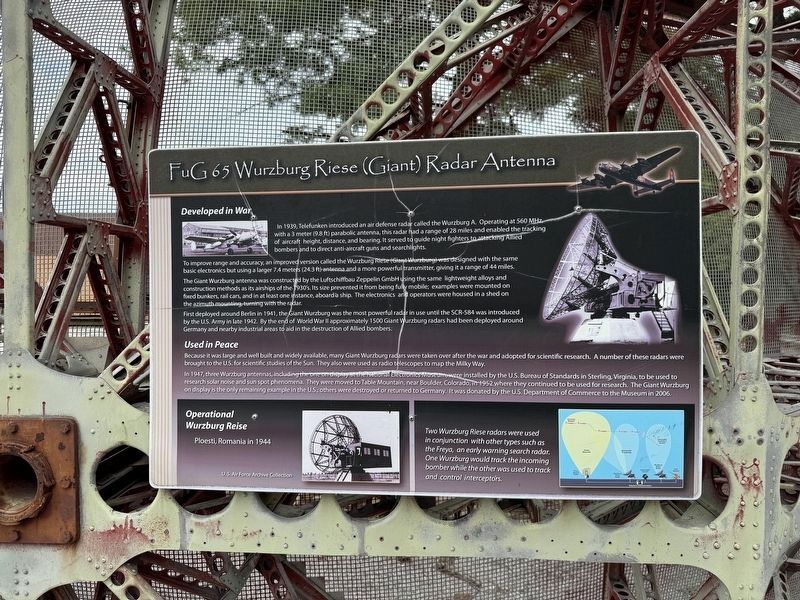
Photographed by Devry Becker Jones (CC0), August 24, 2025
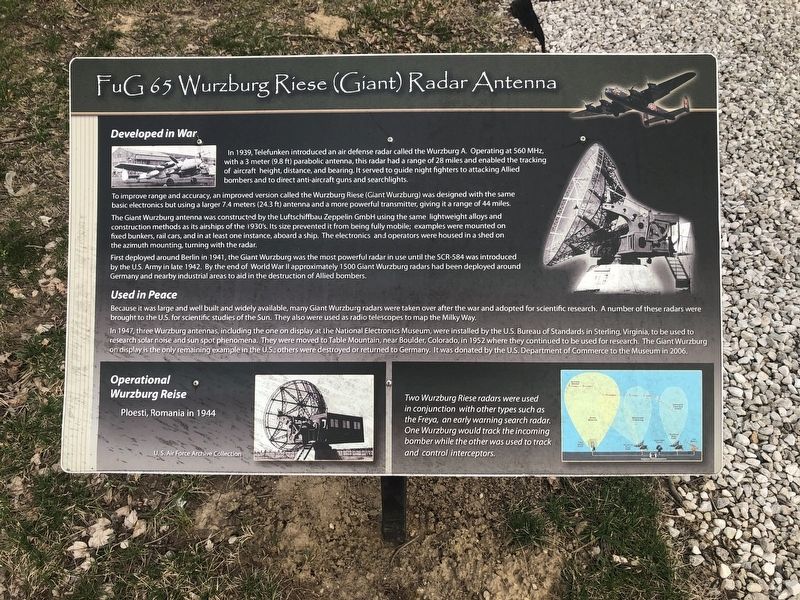
1. FuG 65 Wurzburg Riese (Giant) Radar Antenna Marker
Developed in War
In 1939, Telefunken introduced an air defense radar called the Wurzburg A. Operating at 560 MHz, with a 3 meter (9.8 ft) parabolic antenna, this radar had a range of 28 miles and enabled the tracking of aircraft height, distance, and baring. It served to guide night fighters to attacking Allied bombers and to direct anti-aircraft guns and searchlights.
To improve range and accuracy, an improved version called the Wurzburg Riese (Giant Wurzburg) was designed with the same basic electronics but using a larger 7.4 meters (24.3 ft) antenna and a more powerful transmitter, giving it a range of 44 miles.
The Giant Wurzburg antenna was constructed by the Luftschiffbau Zeppelin GmbH using the same lightweight alloys and construction methods as its airships of the 1930's. Its size prevented it from being fully mobile; examples were mounted on fixed bunkers, rail cars, and in at least one instance, aboard a ship. The electronics and operators were housed in a shed on the azimuth mounting, turning with the radar.
First deployed around Berlin in 1941, the Giant Wurzburg was the most powerful radar in use
this page online
Used in Peace
Because it was large and well built and widely available, many Giant Wurzburg radars were taken over after the war and adopted for scientific research. A number of thee radars were brought to the U.S. for scientific studies of the Sun. They were also used as radio telescopes to map the Milky Way.
In 1947, three Wurzburg antennas including the one on display at the National Electronics Museum, were installed by the U.S. Bureau of Standards in Sterling, Virginia, to be used research solar noise and sun spot phenomena. They were moved to Table Mountain, near Boulder, Colorado, in 1952 where they continued to be used for research. The Giant Wurzburg on display is the only remaining example in the U.S.; others were destroyed or returned to Germany. It was donated by the U.S. Department of Commerce to the Museum in 2006.
Two Wurzburg Riese radars were used in conjunction with other types such as the Freya, an early warning search radar. One Wurzburg would track the incoming bomber while the other was used to track and control interceptors.
Erected by National
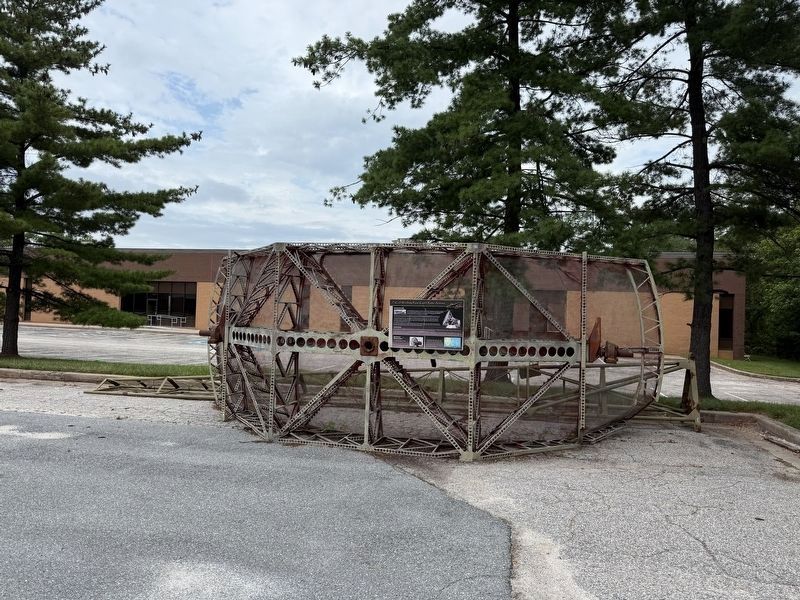
Photographed by Devry Becker Jones (CC0), August 24, 2025
2. FuG 65 Wurzburg Riese (Giant) Radar Antenna Display
Topics. This historical marker is listed in these topic lists: Air & Space • Communications • Military • War, World II. A significant historical year for this entry is 1939.
Location. 39° 29.155′ N, 76° 39.838′ W. Marker is in Cockeysville, Maryland, in Baltimore County. It is in Hunt Valley. It is on Clubhouse Road 0.2 miles west of Gilroy Road, on the right when traveling north. Touch for map. Marker is at or near this postal address: 330 Clubhouse Rd, Hunt Valley MD 21031, United States of America. Touch for directions.

Regionally, this marker is in the Baltimore Metro Region and in Central Maryland. It is also in the American Mid-Atlantic, in the Chesapeake Bay Region, and on the Eastern Seaboard. Globally, it is in the North Atlantic Region, North America, the Western Hemisphere, the Western World, and the Anglosphere. Historically, it finds itself in what was once one of the original Thirteen Colonies and also the Antebellum South.
Other nearby markers. At least 8 other markers are within 2 miles of this marker, measured as the crow flies: Hayfields (approx. 0.8 miles away); "...To Those Who Served"
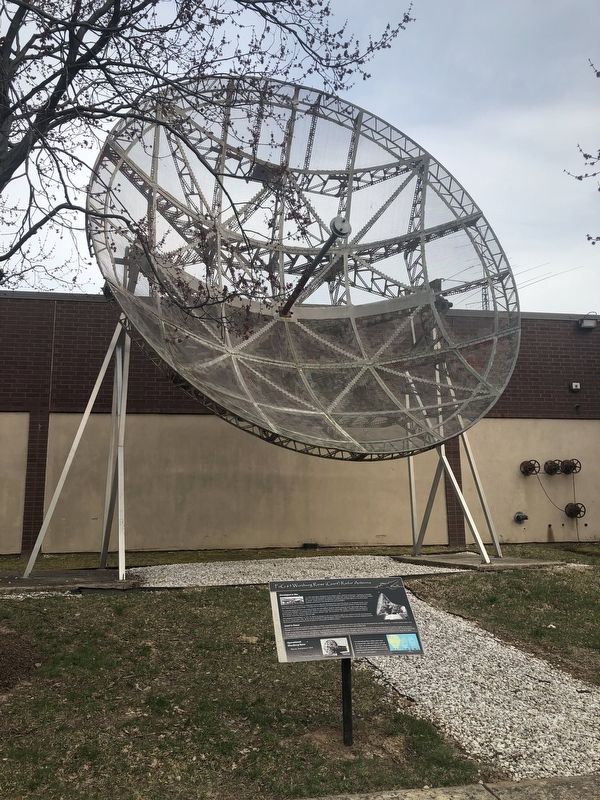
Photographed by Devry Becker Jones (CC0), March 30, 2019
3. FuG 65 Wurzburg Riese (Giant) Radar Antenna Marker
This is a photo of the marker in its prior environs before it was moved.
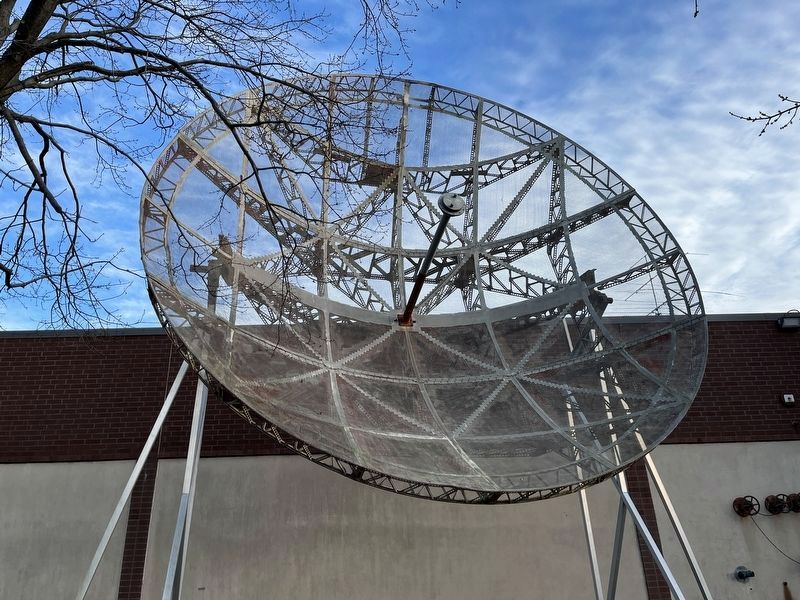
Photographed by Adam Margolis, December 19, 2022
4. FuG 65 Wurzburg Riese (Giant) Radar Antenna
Photographed by Devry Becker Jones (CC0), March 30, 2019
5. FuG 65 Wurzburg Riese (Giant) Radar Antenna Marker
Credits. This page was last revised on August 24, 2025. It was originally submitted on March 31, 2019, by Devry Becker Jones of Washington, District of Columbia. This page has been viewed 1,126 times since then and 105 times this year. Photos: 1, 2. submitted on August 24, 2025, by Devry Becker Jones of Washington, District of Columbia. 3. submitted on March 31, 2019, by Devry Becker Jones of Washington, District of Columbia. 4. submitted on March 21, 2023, by Adam Margolis of Mission Viejo, California. 5. submitted on March 31, 2019, by Devry Becker Jones of Washington, District of Columbia.
