Alcove in Albany County, New York — The American Northeast (Mid-Atlantic)
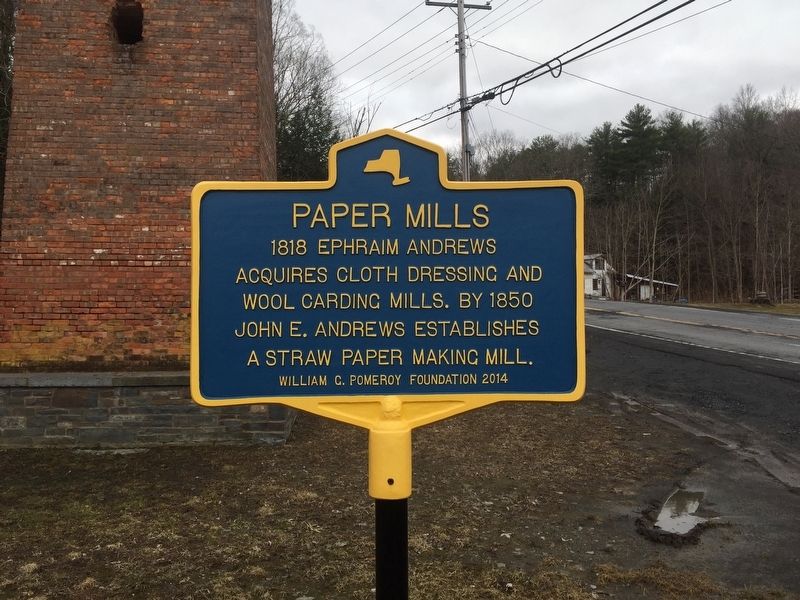
Paper Mills
Photographed by Steve Stoessel, March 31, 2019
1. Paper Mills Marker
Erected 2014 by William G. Pomeroy Foundation.
Topics. This historical marker is listed in these topic lists: Industry & Commerce • Settlements & Settlers. A significant historical year for this entry is 1818.
Location. 42° 28.407′ N, 73° 55.4′ W. Marker is in Alcove, New York, in Albany County. It is at the intersection of New York State Route 143 and County Route 111, on the left when traveling west on New York State Route 143. Touch for map. Marker is in this post office area: Coeymans Hollow NY 12046, United States of America. Touch for directions.

Regionally, this marker is in Upstate New York, in the Capital District, and in the Albany Metropolitan Area. It is also in the American Northeast and in the Mid-Atlantic. Globally, it is in North America, the Western Hemisphere, the Western World, and the Anglosphere. Historically, it finds itself in what was once New Netherland and also one of the original Thirteen Colonies.
Other nearby markers. At least 8 other markers
this page online
Also see . . . Valley Paper Mill Chimney and Site - National Archives. National register of Historic Places documentation (Submitted on November 14, 2023, by Anton Schwarzmueller of Wilson, New York.)
Photographed by Steve Stoessel, March 31, 2019
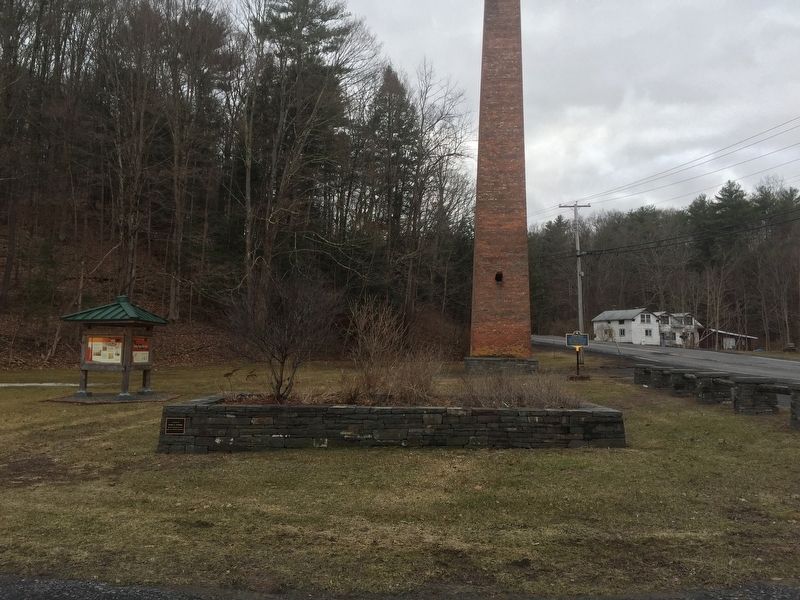
2. Valley Paper Mill Park
Photographed by Steve Stoessel, March 31, 2019
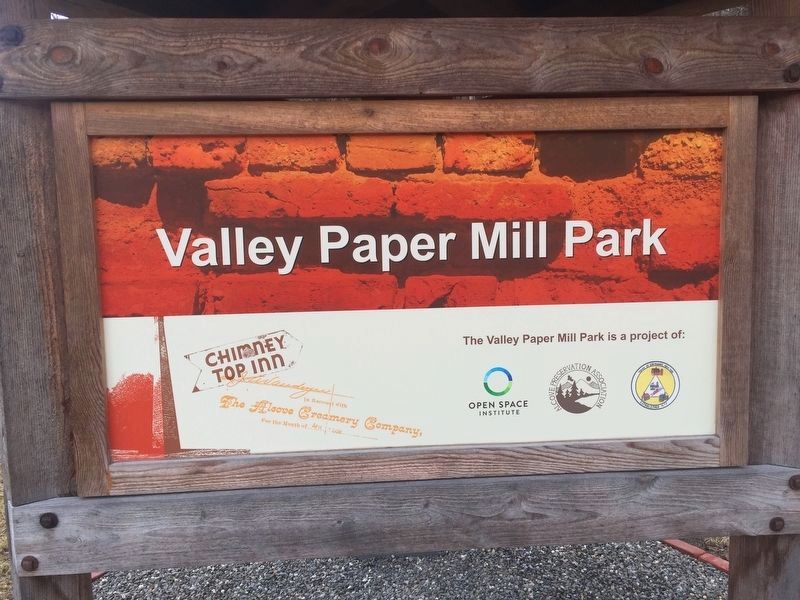
3. Valley Paper Mill Park Marker
The Valley Paper Mill Park is a project of:
Open Space Institute/Alcove Preservation Association/Town of Coeymans
Open Space Institute/Alcove Preservation Association/Town of Coeymans
Photographed by Steve Stoessel, March 31, 2019
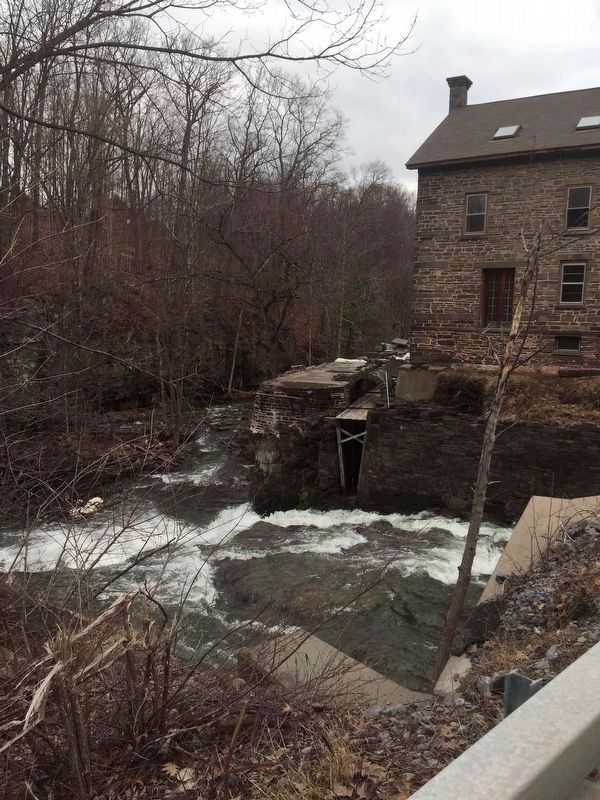
4. Hannacroix Creek
Hannacrois Creek is a 21-mile-long tributary to the Hudson River. From its source in Westerlo, it flows through Dunbar Hollows and over Dickerson Falls to the Alcove Reservoir. It then passes through Coeymans Hollow and just into Greene County to its mouth at the Hudson River in Coeymans, NY.
Variant names of the creek include Hannacroix Creek, Haanadrois Creek, and Hannekraai, among others. The name translates to the Dutch "Rooster crowing". There is a story that the early Dutch settlers here saw a rooster come floating down the creek on a block of ice, so the creek became known as the Hannekraai, meaning "cock-crowing" creek. The settlement of Hannecroix also took its name from the creek.
Variant names of the creek include Hannacroix Creek, Haanadrois Creek, and Hannekraai, among others. The name translates to the Dutch "Rooster crowing". There is a story that the early Dutch settlers here saw a rooster come floating down the creek on a block of ice, so the creek became known as the Hannekraai, meaning "cock-crowing" creek. The settlement of Hannecroix also took its name from the creek.
Photographed by Steve Stoessel, March 31, 2019
5. History
1790
Settled in 1790 as Stephenville, the Alcove community harnessed the power of water from the Hannacroix Creek in the early industrial era of this region of the state.
1844
Here in 1844, Ephraim Andres built a cloth and wool carding mill powered by water impounded by a timber dam on the Hannacroix Creek which flows next to the park.
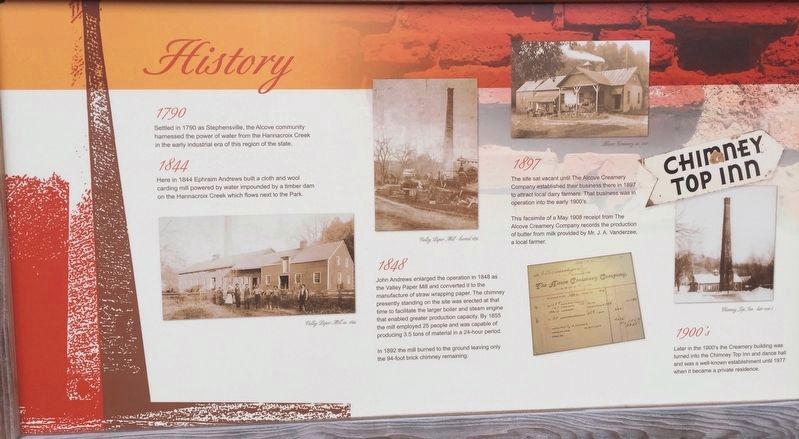
1848 John Andrews enlarged the operation in 1848 as the Valley Paper Mill and converted it to the manufacture of straw wrapping paper. The chimney presently standing on the site was erected at that time to facilitate the larger boiler and steam engine that enabled greater production capacity. By 1855, the mill employed 25 people and was capable of producing 3.5 tons of material in a 24-hour period. In 1892, the mill burned to the ground leaving only the 94-foot brick chimney remaining.
1897
The site sat vacant until The Alcove Creamery Company established their business there in 1897to attract local farmers. That business was in operation into the early 1900’s
This facsimile of a May 1908 receipt from The Alcove Creamery Company records the production of butter from milk provided by Mr. J.A. Vanderzee, a local farmer.
1900’s
Later in the 1900’s, the Creamery building was turned into the Chimney Top Inn and dance hall and was a well-known establishment until 1977 when it became a private residence.
Settled in 1790 as Stephenville, the Alcove community harnessed the power of water from the Hannacroix Creek in the early industrial era of this region of the state.
1844
Here in 1844, Ephraim Andres built a cloth and wool carding mill powered by water impounded by a timber dam on the Hannacroix Creek which flows next to the park.
1848 John Andrews enlarged the operation in 1848 as the Valley Paper Mill and converted it to the manufacture of straw wrapping paper. The chimney presently standing on the site was erected at that time to facilitate the larger boiler and steam engine that enabled greater production capacity. By 1855, the mill employed 25 people and was capable of producing 3.5 tons of material in a 24-hour period. In 1892, the mill burned to the ground leaving only the 94-foot brick chimney remaining.
1897
The site sat vacant until The Alcove Creamery Company established their business there in 1897to attract local farmers. That business was in operation into the early 1900’s
This facsimile of a May 1908 receipt from The Alcove Creamery Company records the production of butter from milk provided by Mr. J.A. Vanderzee, a local farmer.
1900’s
Later in the 1900’s, the Creamery building was turned into the Chimney Top Inn and dance hall and was a well-known establishment until 1977 when it became a private residence.
Photographed by Steve Stoessel, March 31, 2019
6. A Local Landmark
When occupied as a private residence, the Alcove Christian Fellowship held its services on this site for a time burned the building burned in 1985. Until purchased by the Open Space Institute in 2003 in 2003, the site was neglected and overgrown.
The site was purchased from Albany County in 2003 by the Open Space Institute, deeding it to the Alcove Preservation Society to preserve the site as open space, to develop it as a public passive park, and to recognize its historic significance with the construction of this kiosk.
In 2006, the site was placed on both the National Register of Historic Places and the New York State Register of Historic Places.
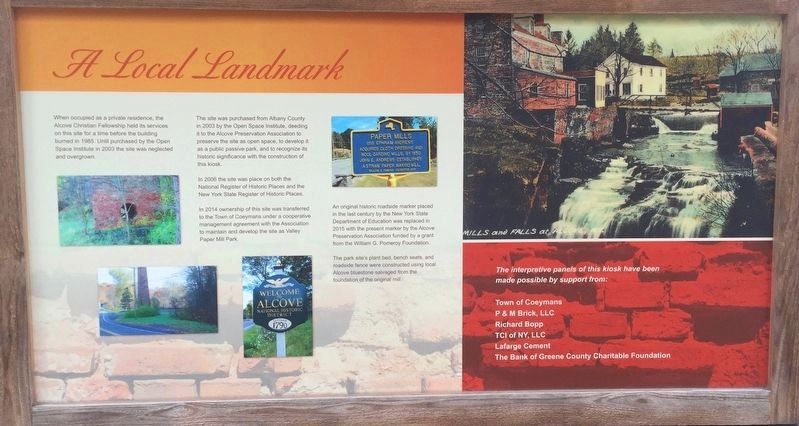
In 2014, ownership of this site was transferred to the Town of Coeymans under a cooperative management agreement with the Association to maintain and develop the site as Valley Paper Mill Park. An original historic roadside marker placed in the last century by the New York State Department of Education was replaced in 2015 with the present marker by the Alcove Preservation Association funded by a grant from the William G. Pomeroy Foundation.
The park site’s plant bed, bench, seats, and roadside fence were constructed using local Alcove bluestone salvaged from the foundation of the original mill.
The site was purchased from Albany County in 2003 by the Open Space Institute, deeding it to the Alcove Preservation Society to preserve the site as open space, to develop it as a public passive park, and to recognize its historic significance with the construction of this kiosk.
In 2006, the site was placed on both the National Register of Historic Places and the New York State Register of Historic Places.
In 2014, ownership of this site was transferred to the Town of Coeymans under a cooperative management agreement with the Association to maintain and develop the site as Valley Paper Mill Park. An original historic roadside marker placed in the last century by the New York State Department of Education was replaced in 2015 with the present marker by the Alcove Preservation Association funded by a grant from the William G. Pomeroy Foundation.
The park site’s plant bed, bench, seats, and roadside fence were constructed using local Alcove bluestone salvaged from the foundation of the original mill.
Credits. This page was last revised on October 3, 2025. It was originally submitted on April 4, 2019, by Steve Stoessel of Niskayuna, New York. This page has been viewed 1,044 times since then and 111 times this year. Photos: 1, 2, 3, 4, 5, 6. submitted on April 4, 2019, by Steve Stoessel of Niskayuna, New York. • Bill Pfingsten was the editor who published this page.
