National Museum of Transportation near Kirkwood in St. Louis County, Missouri — The American Midwest (Upper Plains)
Narrow Gauge
Museum of Transportation
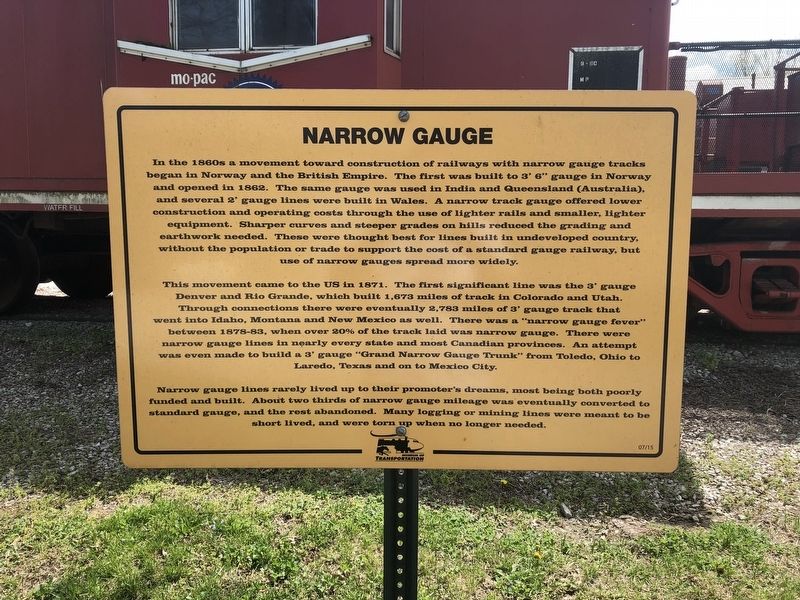
In the 1860s a movement toward construction of railways with narrow gauge tracks began in Norway and the British Empire. The first was built to 3' 6" gauge in Norway and opened in 1862. The same gauge was used in India and Queensland (Australia), and several 2' gauge lines were built in Wales. A narrow track gauge offered lower construction and operation costs through the use of lighter rails and smaller, lighter equipment. Sharper curves and steeper grades on hills reduced the grading and earthwork needed. These were thought best for lines built in undeveloped country without the population or trade to support the cost of a standard gauge railway, but use of narrow gauges spread more widely.
This movement came to the US in 1871. The first significant line was the 3' gauge Denver and Rio Grande, which built 1,673 miles of track in Colorado and Utah. Through connections there were eventually 2,783 miles of 3' gauge track that went into Idaho, Montana and New Mexico as well. There was a "narrow gauge fever" between 1878-83, when over 20% of the track laid was narrow gauge. There were narrow gauge lines in nearly every
this page online
Narrow gauge lines rarely lived up to their promoter's dreams, most being both poorly funded and built. About two third of narrow gauge mileage was eventually converted to standard gauge, and the rest abandoned. Many logging or mining lines were meant to be short lived, and were torn up when no longer needed.
Erected by Museum of Transportation.
Topics. This historical marker is listed in these topic lists: Industry & Commerce • Railroads & Streetcars. A significant historical year for this entry is 1862.
Location. 38° 34.269′ N, 90° 27.809′ W. Marker is near Kirkwood, Missouri, in St. Louis County. It is in National Museum of Transportation. It can be reached from Barrett Station Road east of Old Dougherty Ferry Road, on the right when traveling east. Touch for map. Marker is at or near this postal address: 3015 Barrett Station Road, Saint Louis MO 63122, United States of America. Touch for directions.

Regionally, this marker is in Greater St. Louis. It is
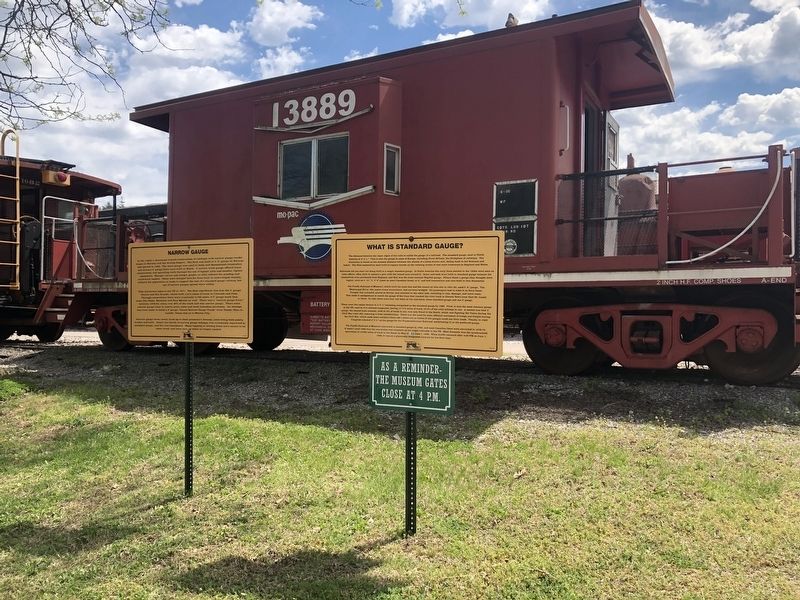
Other nearby markers. At least 8 other markers are within walking distance of this marker: What Is Standard Gauge? (here, next to this marker); Northern Pacific #1082 (a few steps from this marker); Missouri Pacific #13889 (a few steps from this marker); Georgia Railroad #724 (a few steps from this marker); Chicago, Burlington & Quincy #6117 (a few steps from this marker); MCHX #117 (a few steps from this marker); City of St. Louis Water Division #1 (a few steps from this marker); What Does "Bi-Polar" Mean? (a few steps from this marker). Touch for a list and map of all markers in Kirkwood.
Credits. This page was last revised on April 24, 2020. It was originally submitted on April 28, 2019, by Devry Becker Jones of Washington, District of Columbia. This page has been viewed 248 times since then and 20 times this year. Photos: 1, 2. submitted on April 28, 2019, by Devry Becker Jones of Washington, District of Columbia.
