Delmar Loop in St. Louis, Missouri — The American Midwest (Upper Plains)
Carl Wimar
Born February 20, 1828
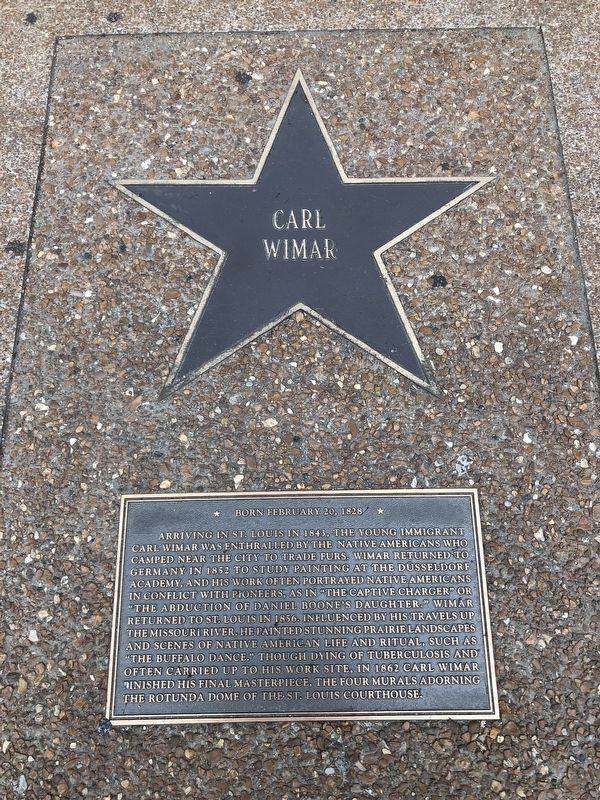
Arriving in St. Louis in 1843, the young immigrant Carl Wimar was enthralled by the Native Americans who camped near the city to trade furs. Wimar returned to Germany in 1852 to study painting at the Düsseldorf Academy, and his work often portrayed Native Americans in conflict with pioneers, as in "The Captive Charger" or "The Abduction of Daniel Boone's Daughter." Wimar returned to St. Louis in 1856. Influenced by his travels up the Missouri River, he painted stunning prairie landscapes and scenes of Native American life and ritual, such as "The Buffalo Dance." Though dying of tuberculosis and often carried up to his work site, in 1862 Carl Wimar finished his final masterpiece, the four murals adorning the rotunda dome of the St. Louis Courthouse.
Erected 2016 by St. Louis Walk of Fame.
Topics and series. This historical marker is listed in these topic lists: Arts, Letters, Music • Immigration • Indigenous Peoples and Communities. In addition, it is included in the Missouri, St. Louis Walk of Fame series list. A significant historical date for this entry is February 20, 1828.
Location. 38° 39.339′ N, 90° 18.044′ W. Marker
this page online

Regionally, this marker is in the American Midwest, in the Lewis & Clark Corridor, in the Corn Belt, and in the Great River Road Region. Globally, it is in North America, the Western Hemisphere, the Western World, and the Anglosphere. Historically, it finds itself in what was once the territory of the Mississippian Culture, the Louisiana Purchase, and the Antebellum South.
Other nearby markers. At least 8 other markers are within walking distance of this marker: "Butch" O'Hare (here, next to this marker); Walker Hancock (a few steps from this marker); Brett Hull (a few steps from this marker); Edna Gellhorn (within shouting distance of this marker); Whitey Herzog (within shouting distance of this marker); Michael & Leon Spinks (within shouting distance of this marker); St. Philippine Duchesne, RSCJ (within shouting distance of this marker); Roscoe Robinson Jr. (within shouting distance of this marker). Touch for a list and map of all markers in St. Louis.
Also see . . . Karl Ferdinand Wimar on Wikipedia. Wimar (1828-1862) emigrated to the United States with his family when he was 15. His first name was also known to begin with a "K." He is buried at Bellefontaine Cemetery. (Submitted on February 2, 2026, by Jason Voigt of Glen Carbon, Illinois.)
Credits. This page was last revised on February 2, 2026. It was originally submitted on April 29, 2019, by Devry Becker Jones of Washington, District of Columbia. This page has been viewed 297 times since then and 21 times this year. Photo 1. submitted on April 29, 2019, by Devry Becker Jones of Washington, District of Columbia.
