Bellflower in Los Angeles County, California — The American West (Pacific Coastal)
Bellflower Pacific Electric Train Depot
Photographed by Craig Baker, March 20, 2019
1. Bellflower Train Depot Marker
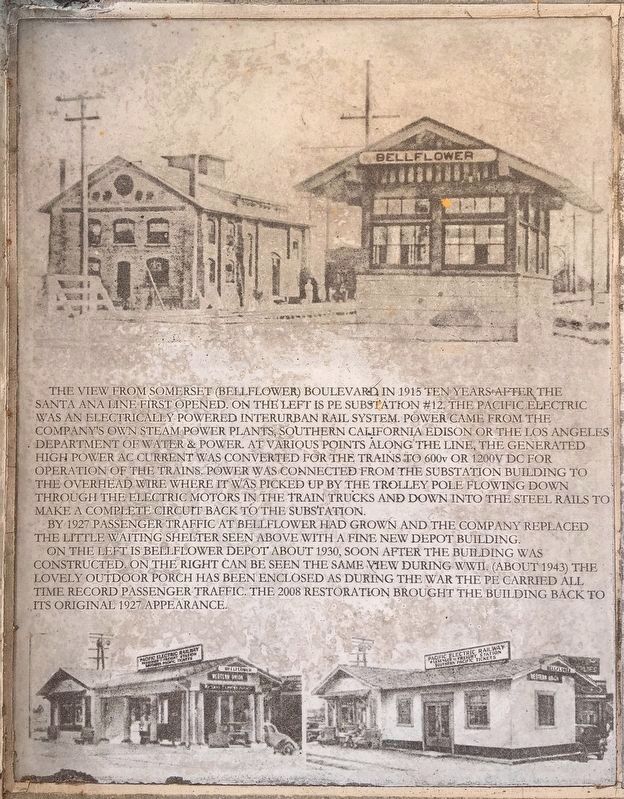
The view from Somerset (Bellflower) Boulevard in 1915, 10 years after the Santa Ana line first opened. On the left is PE substation #12. The Pacific Electric was an electrically powered interurban rail system. Power came from the company’s own steam power plants, Southern California Edison, or the Los Angeles Department of Water & Power. At various points along the line, the generated high power AC current was converted to 600v or 1200v DC for operation of the trains. Power was connected from the substation building to the overhead wire where it was picked up by the trolley pole flowing down through the electric motors in the train trucks and down into the steel rails to make a complete circuit back to the substation.
By 1927 passenger traffic at Bellflower had grown and the company replaced the little waiting shelter seen above with a fine new depot building.
On the left is Bellflower Depot about 1930 soon after the building was constructed. On the right can be seen the same view during WWII. About 1943 the lovely outdoor porch has been enclosed as during the war the PE carried all time record passenger traffic. The
this page online
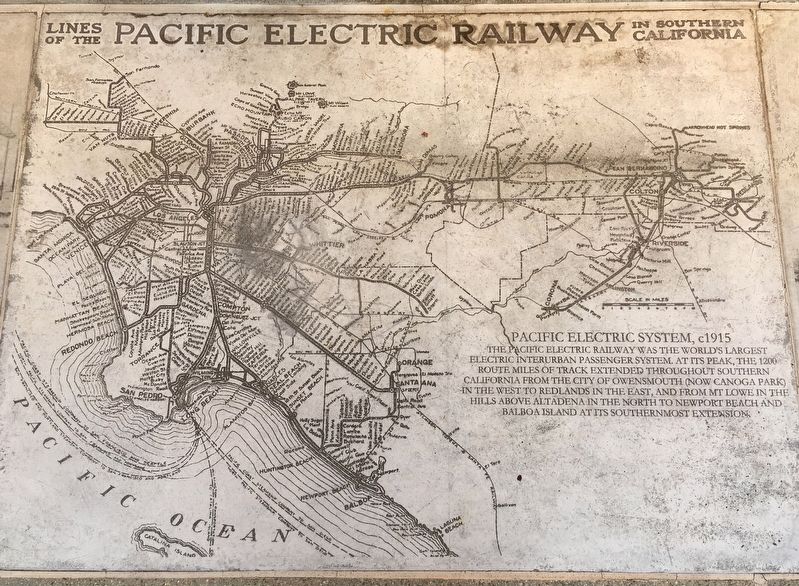
Pacific Electric System, c.1915
The Pacific Electric Railway was the world’s largest electric interurban passenger system. At its peak, the 1200 route miles of track extended throughout Southern California from the city of Owensmouth (now Canoga Park) in the west to Redlands in the east, and from Mt. Lowe in the hills above Altadena in the north to Newport Beach and Balboa Island at its southernmost extension.
Interurban Cars
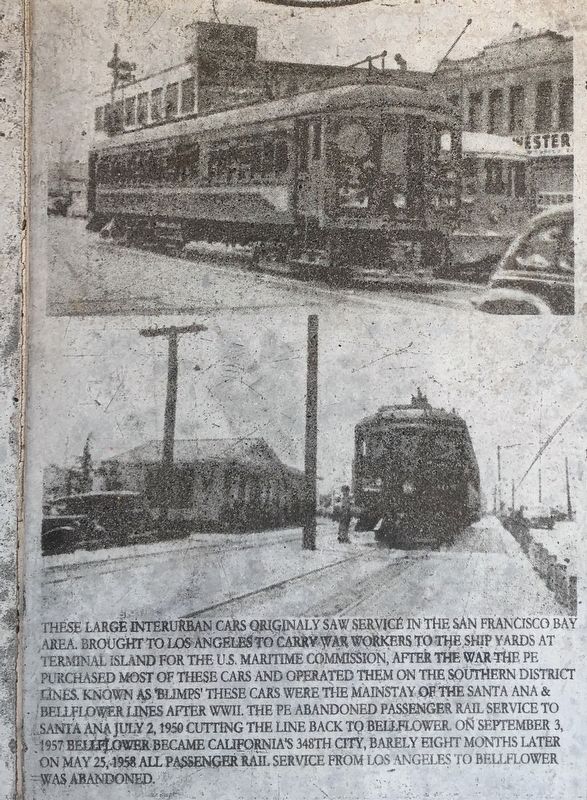
These large interurban cars originally saw service in the San Francisco Bay area. Brought to Los Angeles to carry war workers to the ship yards at Terminal Island for the US Maritime Commission, after the war the PE purchased most of these cars and operated them on the Southern District lines. Known as ‘blimps’ these cars were the mainstay of the Santa Ana & Bellflower lines after WWII. The PE abandoned passenger rail service to Santa Ana July 2, 1950 cutting the line back to Bellflower. On September 3, 1957 Bellflower became California’s 348th city, barely eight months later on May 25, 1958 all passenger rail service
Photographed by Craig Baker, March 20, 2019
2. Pacific Electric System, c.1915
Topics. This historical marker is listed in these topic lists: Architecture • Railroads & Streetcars.
Location. 33° 53.132′ N, 118° 7.498′ W. Marker is in Bellflower, California, in Los Angeles County. It is at the intersection of Bellflower Boulevard and Mayne Street, on the left when traveling south on Bellflower Boulevard. Touch for map. Marker is at or near this postal address: 16398 Bellflower Boulevard, Bellflower CA 90706, United States of America. Touch for directions.

Regionally, this marker is in Greater Los Angeles and in the Transverse Ranges. It is also on the American Pacific Coast. Globally, it is in North America, on the Ring of Fire, on the Pacific Rim, in the Western Hemisphere, in the Western World, and in the Anglosphere. Historically, it finds itself in what was once New Spain and also Mexico’s Alta California.
Other nearby markers. At least 8 other markers are within 4 miles of this marker, measured as the crow flies: Under the Hay Tree, World’s Hay Price Was Set (approx. 2 miles away); Paramount Hay Tree
Photographed by Craig Baker, March 20, 2019
3. Interurban Cars
Another marker is no longer nearby. The Boys of Del Valle Park (was approx. 3.1 miles away but has been confirmed missing).
Photographed by Craig Baker, March 20, 2019
4. Train Depot Marker
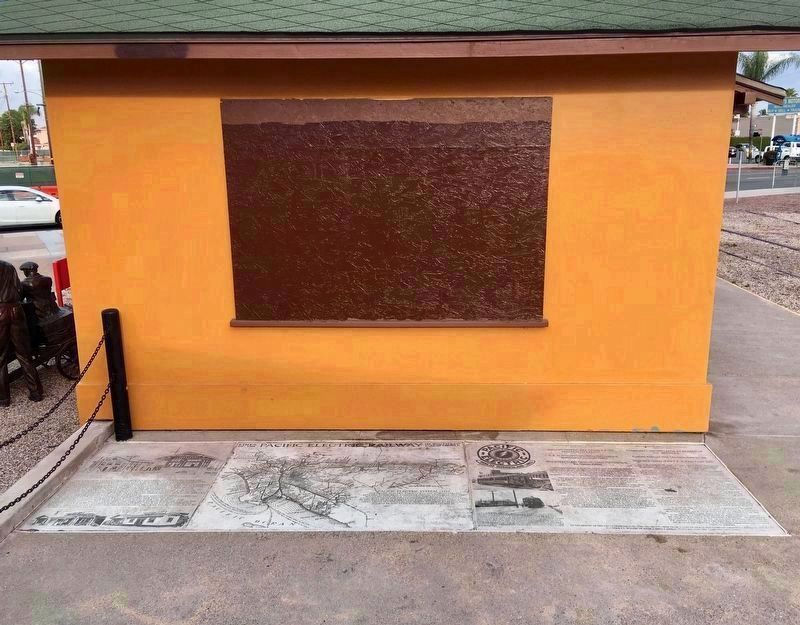
Left to right: Train Depot Marker; Pacific Electric System map c.1915; Interurban Cars; and reproductions of two 1931 newspaper articles about diminishing rail service before WWII.
Photographed by Craig Baker, March 20, 2019
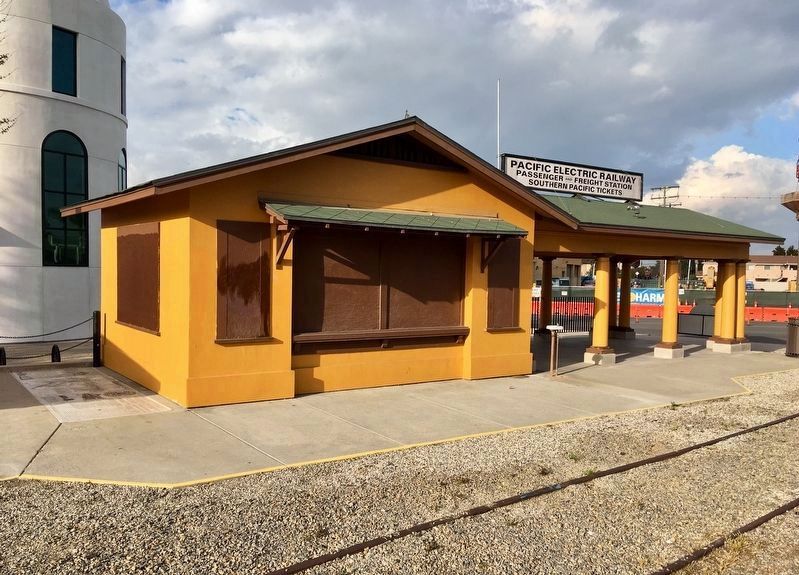
5. Train Depot and Marker
The marker is in the sidewalk, next to the depot, at left.
Photographed by Craig Baker, March 20, 2019
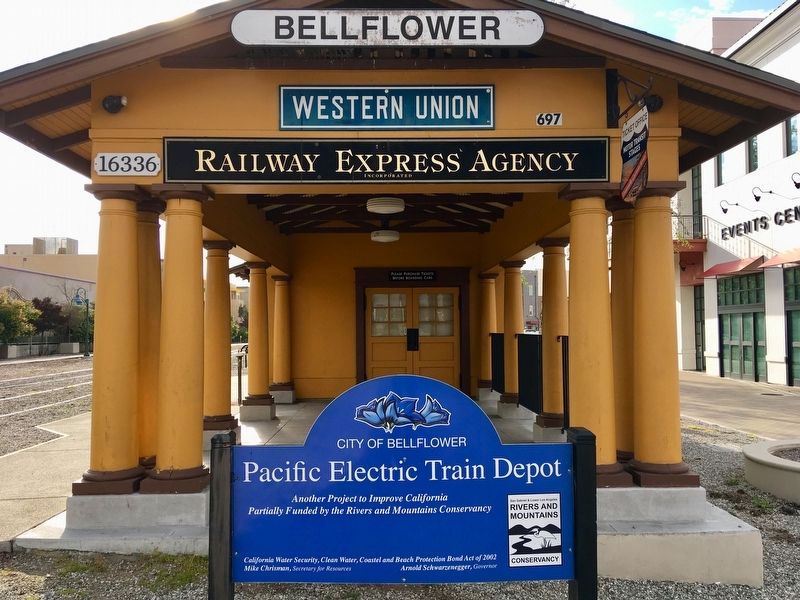
6. Train Depot
Yes, Arnold Schwarzenegger was really Governor of California.
Credits. This page was last revised on February 27, 2023. It was originally submitted on May 3, 2019, by Craig Baker of Sylmar, California. This page has been viewed 1,934 times since then and 100 times this year. Photos: 1, 2, 3, 4, 5, 6. submitted on May 3, 2019, by Craig Baker of Sylmar, California. • Andrew Ruppenstein was the editor who published this page.
