Near Tybee Island in Chatham County, Georgia — The American South (South Atlantic)
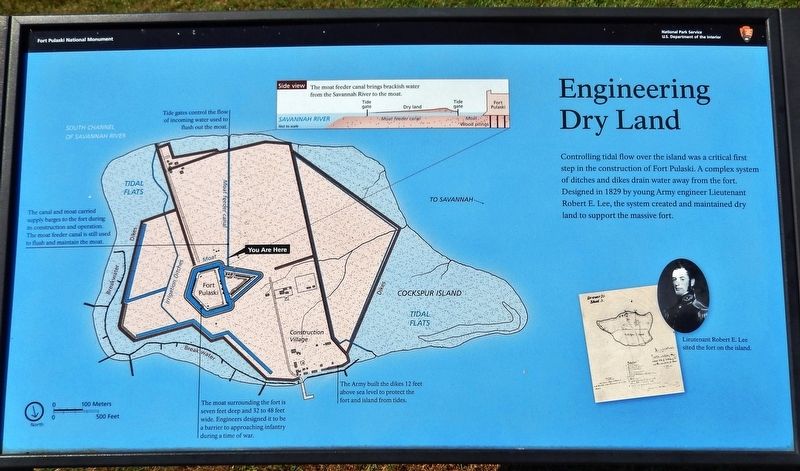
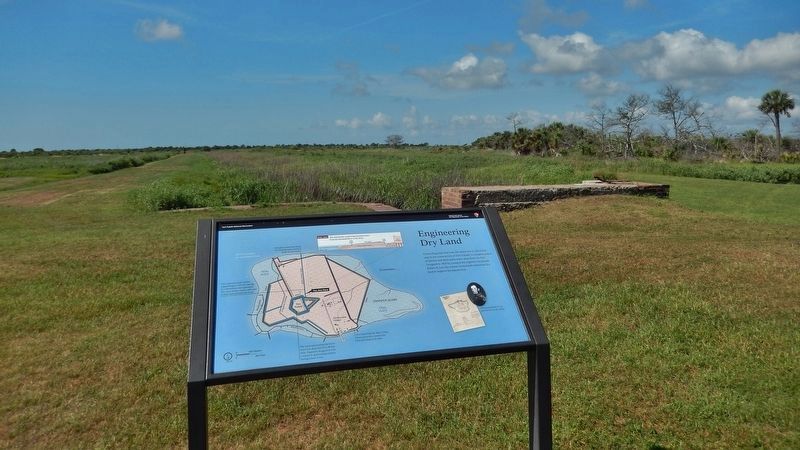
Engineering Dry Land
Fort Pulaski National Monument
Photographed by Cosmos Mariner, April 30, 2019
1. Engineering Dry Land Marker
(diagram captions • counterclockwise from top)
• Tide gates control the flow of incoming water used to flush out the moat.
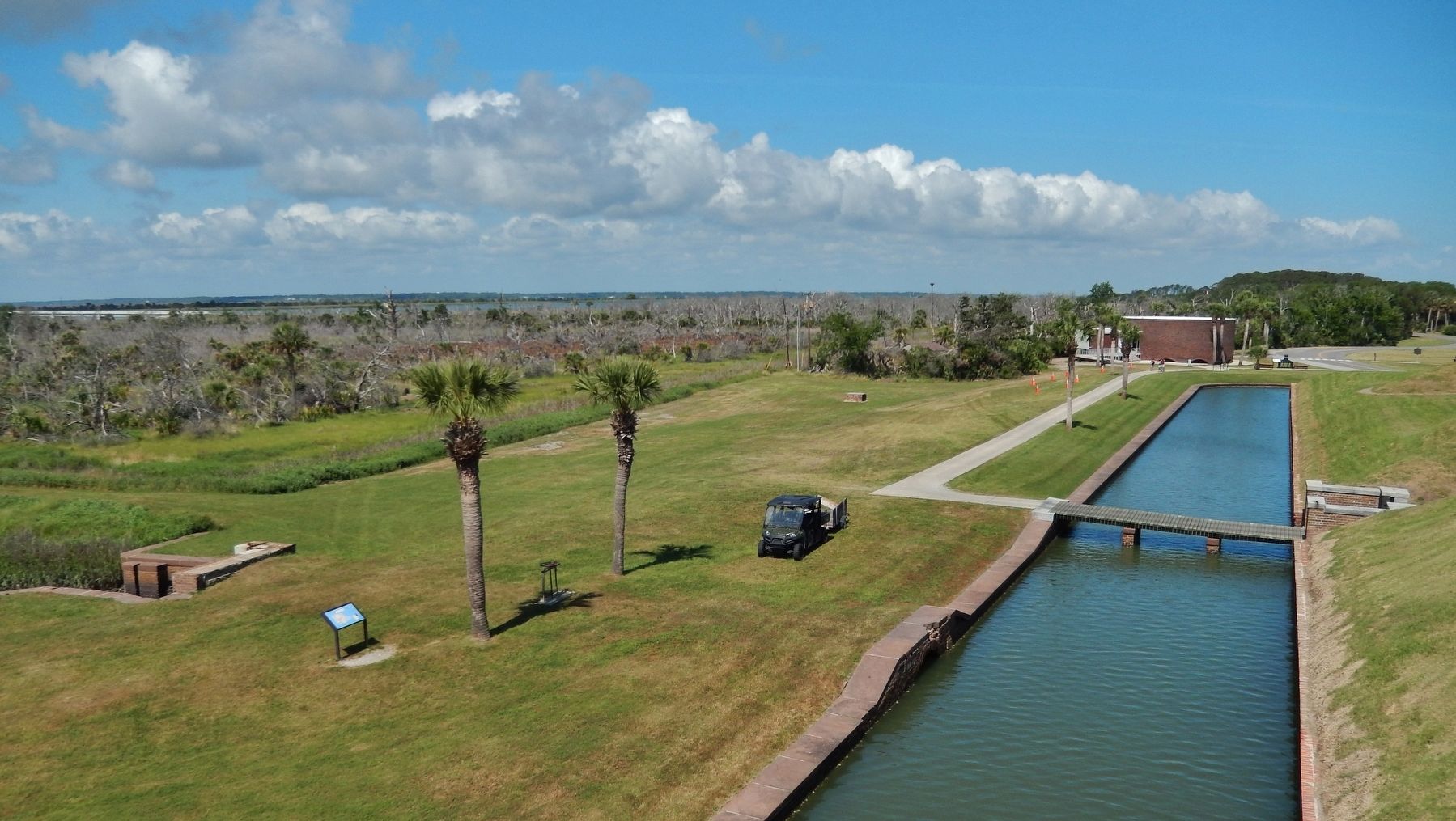
• The canal and moat carried supply barges to the fort during its construction and operation. The moat feeder canal is still used to flush and maintain the moat.
• The moat surrounding the fort is seven feet deep and 32 to 48 feet wide. Engineers designed it to be a barrier to approaching infantry during a time of war.
• The Army built the dikes 12 feet above sea level to protect the fort and island from tides.
Erected by National Park Service, U.S. Department of the Interior.
Topics. This historical marker is listed in this topic list: Forts and Castles. A significant historical year for this entry is 1829.
Location. 32° 1.587′ N, 80° 53.472′ W. Marker is near Tybee Island, Georgia, in
this page online

Regionally, this marker is on the Coastal Plain, on the Georgia Coast and the Golden Isles, in Greater Savannah, and on the Sea Islands. It is also in the American South, specifically in the Deep South, and on the Eastern Seaboard. Globally, it is in the North Atlantic Region, North America, the Western Hemisphere, the Western World, and the Anglosphere. Historically, it finds itself in what was once New Spain, the territory of the Mississippian Culture, one of the original Thirteen Colonies, one of the Confederate States of America, and the Antebellum South.
Other nearby markers. At least 8 other markers are within walking distance of this marker: Southwest Magazine (within shouting distance of this marker); Parrott Rifle (within shouting distance of this marker); Southwest Bastion (within
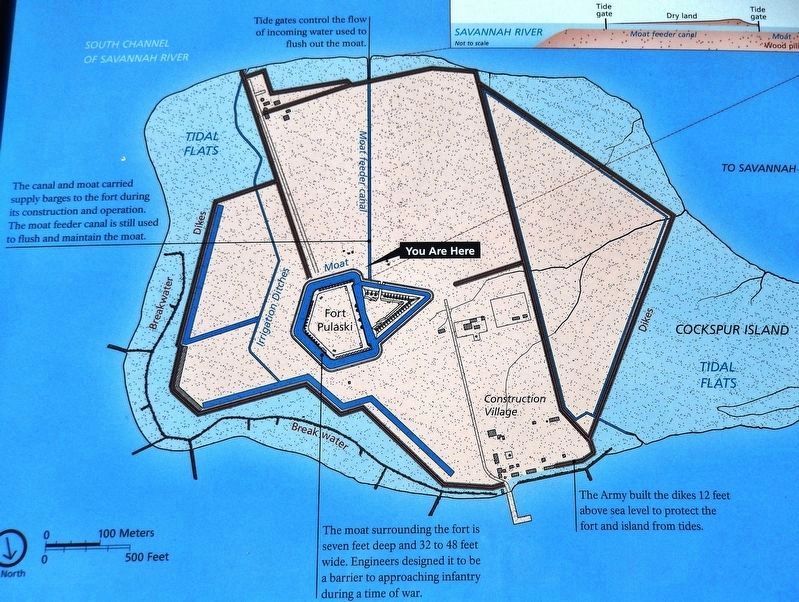
2. Marker detail: Fort Pulaski diagram
Another marker is no longer nearby. Moat Feeder Canal (was a few steps from this marker but has been confirmed missing).
Also see . . . Robert E. Lee. Cockspur Island did not then, nor does it today, present an easy area for engineering operations. Essentially a mud and marsh island, containing a few low sand ridges, Cockspur demanded patience, skill, and strength from new Lieutenant Robert E. Lee. The stalwart young officer had a physique and mind equal to the task, however, and apparently trampled with little perturbation through the mud and marsh of Cockspur. These trying months on Cockspur must certainly have aided in the maturing of young Robert E. Lee to that calmness of purpose and quiet ability which characterized him in
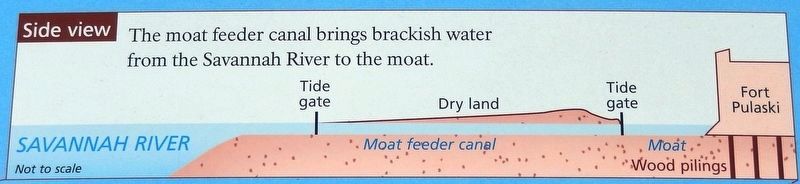
3. Marker detail: Moat feeder canal side view
The moat feeder canal brings brackish water from the Savannah River to the moat.
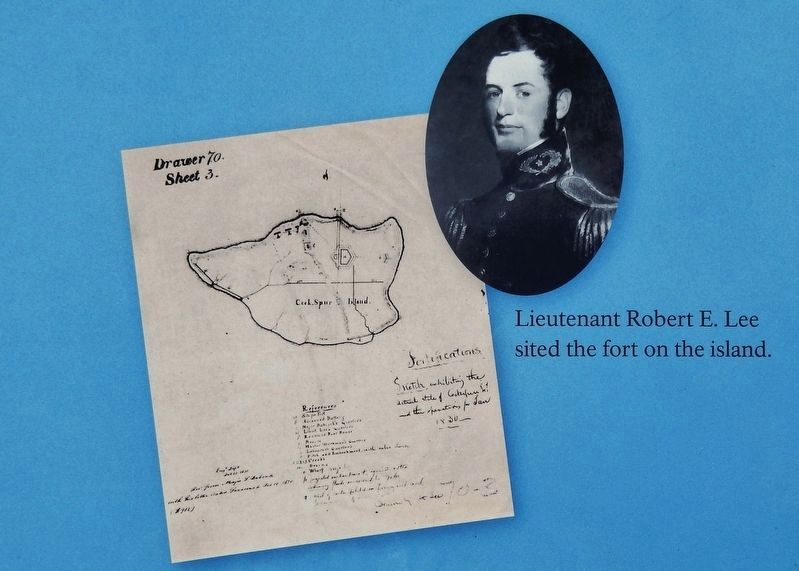
4. Marker detail: Lieutenant Robert E. Lee sited the fort on the island
Photographed by Cosmos Mariner, April 30, 2019
5. Engineering Dry Land Marker
(wide view • moat feeder canal in background)
(wide view • moat feeder canal in background)
Photographed by Cosmos Mariner, April 30, 2019
6. Moat Feeder Canal, Marker & Moat (view looking southwest from atop fort rampart)
Credits. This page was last revised on August 20, 2020. It was originally submitted on May 21, 2019, by Cosmos Mariner of Cape Canaveral, Florida. This page has been viewed 440 times since then and 55 times this year. Photos: 1, 2, 3, 4, 5, 6. submitted on May 21, 2019, by Cosmos Mariner of Cape Canaveral, Florida.
