Old Town in Alexandria, Virginia — The American South (Mid-Atlantic)
The Patton-Fowle House
711 Prince Street
| — | c. 1806 | — |
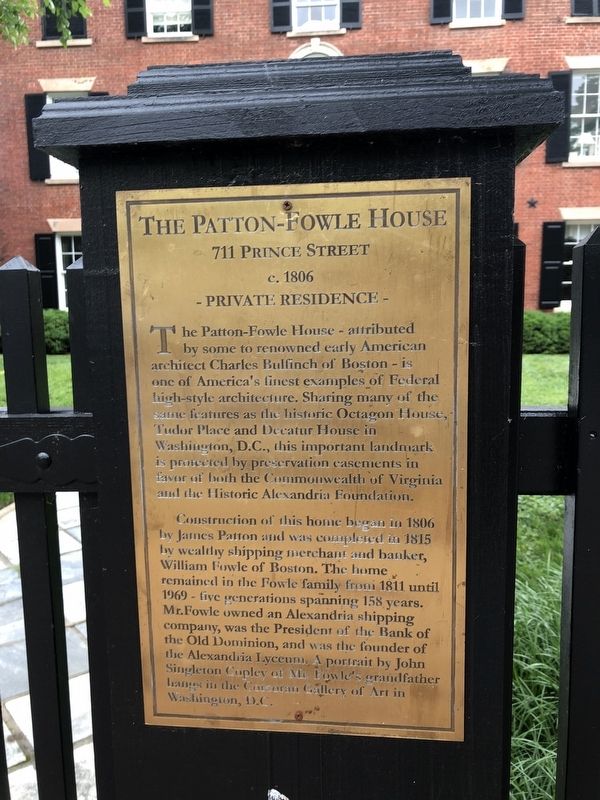
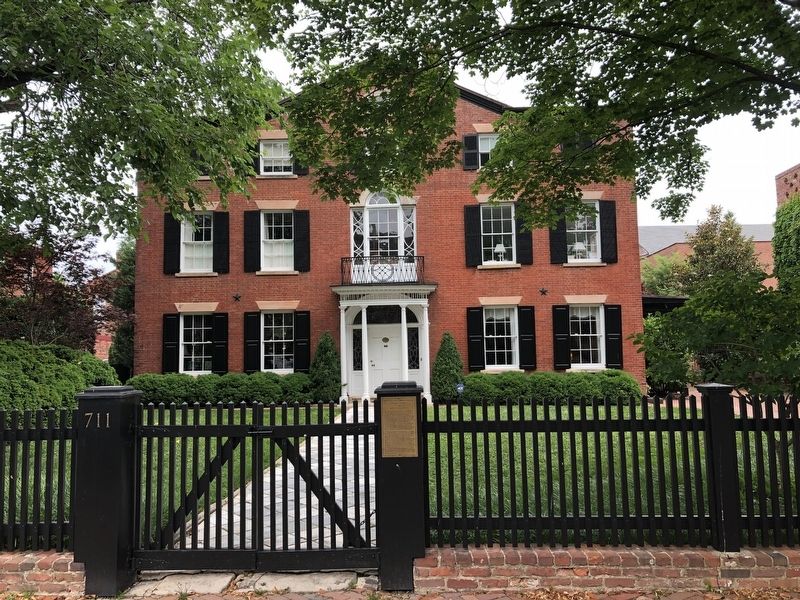
The Patton-Fowle House - attributed by some to renowned early American architect Charles Bulfinch of Boston - is one of America's finest examples of Federal high-style architecture. Sharing many of the same features as the historic Octagon House, Tudor Place and Decatur House in Washington, D.C, this important landmark is protected by preservation easements in favor of both the Commonwealth of Virginia and the Historic Alexandria Foundation.
Construction of this home began in 1806 by James Patton and was completed in 1815 by wealthy shipping merchant and banker, William Fowle of Boston. The home remained in the Fowle family from 1811 until 1969 - five generations spanning 158 years. Mr. Fowle owned an Alexandria shipping company, was the President of the Bank of the Old Dominion, and was the founder of the Alexandria Lyceum. A portrait by John Singleton Copley of Mr. Fowle's grandfather hangs in the Corcoran Gallery of Art in Washington, D.C.
Topics. This historical marker is listed in these topic lists: Architecture • Arts, Letters, Music • Settlements & Settlers. A significant historical year for this entry is 1806.
Location. 38° 48.247′ N,
this page online

Regionally, this marker is in the Washington Metropolitan Area and in Northern Virginia. It is also in the American South, specifically in the Upper South, in the Mid-Atlantic, and on the Eastern Seaboard. Globally, it is in the North Atlantic Region, North America, the Western Hemisphere, the Western World, and the Anglosphere. Historically, it finds itself in what was once the territory of the Mississippian Culture, one of the original Thirteen Colonies, one of the Confederate States of America, and the Antebellum South.
Other nearby markers. At least 8 other markers are within walking distance of this marker: A different marker also named Swann-Daingerfield House (within shouting distance of this marker); The Historic Lyceum (within shouting distance of this marker); The Lyceum (within shouting distance
Other markers no longer nearby. Swann-Daingerfield House (was within shouting distance of this marker but has been permanently removed); The Confederate Statue (was within shouting distance of this marker but has been permanently removed).
More about this marker. The marker notes that the building is a private residence.
Credits. This page was last revised on January 28, 2023. It was originally submitted on June 7, 2019, by Devry Becker Jones of Washington, District of Columbia. This page has been viewed 1,144 times since then and 93 times this year. Photos: 1, 2. submitted on June 7, 2019, by Devry Becker Jones of Washington, District of Columbia.
