Boucvalt House
Maison Boucvalt
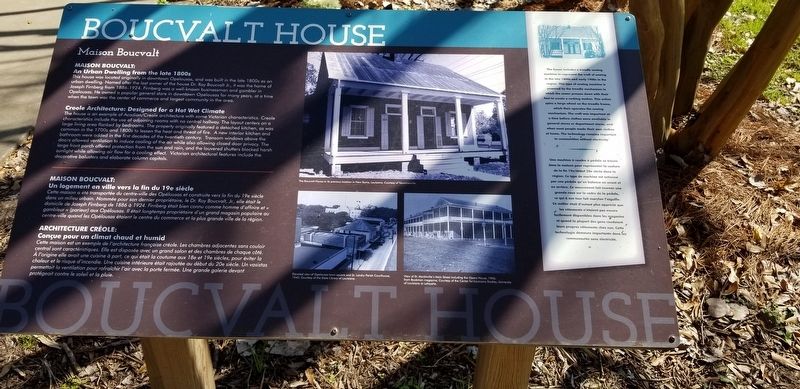
MAISON BOUCVALT:
An Urban Dwelling from the late 1800s
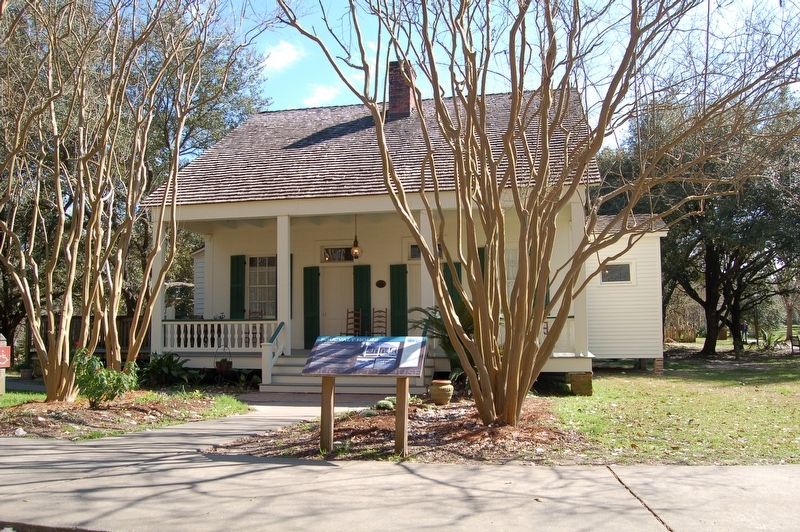
This house was was built in the late 1800s as an located originally in downtown Opelousas, and urban dwelling. Named after the last owner of the house Dr. Roy Boucvalt Jr., it was the home of Joseph Firnberg from 1886-1924. Firnberg was a well-known businessman and gambler in Opelousas. He owned a popular general store in downtown Opelousas for many years, at a time when the town was the center of commerce and largest community in the area.
Creole Architecture:
Designed for a Hot Wet Climate
The house is an example of Acadian/Creole architecture with some Victorian characteristics. Creole
characteristics include the use of adjoining rooms with no central hallway. The layout centers on a
large living area flanked by bedrooms. The property originally featured a detached kitchen, as was
common in the 1700s and 1800s to lessen the heat and threat of fire. A new interior kitchen and
bathroom were added in the first decades of the twentieth century. Transom windows above the
doors allowed ventilation to induce cooling of the air while also allowing closed
this page online
-------------------------------------------------------------------------------------------
MAISON BOUCVALT:
Un logement en ville vers la fin du 19e siècle
Cette maison a été transportée du centre-ville des Opélousas et construite vers la fin du 19e siècle
dans un milieu urbain. Nommée pour son dernier propriétaire, le Dr. Roy Boucvalt, Jr., elle était le
domicile de Joseph Firnberg de 1886 à 1924. Firnberg était bien connu comme homme d''affcire et «
gambleur» (parieur) aux Opélousas. Il était longtemps propriétaire d''un grand magasin populaire
centre-ville quand les Opélousas étaient le centre du commerce et la plus grande ville de la région.
ARCHITECTURE CRÉOLE:
Conçue pour un climat chaud et humid
Cette maison est un exemple de l'architecture française créole. Les chambres adjacentes sans couloir
central sont caractéristiques. Elle est disposée
----------------------------------------------------------
Une machine à coudre à pédale se trouve dans la maison pour représenter la couture de la fin 19e/début 20e siècle dans la région. Ce type de machine est actionné pédale qu'on balance en avant et par une en arrière. Ce mouvement fait tourner une roue sur le cadre de la pédale, grande qui à son tour fait marçher l'aiguille. Ce métier était d''autant plus apprécié que ce les vêtements n''étaient pas encore facilement disponibles dans les magasins et quand la plupart des gens coudaient leurs propres vêtements chez eux. Cette technologie demeure importante dans fes communautés sans électricité.
Topics. This historical marker is listed in this topic list: Settlements & Settlers.
Location. 30° 12.947′ N, 91° 59.656′ W. Marker is in Lafayette, Louisiana, in Lafayette Parish. It can be reached from Fisher Road near Surrey Street (State Highway 728-8). Touch for map. Marker is at or near this postal address: 300 Fisher Road, Lafayette LA 70508, United States of America. Touch for directions.

Regionally, this marker is in Louisiana’s Acadiana — Cajun Country. It is also in the American South and specifically in the Deep South. Globally, it is in North America, a Gulf of Mexico state, the Western Hemisphere, the Western World, and the Anglosphere. Historically, it finds itself in what was once New Spain, Acadia, the territory of the Mississippian Culture, the Louisiana Purchase, one of the Confederate States of America, and the Antebellum South.
Other nearby markers. At least 8 other markers are within walking distance of this marker: Acadian House (within shouting distance of this marker); The Presbytery (within shouting distance of this marker); The Forge (within shouting distance of this marker); Mouton House (within shouting distance of this marker); Mouton Kitchen (within shouting distance of this marker); Le Petit Bayou: Ferry (within shouting distance of this marker); Buller House (within shouting distance of this marker); Attakapas Chapel (within shouting distance of this marker). Touch for a list and map of all markers in Lafayette.
More about this marker. Located on the grounds of the Vermilionville Historic Village, a living history museum. Fee is charged for access to museum grounds.
Also see . . . Vermilionville. Museum website homepage (Submitted on June 8, 2019, by Cajun Scrambler of Assumption, Louisiana.)
Credits. This page was last revised on December 19, 2022. It was originally submitted on June 8, 2019, by Cajun Scrambler of Assumption, Louisiana. This page has been viewed 1,095 times since then and 94 times this year. Photos: 1, 2. submitted on June 8, 2019.
