Washington Heights in Manhattan in New York County, New York — The American Northeast (Mid-Atlantic)
Sugar Hill Luminaries Lawn
Highbridge Park
Photographed by Larry Gertner, May 10, 2019
1. Sugar Hill Luminaries Lawn Marker
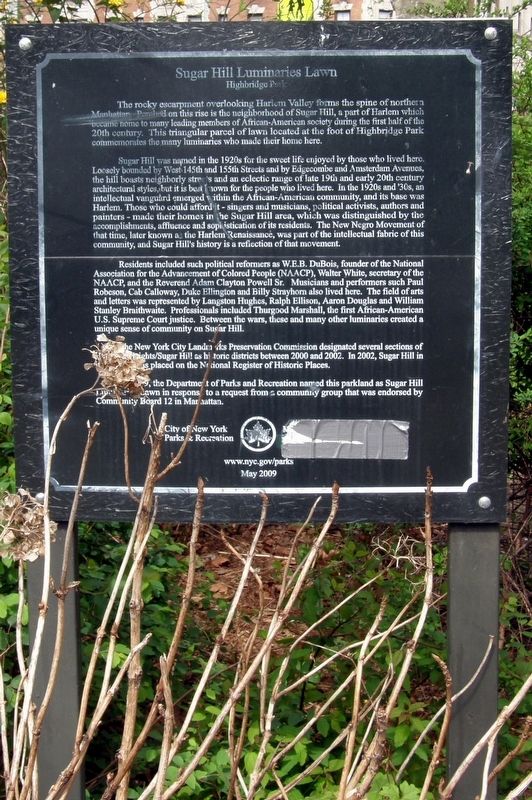
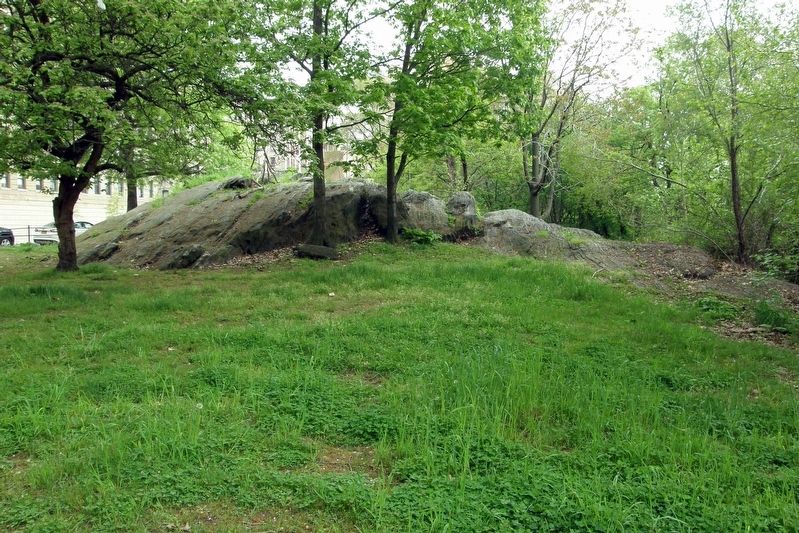
The rock escarpment overlooking Harlem Valley forms the spine of northern Manhattan. Perched on this rise is the neighborhood of Sugar Hill, a part of Harlem which became home to many leading members of African-American society during the first half of the 20th century. This triangular parcel of law located at the foot of Highbridge Park commemorates the many luminaries who made their homes here.
Sugar Hill was named in the 1920s for the sweet life enjoyed by those who lived here. Loosely bounded by West 145th and 155th Streets and by Edgecombe and Amsterdam Avenues, this hill boasts neighborly streets and an eclectic range of late 19th and early 20th century architectural styles, but is best known for the people who lived here. In the 1920s and ‘30s, an intellectual vanguard emerged within the African-American community, and its base was Harlem. Those who could afford it – singers and musicians, political activists, author and painters – made their homes in the Sugar Hill area, which was distinguished by the accomplishments, affluence and sophistication of its residents. The New Negro Movement of this time, later known as the Harlem Renaissance, was part of the intellectual fabric of this community, and Sugar Hill’s history is a reflection of that movement.
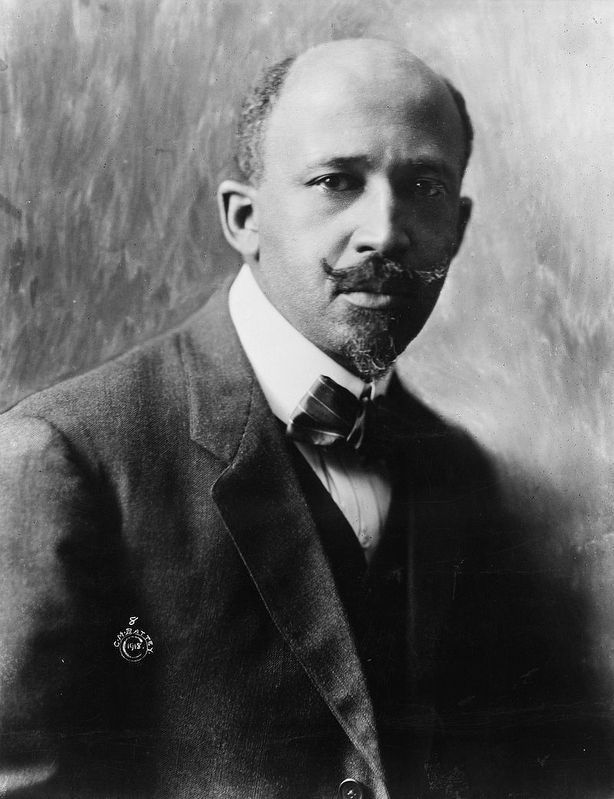
Residents included political reformers W.E.B. DuBois, founder of the National Association for the Advancement of Colored People (NAACP); Walter White, secretary of the NAACP; and the Reverend Adam Clayton Powell Sr. Musicians and performers such as Paul Robeson, Cab Calloway, Duke Ellington, and Billy Strayhorn also lived here. The field of arts and letters was represented by Langston Hughes, Ralph Ellison, Aaron Douglas, and William Stanley Braithwaite. Professionals included Thurgood Marshall, the first African American U.S. Supreme Court justice.
this page online
The New York City Landmarks Preservation Commission designated several sections of Hamilton Heights/Sugar Hill as historic districts between 2000 and 2002. In 2002, Sugar Hill in its entirety was placed on the National Register of Historic Places.
In 2009, NYC Parks named this park feature Sugar Hill Luminaries Lawn in response to a request from a community group that was endorsed by Community Board 12 in Manhattan.
Erected 2009 by City of New York Parks & Recreation (NYC Parks).
Topics and series. This historical marker is listed in these topic lists: African Americans • Architecture • Arts, Letters, Music • Entertainment. In addition, it is included in the NYC Parks series list. A significant historical year for this entry is 2000.
Location. This marker has been replaced by another marker nearby. It was located near 40° 49.847′ N, 73° 56.43′ W. Marker was in Manhattan, New York, in New York County. It was in Washington Heights. It was on Edgecombe Avenue near West 155th Street, on the left when traveling north.
Photographed by Larry Gertner, May 10, 2019
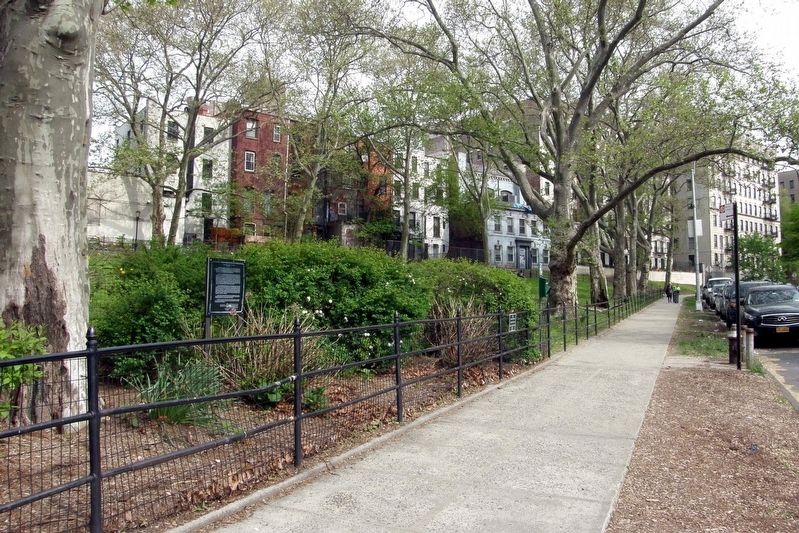
2. Sugar Hill Luminaries Lawn and marker site

Regionally, this marker was in New York City. It was also in the American Northeast, in the Mid-Atlantic, and on the Eastern Seaboard. Globally, it was in the North Atlantic Region, North America, the Western Hemisphere, the Western World, and the Anglosphere. Historically, it found itself in what was once New Netherland and also one of the original Thirteen Colonies.
Other nearby markers. At least 8 other markers are within walking distance of this location: A different marker also named Sugar Hill Luminaries Lawn (here, next to this marker); Old Croton Aqueduct (about 300 feet away, measured in a direct line); The Green Book (about 500 feet away); Edward Kennedy "Duke" Ellington Residence (about 600 feet away); John T. Brush Stairway (about 700 feet away); a different marker also named The John T. Brush Stairway (about 700 feet away); Coleman Hawkins (about 700 feet away); Old Croton Aqueduct Trail (about 700 feet away). Touch for a list and map of all markers in Manhattan.
Also see . . . Sugar Hill Luminaries Lawn in Highbridge Park.
Photographed by Larry Gertner, May 10, 2019
3. Part of the "rocky escarpment"
near Coogan's Bluff Playground
via Wikipedia
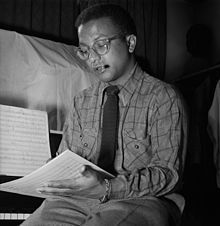
4. Sugar Hill Luminary - Billy Strayhorn
His signature theme for Duke Ellington's orchestra, "Take the A Train", was based on directions for getting to the Duke's house in "Sugar Hill way up in Harlem."
via Wikipedia
5. Sugar Hill Luminary - W.E.B. DuBois
Founder, N.A.A.C.P.
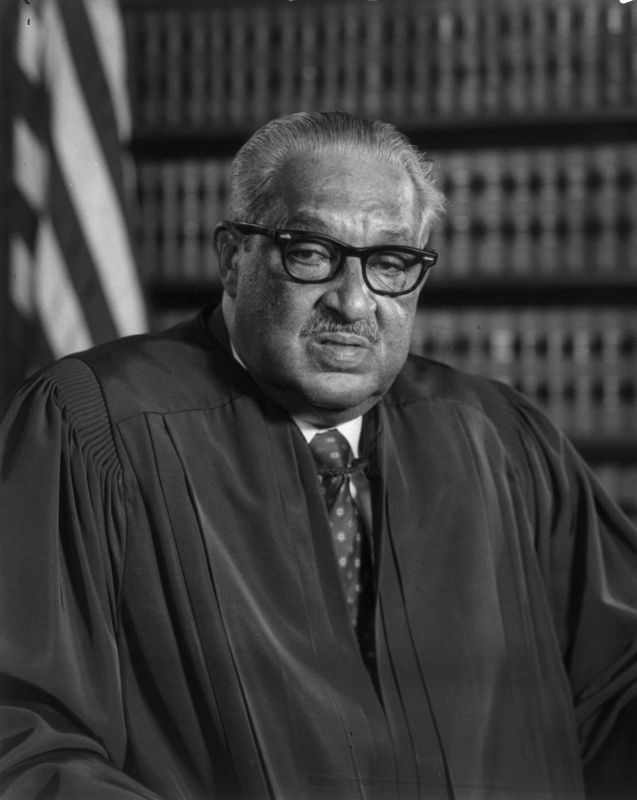
6. Sugar Hill Luminary - Thurgood Marshall
Associate Justice of the Supreme Court of the United States, 1967-1991
Credits. This page was last revised on July 12, 2025. It was originally submitted on June 14, 2019, by Larry Gertner of New York, New York. This page has been viewed 801 times since then and 25 times this year. Photos: 1, 2, 3, 4, 5, 6. submitted on June 14, 2019, by Larry Gertner of New York, New York. • Bill Pfingsten was the editor who published this page.
