Near Marietta in Lancaster County, Pennsylvania — The American Northeast (Mid-Atlantic)
Hot-Blast Stove Bases
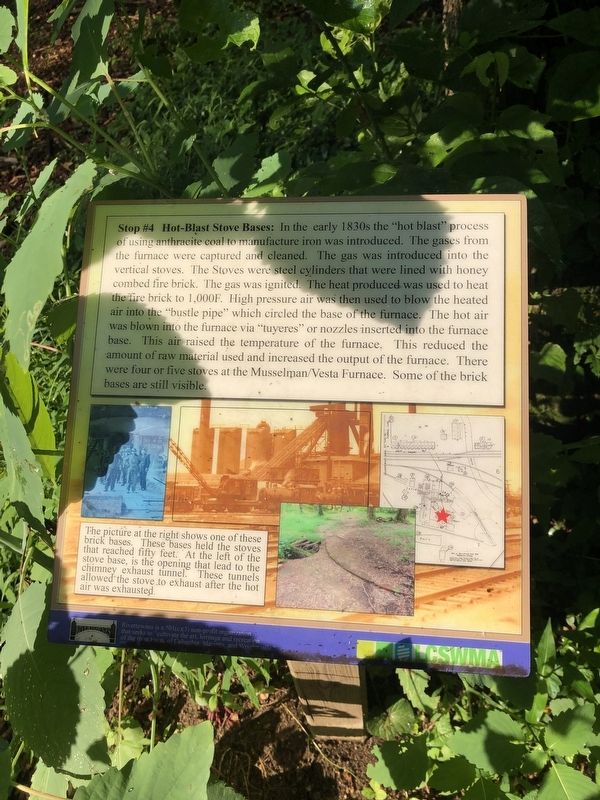
[Caption:]
The picture at the right shows one of these brick bases. These bases held the stoves that reached fifty feet. At the left of the stove base, is the opening that lead to the chimney exhaust tunnel. These tunnels allowed the stove to exhaust after the hot air was exhausted.
Erected by Rivertownes PA USA; Lancaster County Solid Waste Management Authority. (Marker
this page online
Topics. This historical marker is listed in this topic list: Industry & Commerce. A significant historical year for this entry is 1830.
Location. 40° 3.509′ N, 76° 32.114′ W. Marker is near Marietta, Pennsylvania, in Lancaster County. It can be reached from Robert Mowrer Drive south of Furnace Road, on the right when traveling south. Touch for map. Marker is at or near this postal address: 1 Robert Mowrer Drive, Marietta PA 17547, United States of America. Touch for directions.

Regionally, this marker is in South-Central Pennsylvania, specifically in Pennsylvania Dutch Country, and in the Susquehanna Valley. It is also in the American Northeast and in the Mid-Atlantic. Globally, it is in North America, the Western Hemisphere, the Western World, and the Anglosphere. Historically, it finds itself in what was once the Haudenosaunee (Iroquois) Confederacy and also one of the original Thirteen Colonies.
Other nearby markers. At least 8 other markers are within walking distance of this marker: Stone Base of the Chimney (here, next to this marker); Skip Hoist / Oil Shed (a few steps from this marker); The Pennsylvania Canal
Credits. This page was last revised on July 8, 2019. It was originally submitted on July 8, 2019, by Devry Becker Jones of Washington, District of Columbia. This page has been viewed 362 times since then and 26 times this year. Photos: 1, 2. submitted on July 8, 2019, by Devry Becker Jones of Washington, District of Columbia.
