Bedford in Cuyahoga County, Ohio — The American Midwest (Great Lakes)
Bedford Historic Business District
Photographed by J. J. Prats, June 22, 2019
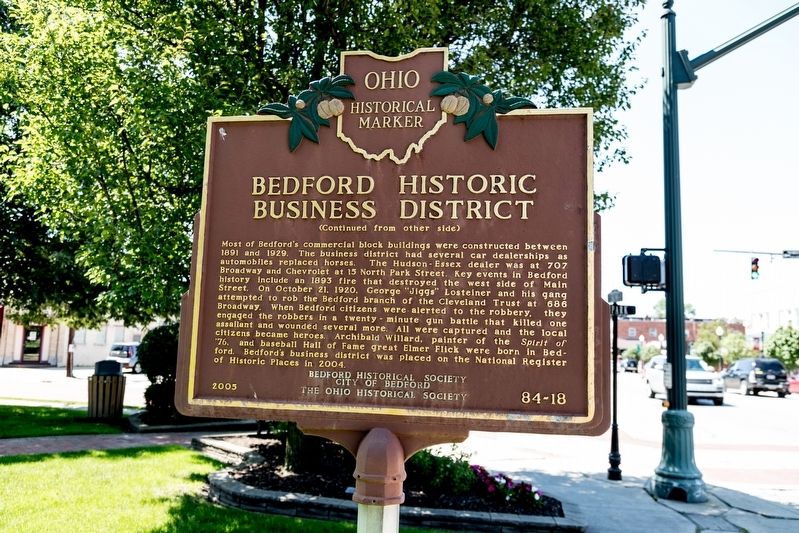
1. Bedford Historic Business District Marker, side two
The town of Bedford was settled in 1837. Early residents, Hezekiah and Clarissa Dunham donated the land that serves as Bedford Public Square. The Dunhams built one of the area's first homes in 1852, which stands at 729 Broadway with the letters H & D above the doorway. Early settlers were attracted to the area by the abundance of natural resources and a large waterfall for mill sites. Bedford also served as a stagecoach stop on the route from Cleveland to Pittsburgh. The road or Turnpike Road as it was called was originally part of the Mahoning Indian Trail. By 1895 the road was renamed Main Street (and later Broadway) when the Akron, Bedford, and Cleveland Railway Company (ABC) traversed the middle of the street carrying passengers. The interurban is called “America’s first high speed long distance electric interurban” with speeds in excess of 60 miles per hour.
Most of Bedford’s commercial block buildings were constructed between 1891 and 1929. The business district had several car dealerships as automobiles replaced horses. The Hudson-Essex dealer was at 707 Broadway and Chevrolet at 15 North Park Street. Key events
this page online
Erected 2005 by the Bedford Historical Society, the City of Bedford, and The Ohio Historical Society. (Marker Number 84-18.)
Topics and series. This historical marker is listed in these topic lists: Railroads & Streetcars • Settlements & Settlers. In addition, it is included in the Ohio Historical Society / The Ohio History Connection series list. A significant historical date for this entry is October 21, 1920.
Location. 41° 23.439′ N, 81° 32.076′ W. Marker is in Bedford, Ohio, in Cuyahoga County. It is at
Photographed by J. J. Prats, June 22, 2019
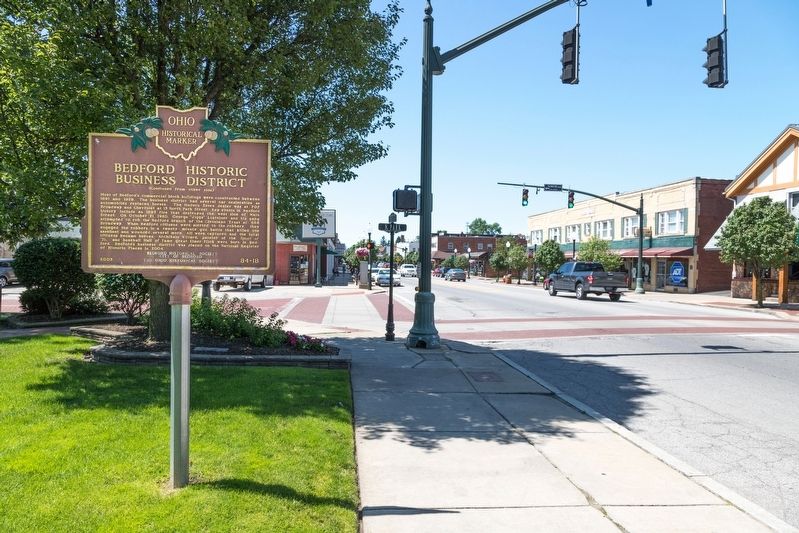
2. Bedford Historic Business District and Marker

Regionally, this marker is in Greater Cleveland, on the Lake Erie Shore, and in the Western Reserve. It is also in the American Midwest. Globally, it is in North America, on the Great Lakes, in the Western Hemisphere, in the Western World, and in the Anglosphere. Historically, it finds itself in what was once the Haudenosaunee (Iroquois) Confederacy, the territory of the Mississippian Culture, and the Northwest Territory.
Other nearby markers. At least 8 other markers are within walking distance of this marker: Benjamin Franklin Fitch (a few steps from this marker); Archibald M. Willard, 1836-1918 (a few steps from this marker); Bradford WWII Veterans Memorial (a few steps from this marker); Bedford Civil War Memorial (within shouting distance of this marker); Hezekiah Dunham House (within shouting distance of this marker);
Photographed by J. J. Prats, June 22, 2019
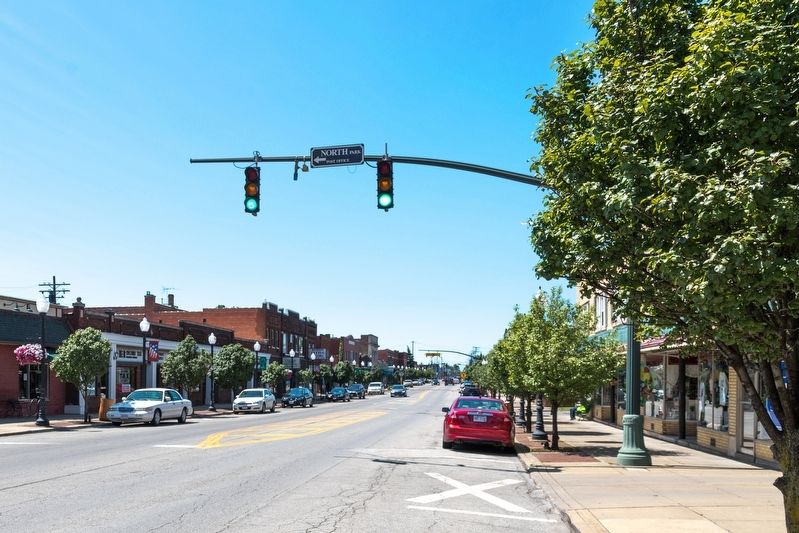
3. Broadway Avenue (previously Main Street) Bedford Ohio
Also see . . . Wikipedia Entry for the Akron, Bedford and Cleveland Railroad. “The Akron, Bedford and Cleveland Railroad (also known as the Alphabet Railroad) began service between Akron and Cleveland, Ohio, on November 9, 1895. At the time, it was the longest electrified rail line in the world. For 50 cents riders could travel from Akron to Cleveland’s Public Square in about 2½ hours.” Today an automobile can travel from Akron to Cleveland’s Public Square via Interstate 77 in about 45 minutes. (Submitted on July 26, 2019.)
Photographed by Akron Evening Times, October 22, 1920
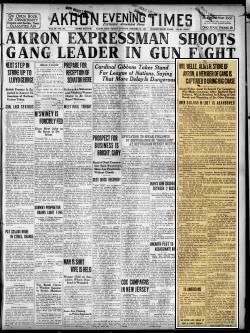
4. Akron Expressman Shoots Gang Leader in Gun Fight
Click on image to read article. An Expressman is a railroad employee in charge of the “express car” and responsible for the safe delivery of gold or currency being transported in strongboxes in the railroad car. While on duty they wore a sidearm. He could have worked for one of the two steam railroads with stations in town at that time: the Pennsylvania Railroad or the Wheeling and Lake Erie.
Click for more information.
Click for more information.
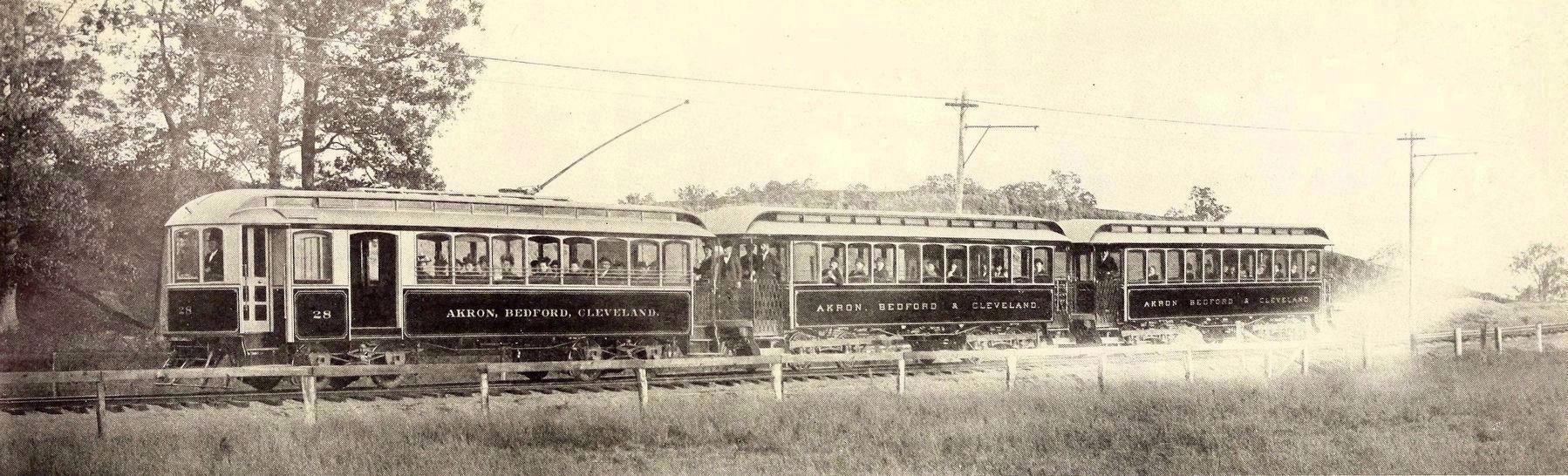
from the Electric Railway Journal, October 2, 1909
5. “Akron, Bedford and Cleveland—Motor Car with Trailers Operated in 1895.”
This illustration accompanied an article in the October 2, 1909 Electric Railway Journal by F. J. J. Sloat. Excerpts: “The railroad was supplied with 15 cars, seven of which were combination express and passenger and eight were straight passenger coaches, all, however, having smoking compartments, plush seats, toilet rooms, etc. ... Hourly service was operated between Akron and Cleveland. ... Baggage was checked to all points on the railroad in the same manner as was customary with steam railroads at the time. ... The United States Mail was carried on all cars under contract.”
Credits. This page was last revised on August 27, 2026. It was originally submitted on July 26, 2019, by J. J. Prats of Powell, Ohio. This page has been viewed 1,009 times since then and 102 times this year. Last updated on August 26, 2026, by Carl Gordon Moore Jr. of North East, Maryland. Photos: 1, 2, 3, 4, 5. submitted on July 26, 2019, by J. J. Prats of Powell, Ohio. • Devry Becker Jones was the editor who published this page.
Editor’s want-list for this marker. A photo of Side 1 of the marker. • Can you help?
