South Village in Manhattan in New York County, New York — The American Northeast (Mid-Atlantic)
Golden Swan Garden
0.560 acre
Photographed by Larry Gertner, 2007
1. Golden Swan Garden Marker
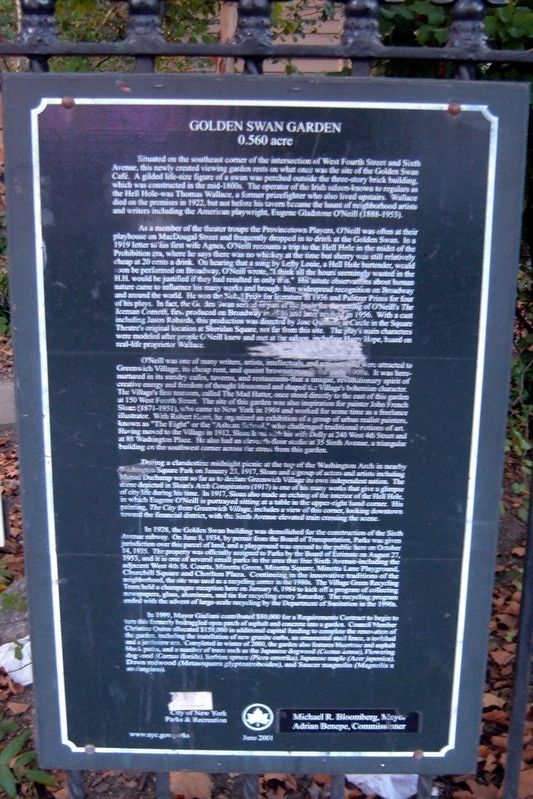
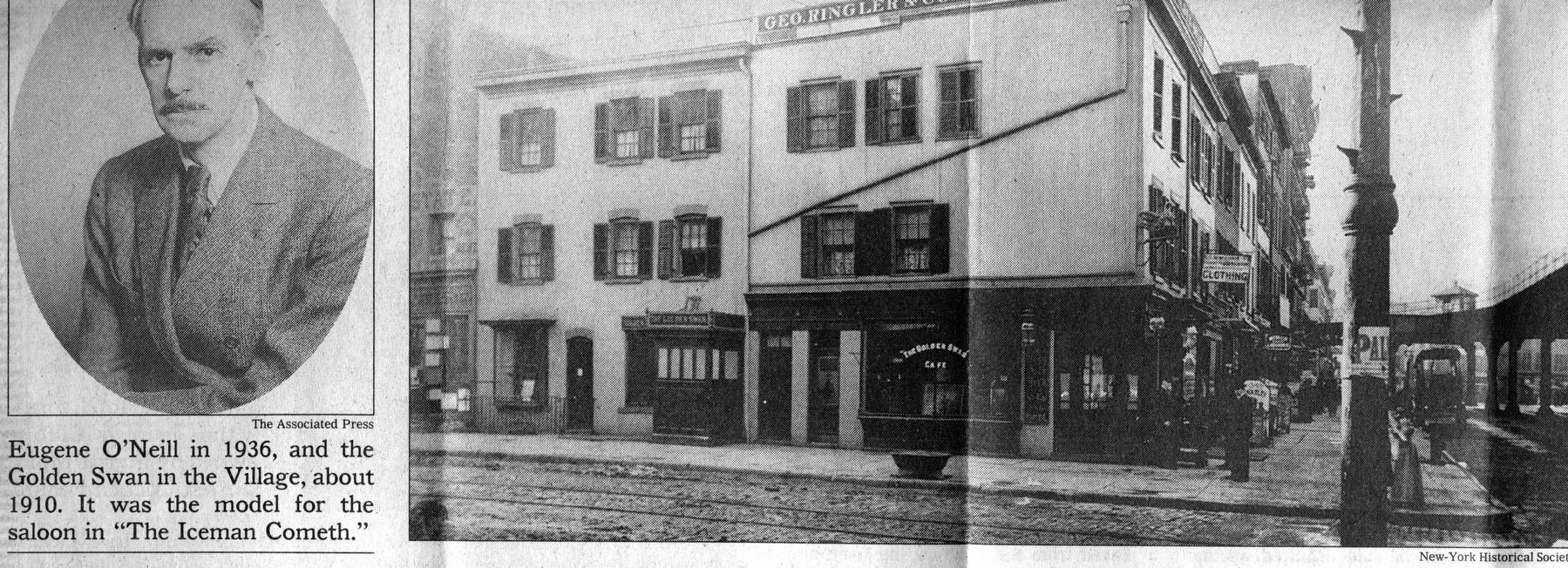
Situated on the southeast corner of the intersection of West Fourth Street and Sixth Avenue, this newly created viewing garden rests on what was once the site of the Golden Swan Café. A gilded life—size figure of a swan was perched outside the three-story brick building, which was constructed in the mid-1800s. The operator of the Irish saloon – known to regulars as the Hell-Hole – was Thomas Wallace, a former prizefighter who also lived upstairs. Wallace died on the premises in 1922, but not before his tavern becoming the haunt of neighborhood artists and writers including the American playwright, Eugene Gladstone O’Neill (1888-1953).
As a member of the theater troupe the Provincetown Players, O’Neill was often at their playhouse on MacDougal Street and frequently dropped in to drink at the Golden Swan. In a 1919 letter to his first wife Agnes, O’Neill recounts a trip to the Hell Hole in the midst of the Prohibition era, where he says there was no whiskey at the time but sherry was still relatively cheap at 20 cents a drink. On hearing that a song by Lefty Louie, a Hell Hole bartender, would soon be performed on Broadway, O’Neill wrote, “I think all the hours seemingly wasted in the HH. would soon be justified if they had resulted in only this.” His astute observations about human nature came to influence his many works and brought him widespread recognition on Broadway and around the world. He won the Nobel Prize for Literature in 1936 and Pulitzer Prizes for four of his plays. In fact, the Golden Swan served as part of the basis for the setting of O’Neill’s The Iceman Cometh, first produced on Broadway in 1946 and later revived in 1956. With a cast including Jason Robards, this production was directed by Jose Quintero at Circle in the Square Theatre’s original location at Sheridan Square, not far from this
this page online
O’Neill was one of the many writers, artists, intellectuals and activists who were attracted to Greenwich Village, its cheap rent, and quaint brownstones in the early 1900s. It was here - nurtured in its sundry cafes, taverns, and restaurants – that a unique, revolutionary spirit of creative energy and freedom of thought blossomed and shaped the Village’s bohemian character. The Village’s first tearoom, called the Mad Hatter, once stood directly to the east of this garden at 150 West Fourth Street. The site of this garden was also inspiration for painter John French Sloan (1871-1951), who came to New York in 1904 and worked for some time as a freelance illustrator. With Robert Henri, he organized an exhibition of a group of urban realist painters, known as “the Eight” or the “Ashcan School’” who challenged traditional notions of art. Having moved to the Village in 1912, Sloan lived with his wife Dolly at 240 West 4th Street and at 88 Washington Place. He also had an eleventh-floor
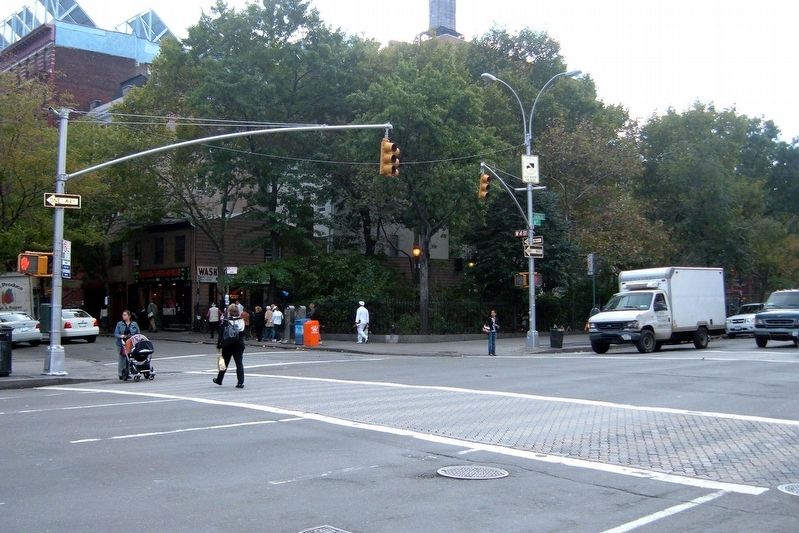
Photographed by Larry Gertner, October 2007
2. The Golden Swan Garden
During a clandestine midnight picnic at the top of the Washington Arch in nearby Washington Square Park on January 23, 1917, Sloan and a group of actors and artists including Marcel Duchamp went so far as to declare Greenwich Village its own independent nation. The scene depicted in Sloan’s Arch Conspirators (1917) in one of his many works that give a glimpse of city life during his time. In 1917, Sloan also made an etching of the interior of the Hell Hole, in which Eugene O’Neil is portrayed sitting at a table in the upper-right hand corner. His painting The City from Greenwich Village , included a view of this corner, looking downtown towards the Financial District, with the Sixth Avenue elevated train crossing the street.
In 1928, the Golden Swan building was demolished for the construction of the Sixth Avenue subway. On June 8, 1934, by permit from the Board of Transportation, Parks was given jurisdiction over this parcel of land, and a playground was opened to the public here on October 14, 1935. The property was officially
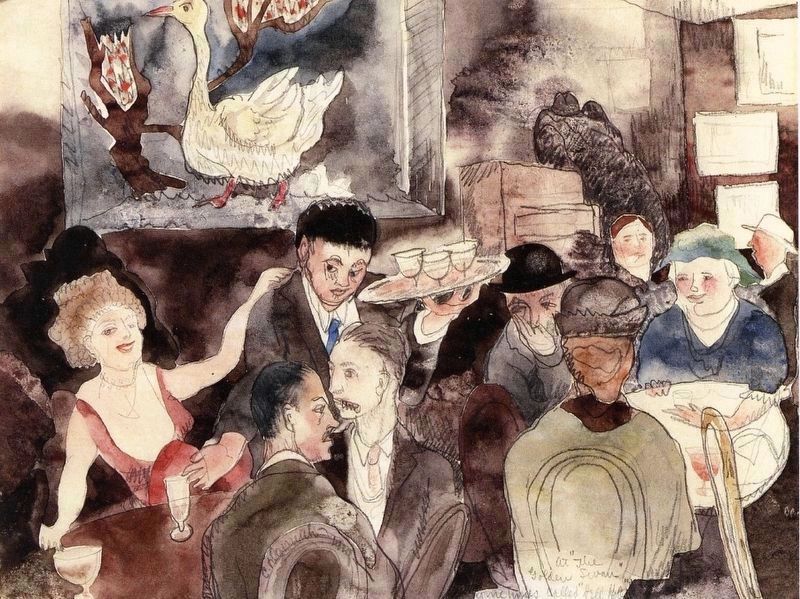
via Ephemeral New York, unknown
3. Charles Demuth: "At The Golden Swan"
"Dingy and divey, the Golden Swan was run by an ex-prize fighter and attracted locals as well as artists drawn to the seedy side of life."
Click for more information.
Click for more information.
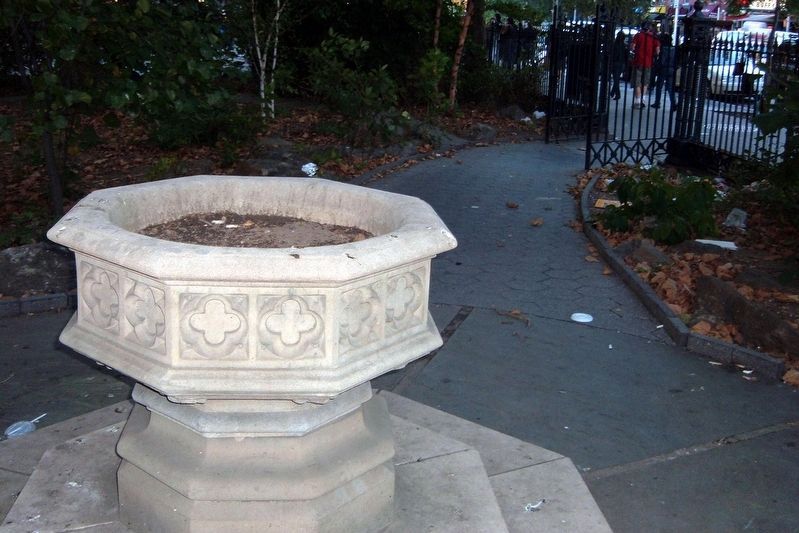
In 1999, Mayor Giuliani contributed $80,000 for a Requirements Contract to begin to turn this formerly bedraggled open patch of asphalt and concrete into a garden. Council Member Christine Quinn allocated $158,000 in additional capital funding to complete the renovation of the garden, including the installation of new granite curbs, an ornamental steel fence, a toolshed and a jardinière urn. Completed in winter of 2000, the garden also features bluestone
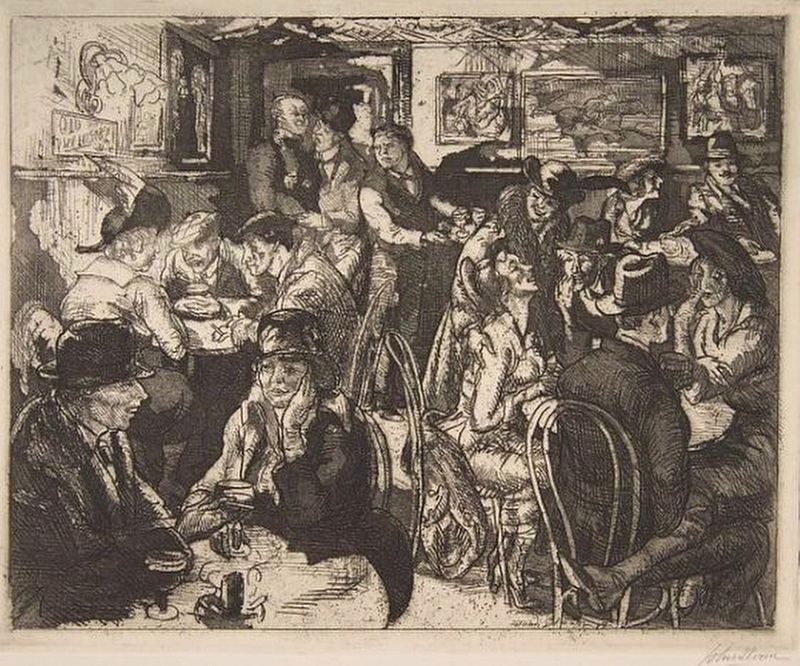
via Ephemeral New York, 1917
4. "Two portraits of one lowdown saloon in 1919 Greenwich Village"
Ephemeral New York Blogsite entry:
“Other patrons included the artist John Sloan, who produced an etching of the bar in 1917 (above)..."
Click for more information.
“Other patrons included the artist John Sloan, who produced an etching of the bar in 1917 (above)..."
Click for more information.
City of New York Parts and Recreation
Michael R. Bloomberg, Mayor
Adrian Benepe, Commissioner June 2001
Erected 2001 by City of New York Parks and Recreation.
Topics. This historical marker is listed in these topic lists: Arts, Letters, Music • Parks & Recreational Areas. A significant historical date for this entry is January 23, 1917.
Location. Marker has been permanently removed. It was located near 40° 43.895′ N, 74° 0.047′ W. Marker was in Manhattan, New York, in New York County. It was in South Village. It was on West 4th Street near Sixth Avenue, on the right when traveling east. Touch for map. Marker was in this post office area: New York NY 10012, United States of America.
We have been informed that this marker is no longer there and will not be replaced. This page is an archival view of what was.
Regionally, this marker was in New York City.

Photographed by Larry Gertner, 2007
5. Golden Swan Garden
The jardinière urn
Other nearby markers. At least 8 other markers are within walking distance of this location: The Golden Swan (a few steps from this marker); Willa Cather 1873-1947 / Richard Wright 1908-1960 (within shouting distance of this marker); 80 Washington Place (about 300 feet away, measured in a direct line); Greenwich Village Historic District (about 300 feet away); St. Joseph’s Church (about 400 feet away); a different marker also named St. Joseph’s Church (about 400 feet away); Honor Roll (about 400 feet away); Frances Perkins (about 500 feet away). Touch for a list and map of all markers in Manhattan.
Other markers no longer nearby. West 4th Street Courts (was within shouting distance of this marker but has been permanently removed); Minetta Playground (was about 300 feet away but has been permanently
via New York Times "Streetscapes"
6. Eugene O'Neill and the Golden Swan
Credits. This page was last revised on September 21, 2025. It was originally submitted on August 25, 2019, by Larry Gertner of New York, New York. This page has been viewed 902 times since then and 60 times this year. Photos: 1, 2. submitted on August 25, 2019, by Larry Gertner of New York, New York. 3. submitted on April 16, 2021, by Larry Gertner of New York, New York. 4. submitted on May 24, 2021, by Larry Gertner of New York, New York. 5, 6. submitted on August 25, 2019, by Larry Gertner of New York, New York. • Andrew Ruppenstein was the editor who published this page.
