Mullens in Wyoming County, West Virginia — The American South (Appalachia)
Mullens
America's Byways
| — | Coal Heritage Trail — National Coal Heritage Area | — |
Photographed by J. J. Prats, July 15, 2019
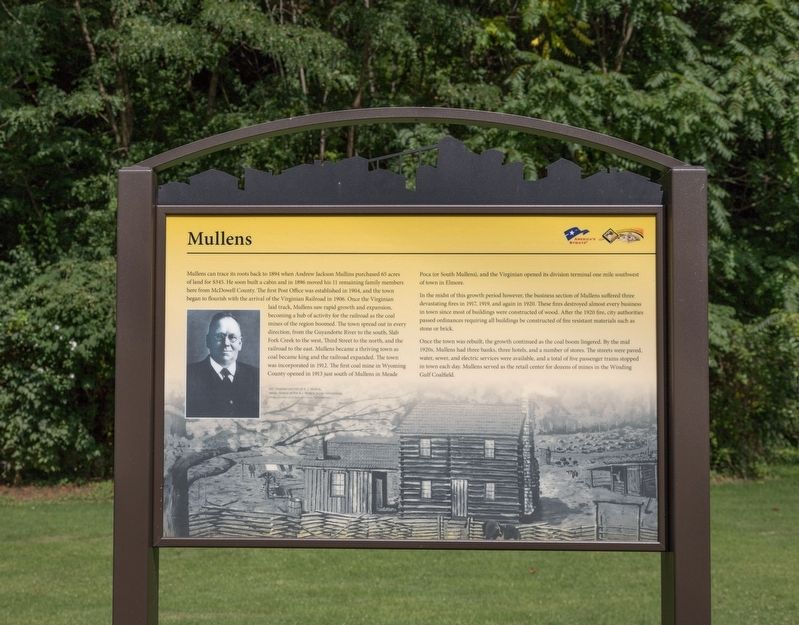
1. Mullens Interpretive Panel
In the midst of this growth period however, the business section of Mullens suffered three devastating fires in 1917, 1919, and again in 1920. These fires destroyed
this page online
Once the town was rebuilt, the growth continued as the coal boom lingered. By the mid 1920s, Mullens had three banks, three hotels, and a number of stores. The streets were paved, water, sewer, and electric services were available, and a total of five passenger trains stopped in town each day. Mullens served as the retail center for dozens of mines in the Winding Gulf Coalfield.
Erected by America’s Byways: Coal Heritage Trail, National Coal Heritage Area.
Topics and series. This historical marker is listed in this topic list: Railroads & Streetcars. In addition, it is included in the Coal Heritage Trail series list. A significant historical year for this entry is 1894.
Location. 37° 34.702′ N, 81° 23.325′ W. Marker is in Mullens, West Virginia, in Wyoming County. It is at the intersection of Guyandotte Avenue (West Virginia Route 16) and Lester Street, on the right when traveling west on Guyandotte
Photographed by J. J. Prats, July 15, 2019
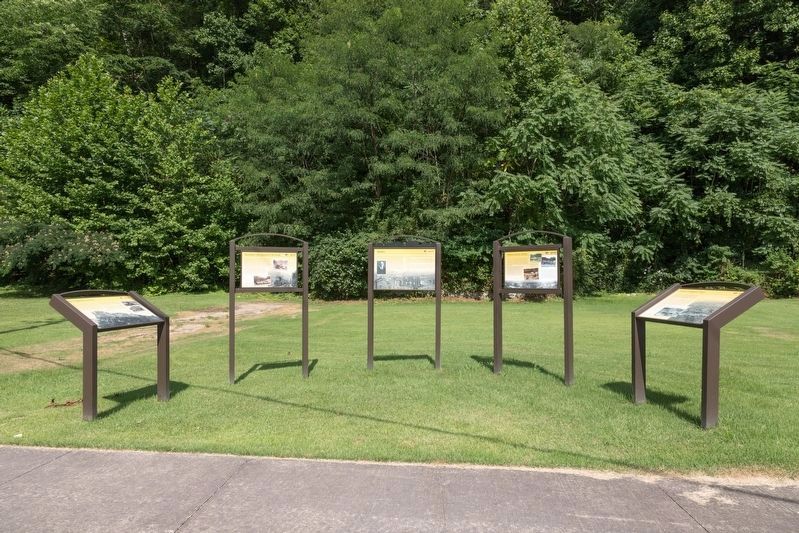
2. Five Interpretive Panels in Mullens
This panel is the center panel.

Regionally, this marker is in the Southern Coalfields. It is also in the American South, specifically in the Upper South, in Appalachia, and specifically in Southern Appalachia. Globally, it is in North America, the Western Hemisphere, the Western World, and the Anglosphere. Historically, it finds itself in what was once the territory of the Mississippian Culture.
Other nearby markers. At least 8 other markers are within 2 miles of this marker, measured as the crow flies: Mullens Historic District (here, next to this marker); The Richest Little Railroad in the World (here, next to this marker); Itmann Company Store (here, next to this marker); The Virginian Arrives (here, next to this marker); a different marker also named Mullens (within shouting distance of this marker); Captain J.F. Lyttle, Jr. Memorial Park & Playground (approx. 0.3 miles away); a different marker also named Mullens (approx. 0.6 miles away); Itmann (approx. 1.6 miles away). Touch for a list and map of all markers in Mullens.
Other markers no longer nearby. Virginian Railway Motor Barn (was approx. half a mile away but has been permanently removed); Virginian Railway Station (was approx. half a mile away but has been permanently removed).
More about this marker. Two images are on this interpretive panel. The mail image across the bottom is a sketch of the A.J. Mullins family homestead. To the left is a portrait of A.J. Mullins.
Credits. This page was last revised on June 9, 2020. It was originally submitted on August 26, 2019, by J. J. Prats of Powell, Ohio. This page has been viewed 720 times since then and 51 times this year. Photos: 1, 2. submitted on August 26, 2019, by J. J. Prats of Powell, Ohio.
