Lexington Park in St. Mary's County, Maryland — The American Northeast (Mid-Atlantic)
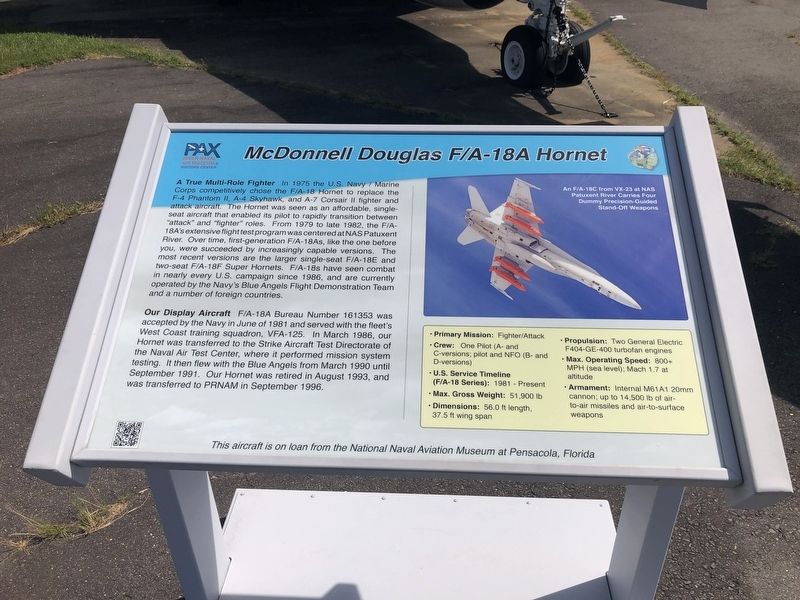
McDonnell Douglas F/A-18A Hornet
Photographed by Devry Becker Jones (CC0), August 30, 2019
1. McDonnell Douglas F/A-18A Hornet Marker
A True Multi-Role Fighter In 1975 the U.S. Navy / Marine Corps competitively chose the F/A-18 Hornet to replace the F-4 Phantom II, A-4 Skyhawk, and A-7 Corsair II fighter and attack aircraft. The Hornet was seen as an affordable, single-seat aircraft that enabled its pilot to rapidly transition between "attack" and "fighter" roles. From 1979 to late 1982, the F/A-18A's extensive flight test program was centered at NAS Patuxent River. Over time, first generation F/A-18As, like the one before you, were succeeded by increasingly capable versions. The most recent versions are the larger single-seat F/A-18E and two-seat F/A-18F Super Hornets. F/A-18s have seen combat in nearly every U.S. campaign since 1986, and are currently operated by the Navy's Blue Angels Flight Demonstration Team and a number of foreign countries.
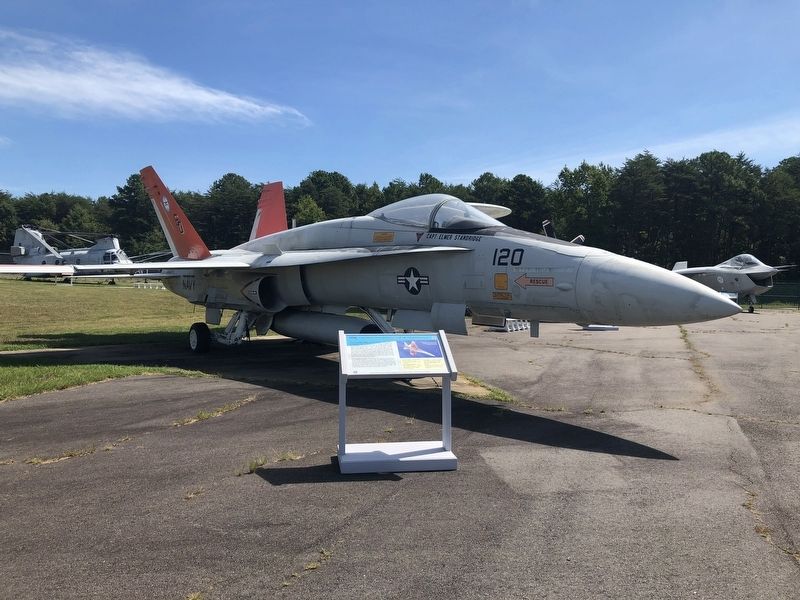
Our Display Aircraft F/A-18A Bureau Number 161353 was accepted by the Navy in June of 1981 and served with the fleet's West Coast training squadron, VFA-125. In March 1986, our Hornet was transferred to the Strike Aircraft Test Directorate of the Naval Air Test Center, where it performed mission system testing.
this page online
• Primary Mission: Fighter/Attack
• Crew: One Pilot (A- and C-versions); pilot and NFO (B- and D-versions)
• U.S. Service Timeline (F/A-18 Series): 1981 - Present
• Max. Gross Weight: 51,900 lb
• Dimensions: 56.0 ft length, 37.5 ft wing span
• Propulsion Two General Electric F404-GE-400 turbofan engines
• Max. Operating Speed: 800+ MPH (sea level); Mach 1.7 at altitude
• Armament: Internal M61A1 20mm cannon; up to 14,500 lb of air-to-air missiles and air-to-surface weapons
Erected by Patuxent River Naval Air Museum.
Topics. This historical marker is listed in these topic lists: Air & Space • Military. A significant historical month for this entry is March 1986.
Location. 38° 16.548′ N, 76° 27.715′ W. Marker is in Lexington Park, Maryland, in St. Mary's County. It can be reached from Three Notch Road (Maryland Route 235) just north of Buse Road, on the right when traveling

Regionally, this marker is in Southern Maryland. It is also in the American South, specifically in the Upper South, in the Mid-Atlantic, in the Tidewater, in the Chesapeake Bay Region, and on the Eastern Seaboard. Globally, it is in the North Atlantic Region, North America, the Western Hemisphere, the Western World, and the Anglosphere. Historically, it finds itself in what was once one of the original Thirteen Colonies and also the Antebellum South.
Other nearby markers. At least 8 other markers are within walking distance of this marker: Grumman NF-14D Tomcat (a few steps from this marker); North American RA-5C Vigilante (a few steps from this marker); Grumman E-2B Hawkeye (a few steps from this marker); McDonnell Douglas F-4J Phantom II (a few steps from this marker); North American T-39D Sabreliner (within shouting distance of this marker); Mk-82 500-lb Snakeye Bomb (within shouting distance of this marker); AIM-9H Sidewinder Missile (within shouting distance of this marker); Grumman A-6E Intruder (within shouting distance of this marker). Touch for a list and map of all markers in Lexington Park.
Credits. This page was last revised on September 1, 2019. It was originally submitted on September 1, 2019, by Devry Becker Jones of Washington, District of Columbia. This page has been viewed 367 times since then and 38 times this year. Photos: 1, 2. submitted on September 1, 2019, by Devry Becker Jones of Washington, District of Columbia.
