White Sands in Doña Ana County, New Mexico — The American Mountains (Southwest)
White Sands Missile Range
AIAA Historic Aerospace Site

Photographed by Don Morfe, September 9, 2008
1. White Sands Missile Range Marker
White Sands Proving Ground, as it was first called, is home to America’s first large-scale rocket and missile launch facilities. Established in 1945, the launching here of 67 V-2 rockets and many other vehicles propelled the United States into the Space Age. Scientists and military researchers learned to handle large rockets and improved the emerging technology. Vital experiments to learn about the nature of the upper atmosphere and the fringes of outer space were conducted here. Tests here also include those of the first air defense missile system, the Nike Ajax, and the first U.S. ballistic missile, the Corporal.
Erected 2005 by The American Institute of Aeronautics and Astronautics.
Topics and series. This memorial is listed in this topic list: Air & Space. In addition, it is included in the AIAA Historic Aerospace Sites series list. A significant historical year for this entry is 1945.
Location. 32° 23.1′ N, 106° 28.721′ W. Memorial is in White Sands, New Mexico, in Doña Ana County. It is on State Road 213. The marker and various missiles shown are located on the grounds of the White Sands Missile Range Museum.
this page online

Regionally, this memorial is in the Rio Grande Valley. It is also in the American Borderlands and in the Southwest. Globally, it is in North America, the Western Hemisphere, the Western World, and the Anglosphere. Historically, it finds itself in what was once New Spain, the Gadsden Purchase, and the Republic of Texas.
Other nearby markers. At least 8 other markers are within walking distance of this marker: In Honor of Joy & Paul Arthur (a few steps from this marker); Pershing II (within shouting distance of this marker); Patriot Missile (within shouting distance of this marker); Huey Helicopter UH-1M (within shouting distance of this marker); Fat Man Bomb Casing (within shouting distance of this marker); Hermes A1 (within shouting distance of this marker); IGOR (within shouting distance of this marker); Clyde Tombaugh (1906-1997) (within shouting distance of this marker). Touch for a list and map of all markers in White Sands.

Photographed by James Hulse, July 23, 2024
2. The view of the White Sands Missile Range Marker from the parking lot
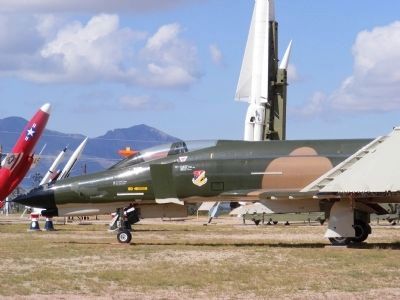
Photographed by Don Morfe, September 9, 2008
3. White Sands Missile Range
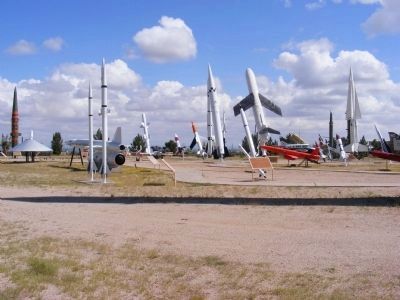
Photographed by Don Morfe, September 9, 2008
4. White Sands Missile Range
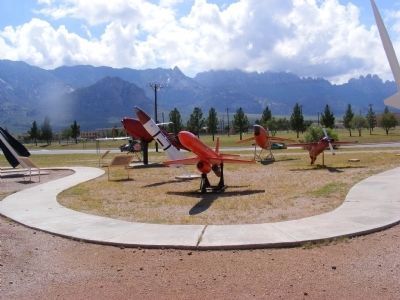
Photographed by Don Morfe, September 9, 2008
5. White Sands Missile Range
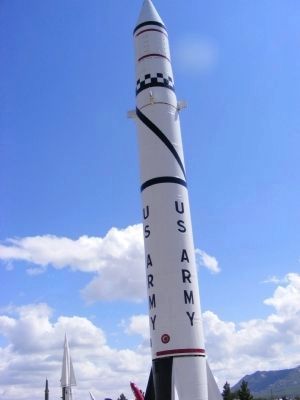
Photographed by Don Morfe, September 9, 2008
6. Redstone Missile
Designed by Dr. Werner Von Braun and developed at Redstone Arsenal this was once the Army's largest surface-to-surface ballistic missile. It could deliver a nuclear warhead to targets 200 miles away. The Redstone was used as the first stage of the Jupiter C which successfully orbed America's first satellite. Redstone boosters were also used by NASA to send Alan Shepard into space in 1961.
Photographed by Don Morfe, September 9, 2008
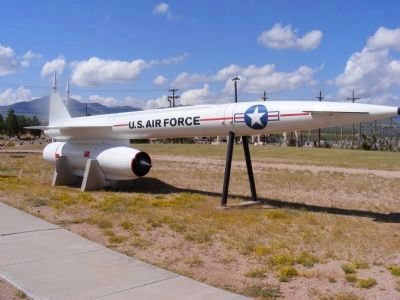
7. Hound Dog Missile
A forerunner to the cruise missile, this jet propelled, supersonic missile was launched from a B-52 bomber and then flew to its target carrying a nuclear warhead. Test flights were conducted between White Sands and Utah
Photographed by Don Morfe, September 9, 2008
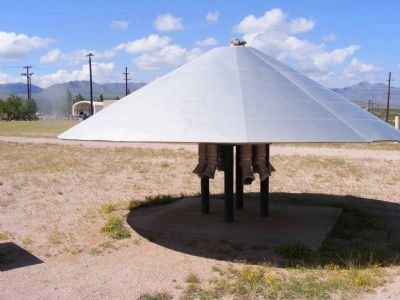
8. Aeroshell "Flying Saucer"
This spacecraft was a section of the Voyager Balloon System which was launched near Roswell, NM and landed on White Sands Missile Range. These bright, shiny aeroshells projected an illusion of flying saucers. Aeroshell was designed for slowing down a missile for landing on Mars. This display is believed to be the only one "in captivity".
Photographed by Don Morfe, September 9, 2008
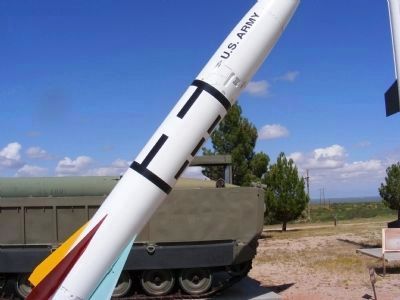
9. Lance Missile
A surface-to-surface missile capable of carrying either a nuclear or conventional warhead. The Lance was the first Army missile to use prepackaged storable liquid propellant. It had a self-propelled launcher and could operate in all types of weather.
Photographed by Don Morfe, September 9, 2008
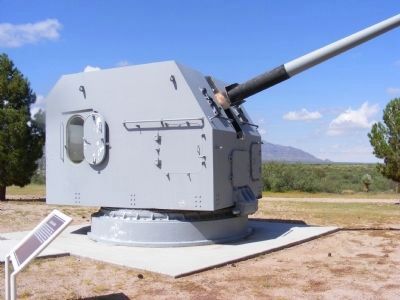
10. MK 39 5in/54 Gun
Originally installed on the U.S.S. Franklin D. Roosevelt CVB-42 in 1945. This 5 inch gun, weighing over 73,000 lbs. was relocated to the LLS-Desert Ship at White Sands Missile Range in 1977. With this gun, the Navy at White Sands became an integral part of the testing that took place with Rocket Propelled Projectiles. To ensure that the gun was still operational warmer rounds were last fired from its barrel back in 1996.
Photographed by Don Morfe, September 9, 2008
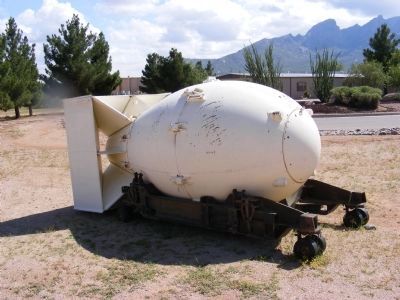
11. Fat Man Bomb Casing
The casing on this display was assembled after WWII, and it is considered the prototype for the original MK III. The original atomic bomb was tested at Trinity Site on July 16, 1945 without a casing. The 5,000 pound bomb was placed atop a 100-foot tower to simulate an aerial blast and reduce the amount of radioactive dust spewed into the air. It was dropped on Nagasaki, Japan on August 9, 1945.
Photographed by Don Morfe, September 9, 2008
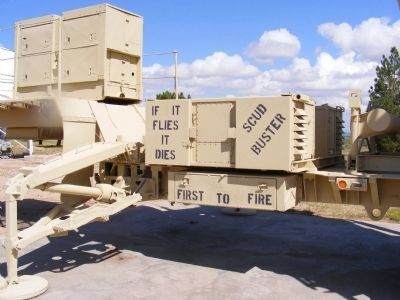
12. Patriot Missile
The replacement for Nike Hercules and improved Hawk, the Patriot was designed to defend against high performance air-breathing targets. The system could simultaneously acquire, identify, track, and destroy multiple targets. In the early 90's it was successfully modified to intercept tactical ballistic missiles. Each launcher can carry four missiles which are protected in their shipping containers. The missiles are launched out of their containers.
Photographed by Don Morfe, September 9, 2008
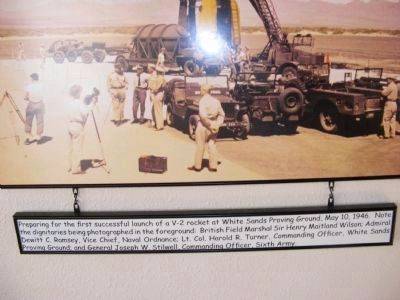
13. Preparing for the first launch of a V-2 rocket
The first successful launch was at White Sands Proving Ground, May 10, 1946. Note the dignitaries being photographed in the foreground. British Field Marshall Sir Henry Maitland Wilson, Admiral Dewitt C. Ramsey, Vice Chief, Naval Ordinance, Lt. Col. Harold R. Turner, Commanding Officer White Sands Proving Grounds, and General Joseph W. Stilwell, Commanding Officer, Sixth Army. This photo is located inside the museum.
Photographed by Don Morfe, September 9, 2008
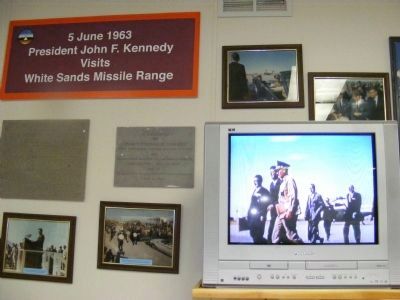
14. President John F. Kennedy Visits White Sands Missile Range
The visit was on 5 June 1963. The photo was inside the museum.
Credits. This page was last revised on March 11, 2026. It was originally submitted on January 30, 2014, by Don Morfe of Baltimore, Maryland. This page has been viewed 1,960 times since then and 217 times this year. Last updated on October 6, 2019, by Craig Baker of Sylmar, California. Photos: 1. submitted on January 30, 2014, by Don Morfe of Baltimore, Maryland. 2. submitted on July 28, 2024, by James Hulse of Medina, Texas. 3, 4, 5, 6, 7, 8, 9, 10, 11, 12, 13, 14. submitted on January 30, 2014, by Don Morfe of Baltimore, Maryland. • J. Makali Bruton was the editor who published this page.
