Sugar City in Madison County, Idaho — The American West (Mountains)
Sugar City Sugar Beet Factory
Photographed by Barry Swackhamer, August 12, 2019
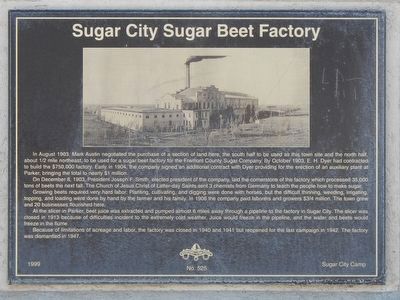
1. Sugar City Sugar Beet Factory Marker
On December 8, 1903, President Joseph F. Smith, elected president of the company, laid the cornerstone of the factory which processed 35,000 tons of beets the next fall. The Church of Jesus Christ of Latter-day Saints sent 3 chemists from Germany to teach the people how to make sugar.
Growing beets required very hard labor. Planting, cultivating, and digging were done with horses, but the difficult thinning, weeding, irrigating, toping, and loading were done by hand by the farmer and his family. In 1906 the company paid laborers and growers $3/4 million. The town grew and 20 businesses flourished here.
At the slicer in Parker, beet juice was
this page online
Because of limitations of acreage and labor, the factory was closed in 1940 and 1941 but reopened for the last campaign in 1942. The factory was dismantled in 1947.
Erected 1999. (Marker Number 525.)
Topics and series. This historical marker is listed in this topic list: Industry & Commerce. In addition, it is included in the Daughters of Utah Pioneers series list.
Location. 43° 52.381′ N, 111° 44.623′ W. Marker is in Sugar City, Idaho, in Madison County. It is at the intersection of Park Avenue and Center Street, on the right when traveling south on Park Avenue. Touch for map. Marker is at or near this postal address: 42 Park Avenue, Sugar City ID 83448, United States of America. Touch for directions.

Regionally, this marker is in Eastern Idaho and the Yellowstone Fringe. It is also in the American Mountain
Photographed by Barry Swackhamer, August 12, 2019
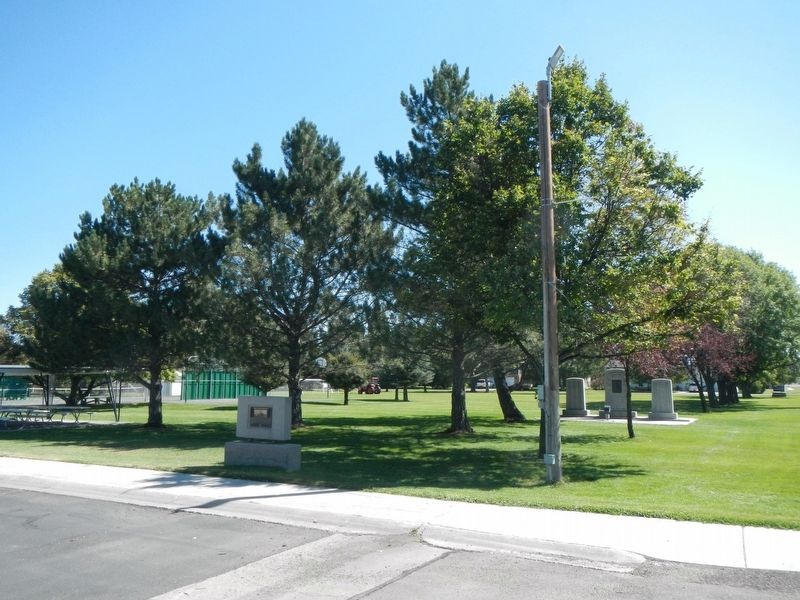
2. Sugar City Sugar Beet Factory Marker
Other nearby markers. At least 8 other markers are within 4 miles of this marker, measured as the crow flies: Thomas C. Neibaur Monument (about 400 feet away, measured in a direct line); The Settlement of Salem, Idaho (approx. 1.7 miles away); Rexburg Milling Company (approx. 3.3 miles away); The Tithing Barn Block (approx. 3½ miles away); Teton City Settlers (approx. 3.7 miles away); The Teton Dam Flood Marker (approx. 3.7 miles away); In Honor of the Rexburg Stake Pioneers (approx. 3.7 miles away); Rexburg Tabernacle Centennial (approx. 3.7 miles away).
More about this marker. The marker is located at Veteran's Park.
Credits. This page was last revised on October 8, 2019. It was originally submitted on October 8, 2019, by Barry Swackhamer of Brentwood, California. This page has been viewed 1,731 times since then and 94 times this year. Photos: 1, 2. submitted on October 8, 2019, by Barry Swackhamer of Brentwood, California.
