East Dover Hundred in Kent County, Delaware — The American Northeast (Mid-Atlantic)
Calvary Baptist Church
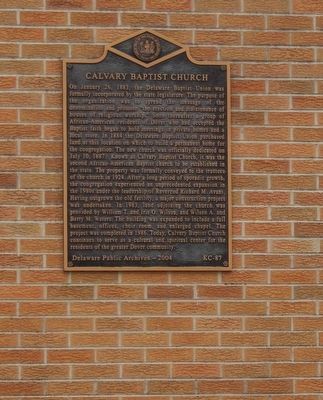
Photographed by Don Morfe, October 13, 2019
1. Calvary Baptist Church Marker
this page online
Erected 2004 by Delaware Public Archives. (Marker Number KC-87.)
Topics and series. This historical marker is listed in these topic lists: African Americans • Religion & Religious Structures. In addition, it is included in the Delaware Public Archives series list. A significant historical date for this entry is January 26, 1883.
Location. 39° 9.708′ N, 75° 31.878′ W. Marker is in Dover, Delaware, in Kent County. It is in East Dover Hundred. It is at the intersection of N. Queen Street and Fulton Street on N. Queen Street. Touch for map. Marker is at or near this postal address: 410 Fulton Street, Dover DE 19904, United States of America. Touch for directions.

Regionally, this marker is in the American Mid-Atlantic, on the Delmarva Peninsula, and on the Eastern Seaboard. Globally, it is in the North Atlantic Region, North America, the Western Hemisphere,
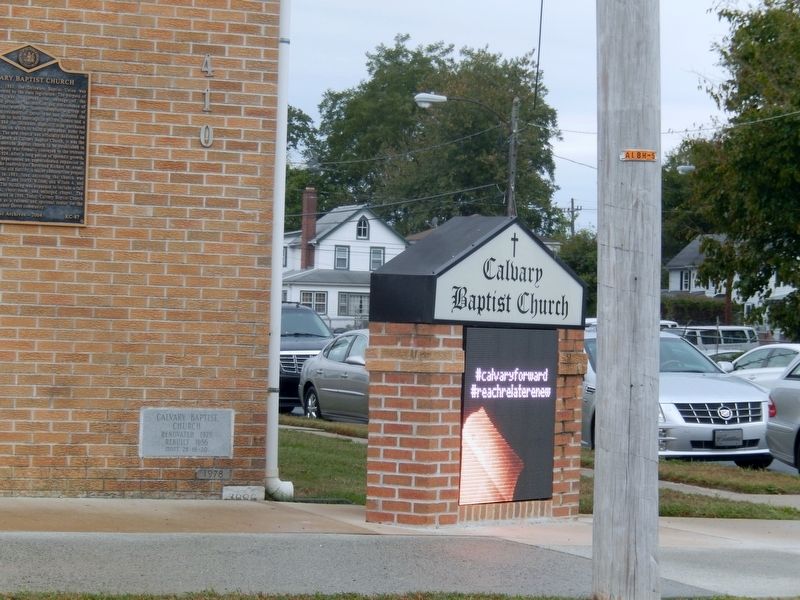
Photographed by Don Morfe, October 13, 2019
2. Calvary Baptist Church Marker
Other nearby markers. At least 8 other markers are within walking distance of this marker: Mount Zion African Methodist Episcopal Church (within shouting distance of this marker); Wesley College (approx. ¼ mile away); Annie Jump Cannon (approx. 0.3 miles away); Former Site of ILC Dover (approx. 0.3 miles away); Site of Dover's First Methodist Church (approx. 0.4 miles away); Richardson and Robbins Complex (approx. 0.4 miles away); a different marker also named Woodburn: The Governor's House (approx. 0.4 miles away); World War II Memorial (approx. 0.4 miles away). Touch for a list and map of all markers in Dover.
Another marker is no longer nearby. Woodburn: The Governor's House (was approx. 0.4 miles away but has been replaced with another marker now near it).
Credits. This page was last revised on May 15, 2026. It was originally submitted on October 19, 2019, by Don Morfe of Baltimore, Maryland. This page has been viewed 429 times since then and 22 times this year. Photos: 1, 2. submitted on October 19, 2019, by Don Morfe of Baltimore, Maryland. • Bill Pfingsten was the editor who published this page.
