Grangeville in Idaho County, Idaho — The American West (Mountains)
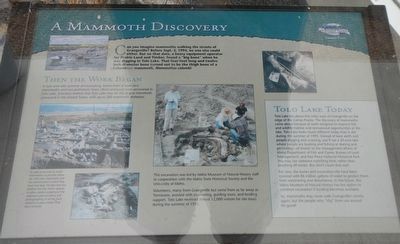
A Mammoth Discovery
Photographed by Barry Swackhamer, August 25, 2019
1. A Mammoth Discovery Marker
Caption: (bottom left) In order to recover as much information as possible about the Tolo Lake mammoths and the environment in which they lived and died, the lake bed was gridded into five-meter squares to allow careful sampling of the sediments and recording and photographing of all the fossil elements in place before they were removed.
Then the Work Began
In just one summer of excavating, bones from at least nine mammoths and two prehistoric bison (Bison antiques) were uncovered in Tolo Lake. Scientists believe that Tolo Lake may be the largest mammoth graveyard in the United States, with up to 200 mammoth skeletons.
The excavation was led by Idaho Museum of Natural History staff in cooperation with the Idaho State Historical Society and the University of Idaho.
Volunteers, many from Grangeville but some from as far away as Tennessee, assisted with the excavating, guiding tours, and lending support. Tolo Lake received almost 12,000 visitors for site tours during the summer of 1995.
(side-bar on right:)
Tolo Lake Today
Tolo Lake lies about five miles west of Grangeville on
this page online
For now, the bones and excavation site have been covered with 86 million gallons of water to protect them from weathering and disturbance. In the future, the Idaho Museum of Natural History has the option to continue excavation if funding becomes available.
So, mammoths may never walk Grangeville's streets again, but the people who "dig" them are around for good!
Erected by Northwest Passage Scenic Byway and All-American Road.
Topics. This historical marker is listed in this topic list: Paleontology. A significant historical date for this entry is September 4, 1994.
Location. 45° 55.924′ N,
Photographed by Barry Swackhamer, August 25, 2019
2. A Mammoth Discovery Marker
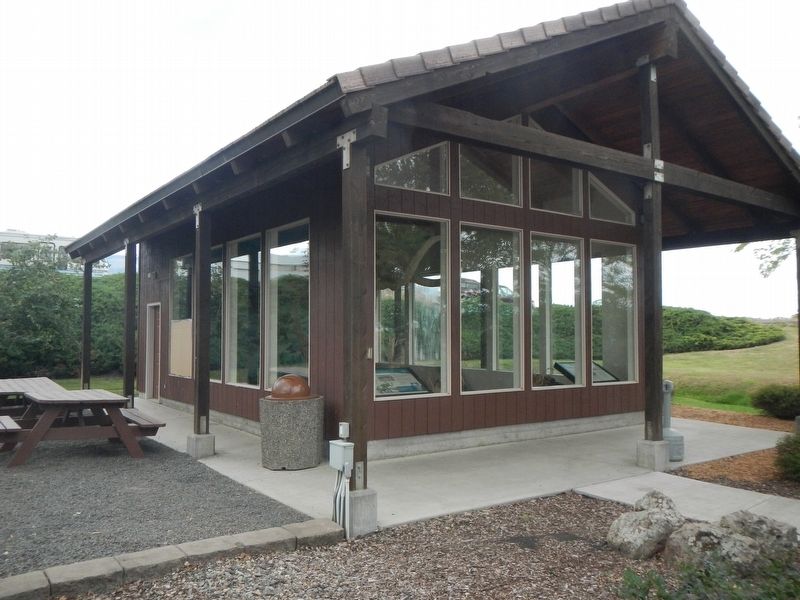
The marker is in the window on the right.

Regionally, this marker is in North Idaho — Idaho’s Panhandle. It is also in the American Mountain West, specifically in the Pacific Northwest, and in the Lewis & Clark Corridor. Globally, it is in North America, the Rocky Mountains, the Western Hemisphere, the Western World, and the Anglosphere.
Other nearby markers. At least 8 other markers are within 3 miles of this marker, measured as the crow flies: The Camas Prairie Mammoth (here, next to this marker); Gold Pans and Whipsaws (a few steps from this marker); The Camas Connection (a few steps from this marker); Home on the Grange (a few steps from this marker); The Eimers Legacy (a few steps from this marker); Tolo, Alab-lemot (within shouting distance of this marker); The ADVANCE Steam Traction Engine (approx. 0.6 miles away); Mount Idaho (approx. 3.1 miles away). Touch for a list and map
Photographed by Barry Swackhamer, August 25, 2019
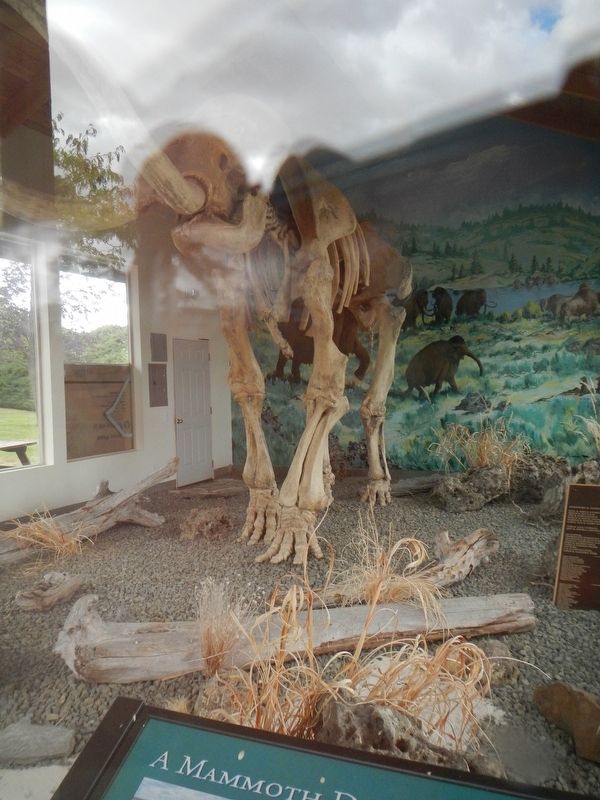
3. Replica of the Columbian Mammoth (Mammuthus columbi)
More about this marker. This exhibit is in Eimers Park.
Credits. This page was last revised on October 20, 2019. It was originally submitted on October 20, 2019, by Barry Swackhamer of Brentwood, California. This page has been viewed 2,618 times since then and 259 times this year. Photos: 1, 2, 3. submitted on October 20, 2019, by Barry Swackhamer of Brentwood, California.
