Cotton Plant in Woodruff County, Arkansas — The American South (West South Central)
Woodruff County Courthouse
Cotton Plant
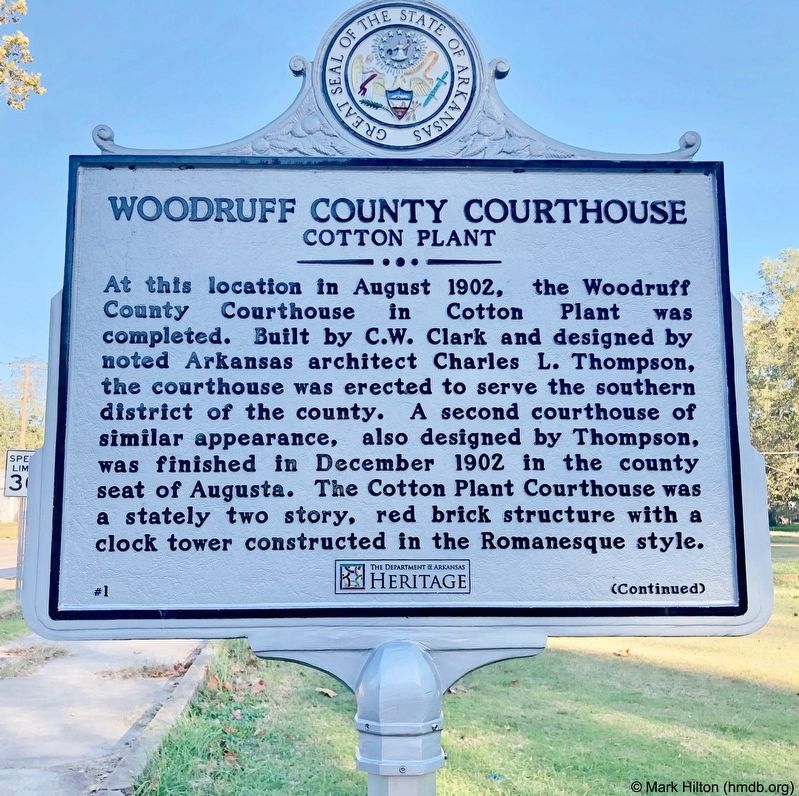
Photographed by Mark Hilton, October 23, 2019
1. Woodruff County Courthouse Marker
Inscription.
Woodruff County Courthouse. Cotton Plant. At this location in August 1902, the Woodruff County Courthouse in Cotton Plant was completed. Built by C.W. Clark and designed by noted Arkansas architect Charles L. Thompson, the courthouse was erected to serve the southern district of the county. A second courthouse of similar appearance, also designed by Thompson, was finished in December 1902 in the county seat of Augusta. The Cotton Plant Courthouse was a stately two story, red brick structure with a clock tower constructed in the Romanesque style. , (Continued)
[Reverse] ,
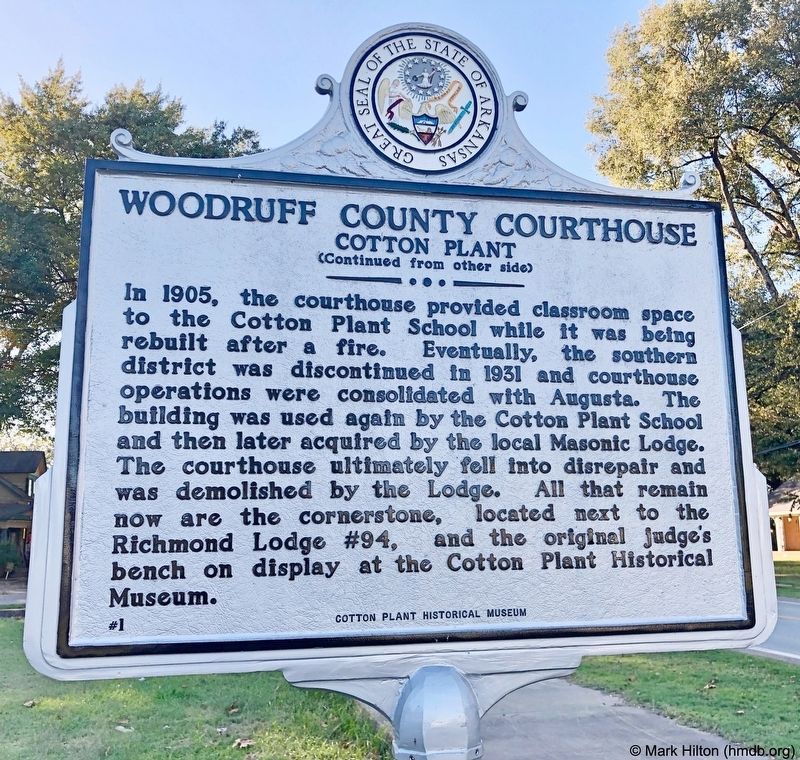
(Continued from other side) , . In 1905, the courthouse provided classroom space to the Cotton Plant School while it was being rebuilt after a fire. Eventually, the southern district was discontinued in 1931 and courthouse operations were consolidated with Augusta. The building was used again by the Cotton Plant School and then later acquired by the local Masonic Lodge. The courthouse ultimately fell Into disrepair and was demolished by the Lodge. All that remain now are the cornerstone, located next to Richmond Lodge #94, and the original judges bench on display at the Cotton Plant Historical Museum.
At this location in August 1902, the Woodruff County Courthouse in Cotton Plant was completed. Built by C.W. Clark and designed by noted Arkansas architect Charles L. Thompson, the courthouse was erected to serve the southern district of the county. A second courthouse of similar appearance, also designed by Thompson, was finished in December 1902 in the county seat of Augusta. The Cotton Plant Courthouse was a stately two story, red brick structure with a clock tower constructed in the Romanesque style.
(Continued)
[Reverse]
(Continued from other side)
In 1905, the courthouse provided classroom space to the Cotton Plant School while it was being rebuilt after a fire. Eventually, the southern district was discontinued in 1931 and courthouse operations were consolidated with Augusta. The building was used again by the Cotton Plant School and then later acquired by the local Masonic Lodge. The courthouse ultimately fell Into disrepair and was demolished by the Lodge. All that remain now are the cornerstone, located next to Richmond Lodge #94, and the original judges bench on display at the Cotton Plant Historical Museum.
Erected 2018
Click or scan to see this page online
by the Department of Arkansas Heritage & Cotton Plant Historical Museum. (Marker Number 1.)
Topics and series. This historical marker is listed in this topic list: Architecture. In addition, it is included in the Arkansas Heritage series list. A significant historical month for this entry is August 1902.
Location. 35° 0.275′ N, 91° 15.277′ W. Marker is in Cotton Plant, Arkansas, in Woodruff County. It is at the intersection of Main Street (Arkansas Route 38) and South Gum Street, on the right when traveling east on Main Street. Touch for map. Marker is at or near this postal address: 409 Main Street, Cotton Plant AR 72036, United States of America. Touch for directions.

Regionally, this marker is in the American South and specifically in the Upper South. Globally, it is in North America, the Western Hemisphere, the Western World, and the Anglosphere. Historically, it finds itself in what was once the territory of the Mississippian Culture, the Louisiana Purchase, one of the Confederate States of America, and the Antebellum South.
Other nearby markers. At least 8 other markers are within 9 miles of this marker, measured as the crow
3. Location of former Woodruff County Courthouse (cornerstone mentioned is on right of building).
Credits. This page was last revised on October 24, 2019. It was originally submitted on October 24, 2019, by Mark Hilton of Montgomery, Alabama. This page has been viewed 611 times since then and 11 times this year. Photos:1, 2, 3. submitted on October 24, 2019, by Mark Hilton of Montgomery, Alabama.
