Near Wolf Creek in Lewis and Clark County, Montana — The American West (Mountains)
The Mann Gulch Fire
Photographed by Barry Swackhamer, August 13, 2019
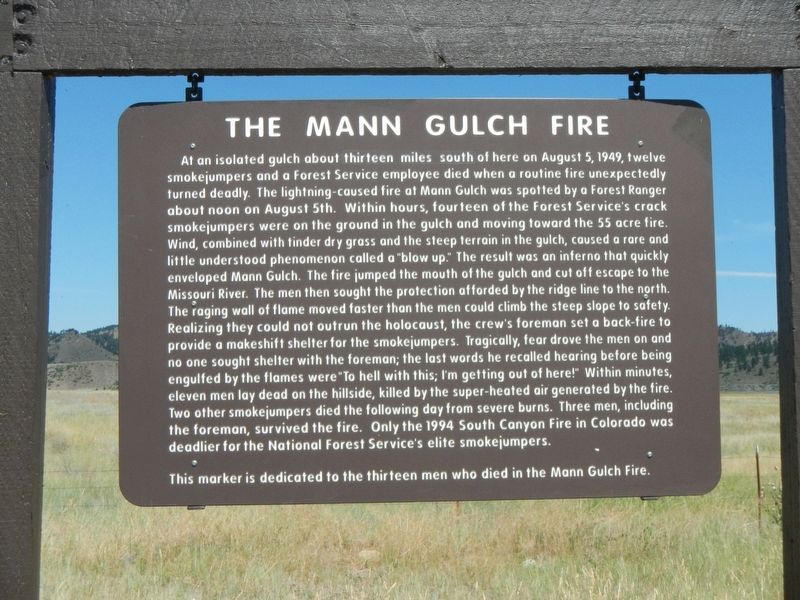
1. The Mann Gulch Fire Marker
Inscription.
The Mann Gulch Fire. . At an isolated gulch about thirteen miles south of here on August 5, 1949, twelve smokejumpers and a Forest Service employee died when a routine fire unexpectedly turned deadly. The lightning-caused fire at Mann Gulch was spotted by a Forest Ranger about noon on August 15th. Within hours, fourteen of the Forest Service's crack smokejumpers were on the ground in the gulch and moving toward the 55 acre fire. Wind, combined with tinder dry grass and the steep terrain in the gulch, caused a rare and little understood phenomenon called a "blow up." The result was an inferno that quickly enveloped Mann Gulch. The fire jumped the mouth of the gulch and cut off escape to the Missouri River. The men sought the protection afforded by the ridge line to the north. The raging wall of flame moved faster than the men could climb the steep slope to safety. Realizing they could not outrun the holocaust, the crew's foreman set a back-fire to provide a makeshift shelter for the smokejumpers. Tragically, fear drove the men on and no one sought shelter with the foreman; the last words he recalled hearing before being engulfed by the flames were "To hell with this; I'm getting out of here!" Within minutes, eleven men lay dead on the hillside, killed by the super-heated air generated by the fire. Two other smokejumpers died the following day from severe burns. Three men, including the foreman, survived the fire. Only the 1994 South Canyon Fire in Colorado was deadlier for the National Forest Service's elite smokejumpers. , This marker is dedicated to the thirteen men who died in the Mann Gulch Fire.
At an isolated gulch about thirteen miles south of here on August 5, 1949, twelve smokejumpers and a Forest Service employee died when a routine fire unexpectedly turned deadly. The lightning-caused fire at Mann Gulch was spotted by a Forest Ranger about noon on August 15th. Within hours, fourteen of the Forest Service's crack smokejumpers were on the ground in the gulch and moving toward the 55 acre fire. Wind, combined with tinder dry grass and the steep terrain in the gulch, caused a rare and little understood phenomenon called a "blow up." The result was an inferno that quickly enveloped Mann Gulch. The fire jumped the mouth of the gulch and cut off escape to the Missouri River. The men sought the protection afforded by the ridge line to the north. The raging wall of flame moved faster than the men could climb the steep slope to safety. Realizing they could not outrun the holocaust, the crew's foreman set a back-fire to provide a makeshift shelter for the smokejumpers. Tragically, fear drove the men on and no one sought shelter with the foreman; the last words he recalled hearing before being engulfed by the flames
Click or scan to see this page online
were "To hell with this; I'm getting out of here!" Within minutes, eleven men lay dead on the hillside, killed by the super-heated air generated by the fire. Two other smokejumpers died the following day from severe burns. Three men, including the foreman, survived the fire. Only the 1994 South Canyon Fire in Colorado was deadlier for the National Forest Service's elite smokejumpers.
This marker is dedicated to the thirteen men who died in the Mann Gulch Fire.
Erected by Montana Department of Transportation.
Topics. This historical marker is listed in these topic lists: Disasters • Natural Features. A significant historical date for this entry is August 5, 1949.
Location. 47° 1.2′ N, 112° 0.604′ W. Marker is near Wolf Creek, Montana, in Lewis and Clark County. It is on Craig Frontage Road near Beartooth Road, on the left when traveling north. Touch for map. Marker is in this post office area: Wolf Creek MT 59648, United States of America. Touch for directions.

Regionally, this marker is in Central Montana, in Gold West Country and in Greater Helena. It is also in the American Mountain West and in the Lewis & Clark Corridor.
Photographed by Barry Swackhamer, August 13, 2019
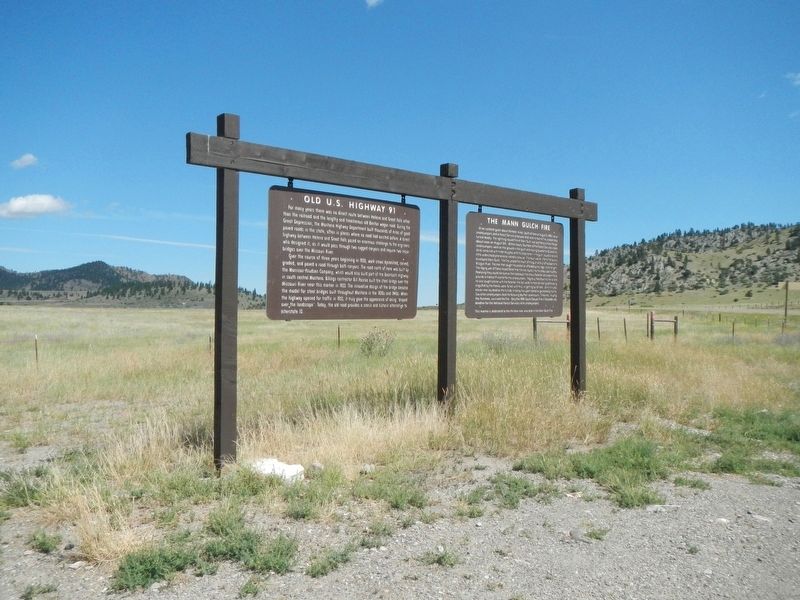
2. The Mann Gulch Fire Marker
Globally, it is in North America, the Rocky Mountains, the Western Hemisphere, the Western World, and the Anglosphere. Historically, it finds itself in what was once Ruperts Land and also the Louisiana Purchase.
Regarding The Mann Gulch Fire. The Mann Gulch Fire was the basis for the 1952 movie The Red Skies of Montana starring Richard Widmark.
Also see . . . Mann Gulch Fire. Wikipedia entry (Submitted on April 18, 2026, by Larry Gertner of New York, New York.)
Photographed by Forest Service
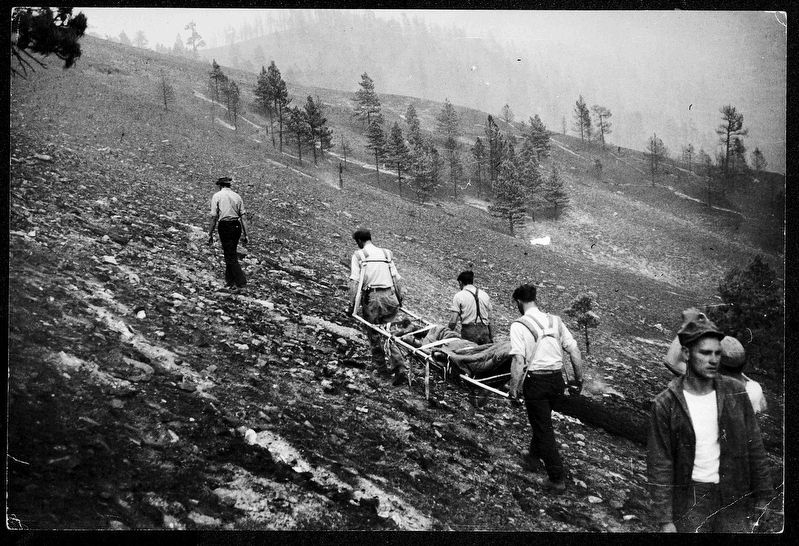
3. Retrieving the bodies at Mann Gulch
Credits. This page was last revised on April 18, 2026. It was originally submitted on October 28, 2019, by Barry Swackhamer of Brentwood, California. This page has been viewed 541 times since then and 30 times this year. Photos:1, 2, 3. submitted on October 28, 2019, by Barry Swackhamer of Brentwood, California.
