Tulare in Tulare County, California — The American West (Pacific Coastal)
Tulare Irrigation District
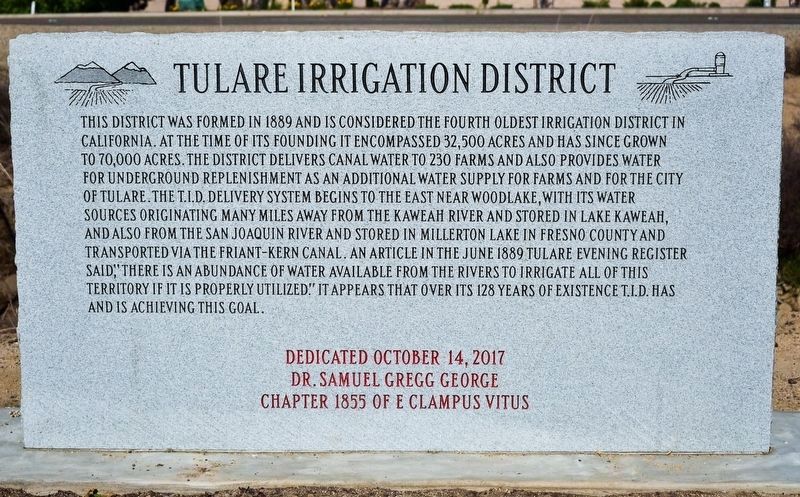
Photographed by Dr. Samuel Gregg George Chapter No. 1855 E Clampus Vitus, May 13, 2018
1. Tulare Irrigation District Marker
Erected 2017 by Dr. Samuel Gregg George Chapter 1855 of E Clampus Vitus.
Topics and series. This historical marker is listed in this topic list: Agriculture. In addition, it is included in the E Clampus Vitus
this page online
Location. 36° 13.241′ N, 119° 18.801′ W. Marker is in Tulare, California, in Tulare County. It is on North Mooney Boulevard, on the right when traveling south. This marker is on the Tulare-Santa Fe Trail, by the Tulare Canal. Touch for map. Marker is in this post office area: Tulare CA 93274, United States of America. Touch for directions.

Regionally, this marker is in California’s San Joaquin Valley, specifically in the Central Valley, and in the Sierra Nevada. It is also on the American Pacific Coast. Globally, it is in North America, on the Ring of Fire, in the Pacific Rim, in the Western Hemisphere, in the Western World, and in the Anglosphere. Historically, it finds itself in what was once New Spain and also Mexico’s Alta California.
Other nearby markers. At least 8 other markers are within 4 miles of this marker, measured as the crow flies: First Airplane in Tulare County (approx. 0.8 miles away); St. Aloysius Gonzaga (approx. 1.9 miles away); Tulare City, Main Southern Pacific Railroad Terminal, 1872-1892 (approx. 2.1 miles away); Tuggleville (approx.
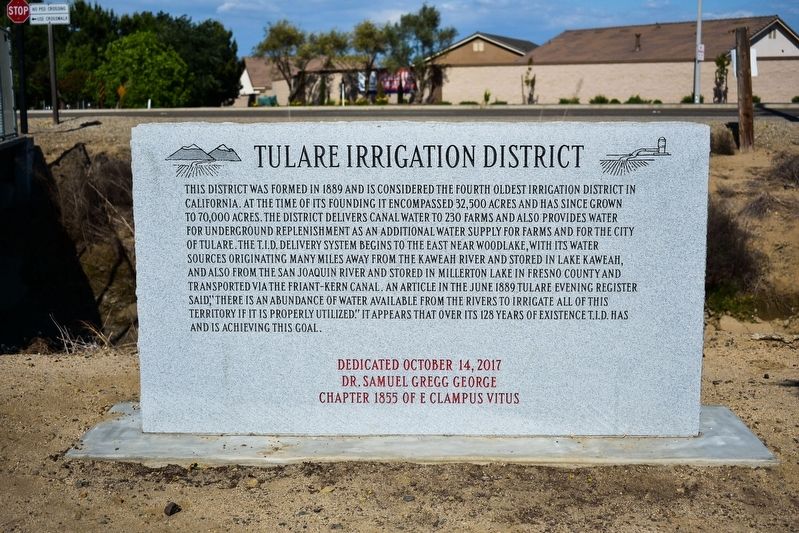
Photographed by Dr. Samuel Gregg George Chapter No. 1855 E Clampus Vitus, May 13, 2018
2. Tulare Irrigation District Marker
Credits. This page was last revised on November 3, 2019. It was originally submitted on October 30, 2019, by Frank Gunshow Sanchez of Hollister, California. This page has been viewed 524 times since then and 39 times this year. Photos: 1. submitted on November 3, 2019, by Frank Gunshow Sanchez of Hollister, California. 2. submitted on October 30, 2019, by Frank Gunshow Sanchez of Hollister, California. • Syd Whittle was the editor who published this page.
