The Resignation of Mayor William L. Couch
Oklahoma City November 11, 1889
| — | The ‘89er Trail | — |
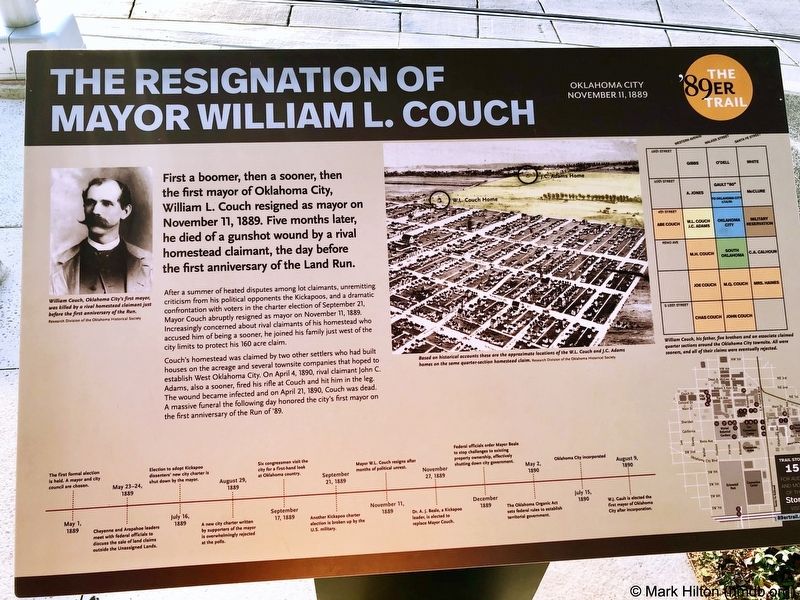
First a boomer, then a sooner, then the first mayor of Oklahoma City, William L. Couch resigned as Mayor on November 11, 1889. Five months later, he died of a gunshot wound by a rival homestead claimant, the day before the first anniversary of the Land Run.
After a summer of heated disputes among lot claimants, unremitting criticism from his political opponents the Kickapoos, and a dramatic confrontation with voters in the charter election of September 21, Mayor Couch abruptly resigned as mayor on November 11, 1889. Increasingly concerned about rival claimants of his homestead who accused him of being a sooner, he joined his family just west of the city limits to protect his 160 acre claim.
Couch's homestead was claimed by two other settlers who had built houses on the acreage and several townsite companies that hoped to establish West Oklahoma City. On April 4, 1890, rival claimant John C. Adams, also a sooner, fired his rifle at Couch and hit him in the leg. The wound became infected and on April 21, 1890, Couch was dead. A massive funeral the following day honored the city's first mayor on the first anniversary
this page online
Photo captions:
Top left: William Couch, Oklahoma City's first mayor, was killed by a rival homestead claimant just before the first anniversary of the Run.
Research Division of the Oklahoma Historical Society
Middle: Based on historical accounts these are the approximate locations of the W.L. Couch and J.С. Adams homes on the same quarter-section homestead claim.
Research Division of the Oklahoma Historical Society
Top right: William Couch, his father, five brothers and an associate claimed quarter sections around the Oklahoma City townsite. All were sooners, and all of their claims were eventually rejected.
Erected 2018 by Oklahoma City Community Foundation, Wiggin Properties. (Marker Number 15.)
Topics and series. This historical marker is listed in this topic list: Settlements & Settlers. In addition, it is included in the The '89er Trail series list. A significant historical date for this entry is April 4, 1890.
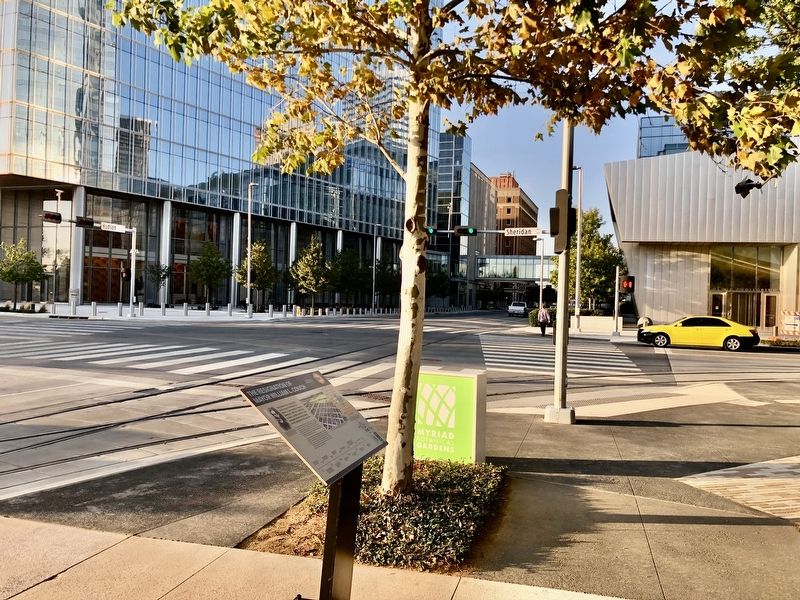
Location. 35° 27.978′ N, 97° 31.168′ W. Marker is in Oklahoma City, Oklahoma, in Oklahoma County. It is in Central Oklahoma City. It is at the intersection of South Hudson Avenue and West

Regionally, this marker is in Central Oklahoma—Frontier Country. It is also in the American South, specifically on the prairies, and on the Southern Plains. Globally, it is in North America, the Western Hemisphere, the Western World, and the Anglosphere. Historically, it finds itself in what was once the territory of the Mississippian Culture and also the Louisiana Purchase.
Other nearby markers. At least 8 other markers are within walking distance of this marker: T.M. Richardson and the Oklahoma Bank (about 600 feet away, measured in a direct line); 420 W. Main Street (about 600 feet away); The Harbour-Longmire Building (about 600 feet away); Henry Overholser (about 600 feet away); Jim Couch (about 600 feet away); Hightower Building (about 700 feet away); Charles Colcord (about 700 feet away); Beale Defeats Overholser For Mayor (approx. 0.2 miles away). Touch for a list and map of all markers in Oklahoma City.
Also see . . . Wikipedia entry for Land Rush of 1889. Excerpt:
On April 22, 1889, the Oklahoma lands were settled by what would later be called the Run of ’89. Over 50,000 people entered on the first day, among them several thousand freedmen and descendants of slaves. Tent cities were erected overnight at Oklahoma City, Kingfisher, El Reno, Norman, Guthrie and Stillwater, which was the first of the settlements.(Submitted on March 28, 2020.)
A number of the people who participated in the run entered the unoccupied land early and hid there until the legal time of entry to lay quick claim to some of the most choice homesteads. These people came to be identified as “Sooners.” This led to hundreds of legal contests that arose and were decided first at local land offices and eventually by the U.S. Department of the Interior. Arguments included what constituted the “legal time of entry.”
Credits. This page was last revised on February 16, 2023. It was originally submitted on November 1, 2019, by Mark Hilton of Montgomery, Alabama. This page has been viewed 551 times since then and 28 times this year. Photos: 1, 2. submitted on November 1, 2019, by Mark Hilton of Montgomery, Alabama.
